Written by: Anand Sen; Reviewed by: Dr. Shree (B.V.Sc & A.H, M.V.Sc)
What Is Thyroid Disease in Pets and Why Does It Matter?
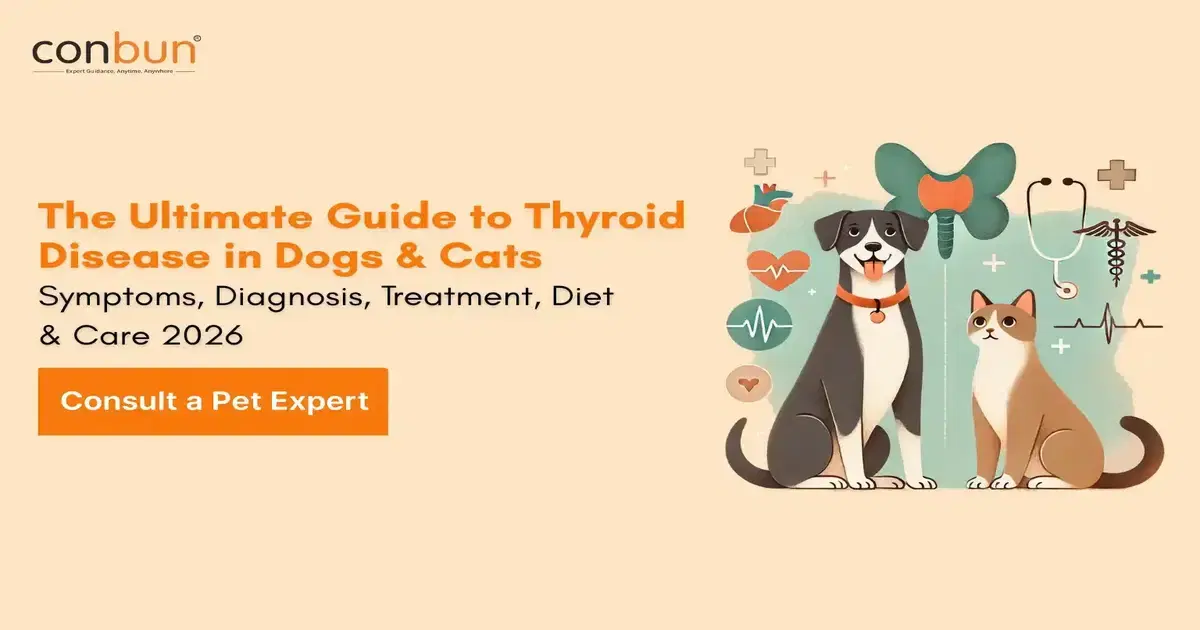
In pets, thyroid disease is one of the most underdiagnosed yet clinically impactful endocrine disorders. In simple words, when the thyroid gland produces too little or too much of the thyroid hormone, this disease emerges. It disrupts organ function, metabolism and overall quality of life of pets.
In dogs, thyroid disease most commonly comes as hypothyroidism. It is a condition marked by a slowed metabolic rate and generally affects middle-aged dogs. In cats, it’s the opposite. Hyperthyroidism dominates, especially in senior cats, where metabolism is overactive, causing strain on organs.
A large-scale veterinary epidemiological study found that hypothyroidism affects approximately 0.2–0.8% of dogs. On the other hand, hyperthyroidism is diagnosed in over 10% of cats above 10 years of age, making it one of the most common endocrine disorders in felines.
Why early detection matters cannot be overstated?
Thyroid hormones influence various bodily functions like heart rate, skin health, digestion, kidney perfusion, neurological function, and even thermoregulation.
If left untreated or not treated on time, thyroid disease in dogs and cats can progress into
Heart disease
Kidney failure
Severe dermatologic conditions
Irreversible metabolic damage.
Many pet parents first notice vague changes like weight fluctuation, altered appetite, low energy, or unexplained vomiting, etc.
These signs are often dismissed as age-related. symptoms. However, in endocrine disorders, subtle symptoms are in fact the loudest early warning signs.
Understanding thyroid disease in pets allows pet owners to recognise these changes early, seek timely diagnosis and care, and dramatically improve health outcomes.
Related Readings: Pets Emergency or Not? How to Know If Your Pet’s Condition Can’t Wait
What Is the Thyroid Gland and How Does It Work?
The thyroid gland is a small, butterfly-shaped endocrine organ that is located in the neck, adjacent to the trachea. Despite its modest size, its influence on the body is profound.
Thyroid Gland Function Explained Simply
The thyroid gland produces two hormones primarily:
Thyroxine (T4)
Triiodothyronine (T3)
These hormones regulate:
Basal metabolic rate
Cardiac output and heart rate
Gastrointestinal motility
Skin and hair follicle turnover
Neuromuscular function
Temperature regulation and Heat production
T4 acts as a circulating “storage hormone,” while T3 is the biologically active form at the cellular level. The conversion of T4 to T3 occurs in peripheral tissues such as the liver and kidneys.
The entire system is regulated by the hypothalamic–pituitary–thyroid (HPT) axis, a feedback loop involving:
Hypothalamus (TRH release)
Pituitary gland (TSH release)
Thyroid gland (T3/T4 secretion)
Hypothyroidism vs Hyperthyroidism in Pets
Hypothyroidism occurs in pets when the thyroid gland fails to produce adequate hormones, which thereby slows down the metabolic rate.
Hyperthyroidism, on the other hand, occurs when excess hormone is released, which accelerates metabolic processes beyond healthy limits.
Understanding this distinction is essential for pet owners, as these conditions differ not only in symptoms but also in treatment approach, prognosis, and management.
Related Readings: Pets for Adoption: How to Find the Right Pet for Your Home?
Types of Thyroid Disease in Pets
Hypothyroidism (Underactive Thyroid)
Hypothyroidism is primarily a canine disease and is rarely diagnosed in cats.
Causes
The most common causes include:
Immune-mediated thyroiditis, where the body’s immune system gradually destroys thyroid tissue
Idiopathic thyroid atrophy, which involves unexplained shrinkage of the gland
Less commonly, congenital absence or iatrogenic causes (post-surgical or medication-induced)
A Peer-reviewed study published in the Veterinary Clinics of North America: Small Animal Practice suggests that immune-mediated destruction accounts for over 50% of hypothyroidism cases in dogs.
Why It’s Common in Dogs
Canine bodies tend to rely heavily on thyroid hormones for thermoregulation, coat health and energy balance. When hormonal levels drop, changes occur gradually, often spanning months, which leads to a delayed diagnosis.
Middle-aged to older dogs are most commonly affected, and symptoms often overlap with other chronic conditions, including arthritis or loss of appetite.
Hyperthyroidism (Overactive Thyroid)
Hyperthyroidism can be regarded as a feline disease, as it is mostly seen in cats. Senior cats are mostly affected by this disease.
Causes
Most cases are caused by benign adenomatous hyperplasia of the thyroid gland, making it the most common cause of hyperthyroidism in cats. Malignant thyroid carcinoma is rare but possible
According to the Journal of Feline Medicine and Surgery, over 95% of feline hyperthyroidism cases are benign, yet the physiological impact is severe if untreated.
How It Differs from Hypothyroidism
Unlike the slow metabolic decline seen in hypothyroidism in dogs, hyperthyroidism in cats leads to:
Increased cardiac workload
Accelerated metabolism
Progressive muscle wasting
Secondary kidney disease
Related Readings: Ticks, Fleas & Worms
Breed and Age Risk Factors
Certain dog breeds show a clear genetic predisposition to hypothyroidism. These are:
Doberman Pinschers
Rhodesian Ridgeback
Giant Schnauzer
Hovawart
Old English Sheepdog
Boxers
Beagle
English Setters
According to a 2015 study, these breeds carry heritable immune traits that increase vulnerability to thyroid autoimmunity and hypothyroidism.
Cat Breeds and Hyperthyroidism
Hyperthyroidism can emerge in both purebred and domestic cats, though it is more commonly reported in Domestic shorthair and longhair cats.
Siamese cats on the other hand, appear to have a lower reported incidence, which suggests the presence of a possible genetic protective factor
Age and Gender Influence
Dogs are commonly diagnosed between 4 and 10 years of age, i.e., during their Middle Ages.
Cats are typically diagnosed after 10 years
In thyroid diseases, there is no strong gender predisposition. Though neutered animals are slightly overrepresented, it may be likely due to longevity rather than causation.
These age-related trends explain why thyroid disease is often discovered during investigations for other senior-pet concerns, such as vomiting episodes, as explored in cases where a cat is vomiting repeatedly.
Symptoms of Thyroid Disease by Species and Condition
Recognition of the early signs of thyroid disease in dogs and cats requires species-specific awareness as the same hormonal imbalance produces opposite outward effects.
Signs of Thyroid Disease in Dogs (Hypothyroidism)
Common clinical signs include:
Unexplained weight gain without increased food intake
Reduced exercise tolerance and lethargy
Cold intolerance
Symmetrical hair loss, especially along the trunk and tail
Recurrent skin infections
Reproductive abnormalities
Behavioural dullness, especially seen in hyperactive pets.
In advanced cases, pets with thyroid disease may show neurological signs like facial nerve paralysis or weakness.
Hyperthyroidism Symptoms in Cats
Cats typically present with:
Weight loss despite increased appetite
Irritability or Hyperactivity
Diarrhoea and vomiting
Increased thirst and urination
Rough, unkempt coat
Heart murmurs or rapid heart rate
Advanced disease may lead to hypertrophic cardiomyopathy or kidney dysfunction, which makes early diagnosis even more critical.
Dog vs Cat Thyroid Symptoms at a Glance
Feature | Dogs (Hypothyroidism) | Cats (Hyperthyroidism) |
Weight | Gain | Loss |
Appetite | Normal or reduced | Increased |
Energy | Low | Hyperactive |
Skin/Coat | Dry, hair loss | Poor coat quality |
Heart Effects | Bradycardia | Tachycardia |
GI Signs | Constipation | Vomiting/diarrhoea |
Diagnosis and Veterinary Testing
Effective diagnosis of thyroid disease in pets depends on a combination of targeted laboratory testing and clinical assessment.
Physical Examination
Veterinarians assess:
Body condition and weight trends
Skin and coat quality
Heart rate and rhythm
Palpable thyroid enlargement (especially in cats)
Thyroid Blood Tests in Pets
Core tests include:
Total T4 (TT4) – primary screening test
Free T4 (fT4) – useful when TT4 is borderline
TSH levels – particularly valuable in diagnosing canine hypothyroidism
T3 levels – supplementary, not diagnostic alone
In dogs, a low T4 combined with higher TSH strongly indicates hypothyroidism. In cats, elevated T4 indicates hyperthyroidism in most cases.
Advanced Diagnostics
Thyroid ultrasound helps assess gland structure
Scintigraphy is considered the gold standard for feline hyperthyroidism in complex cases
Additional bloodwork is often performed to evaluate liver, kidney, and cardiac involvement
Veterinary consensus guidelines stress that no single test should be interpreted in isolation. Clinical context is critical, especially because non-thyroidal illness can temporarily suppress hormone levels.
Related Readings: Catnip Secrets
Treatment Options for Thyroid Disease in Pets (Condition-Specific)
When managed correctly, thyroid disease is one of the most treatable endocrine disorders in modern veterinary medicine. However, treatment is not one-size-fits-all. It varies from species, severity and type of disorder to the presence of concurrent illnesses.
Hypothyroidism in Dogs
Hypothyroidism in dogs is treated medically, not surgically. With effective treatment, most dogs lead a normal and active life.
Hormone Replacement Therapy (Levothyroxine)
The treatment of hypothyroidism has synthetic levothyroxine (L-T4) as a cornerstone, which works by replacing deficient thyroid hormone.
Key clinical points:
Administered orally, once or twice daily based on severity
Dosage is calculated based on ideal body weight, not current weight
Improvement is seen within 2–4 weeks
Clinical response typically follows a predictable pattern:
Alertness and energy improve first
Appetite and metabolism normalise next
Skin and coat changes may take 2–4 months to resolve
A study published in the Journal of Veterinary Internal Medicine found that clinical signs of hypothyroidism improved or resolved in 91% of dogs after treatment with levothyroxine.
Monitoring and Dosage Adjustments
Treatment success depends on follow-up testing:
Blood T4 levels are checked 4–6 weeks after starting therapy
Testing is ideally done 4–6 hours after dosing
Dosage is adjusted based on both clinical response and blood values
It is essential to note that over-supplementation can result in hyperthyroidism. Observe signs like restlessness, panting, and weight loss. This makes routine monitoring is essential, not optional.
Hyperthyroidism in Cats
There are multiple treatment pathways for Hyperthyroidism in cats, each with advantages and limitations. Choice is based on age, lifestyle, kidney health, and owner preference.
Anti-thyroid medication
First is the use of anti-Thyroid Medications (Methimazole). It is the most commonly used initial treatment.
How it works:
Blocks thyroid hormone synthesis
Does not cure the disease but controls hormone levels
Advantages:
Non-invasive
Useful as a trial therapy to assess kidney function
Reversible
Limitations:
Lifelong medication
Side effects in ~15–20% of cats (vomiting, facial itching, liver enzyme elevation)
Requires frequent blood work
Methimazole is often used as a diagnostic step to control symptoms before permanent treatments, especially in senior cats.
Radioactive Iodine Therapy (I-131)
For feline hyperthyroidism, Radioactive Iodine therapy is considered to be a gold standard treatment.
Key facts:
Single injection
Destroys abnormal thyroid tissue while sparing normal tissue
High cure rate of 95%
Advantages:
Permanent solution
No daily medication
Minimal to no long-term complications
Considerations:
Temporary isolation is required post-treatment
Higher upfront cost
Limited availability in some regions
From a veterinary standpoint, I-131 offers the best long-term outcome for suitable candidates.
Surgical Thyroidectomy
Surgical removal of the thyroid gland is less common today, but it is still used in select cases.
Pros:
Immediate resolution
Cons:
Requires general anesthesia
Risk of damaging parathyroid glands
Not ideal for older cats or those with cardiac disease
Dietary Management
Prescription low-iodine diets restrict iodine availability, reducing hormone production.
Important caveats:
Must be fed exclusively
Treats and supplements can disrupt effectiveness
Not suitable for multi-pet households unless managed carefully
Dietary therapy only controls but does not cure the disease. It also requires strict compliance.
Related Readings: Dog UTI Symptoms: The Early Warning Signs You Should Never Ignore
Diet, Supplements & Lifestyle Management

Medical therapy alone is not enough. Long-term stability depends on diet, environment, and daily routines.
Dietary Strategies by Condition
Maintain ideal body weight
Avoid excessive calorie restriction
Balanced protein intake supports muscle mass
Omega-3 fatty acids help reduce skin inflammation
There is no evidence supporting raw or grain-free diets as beneficial for hypothyroid dogs. Go for vet-approved homemade diets rather than relying on outside market products.
Diet for Hyperthyroid Cats
Low-iodine prescription diets
Offer protein to counter muscle wasting
Monitor kidney values during dietary changes
Supplements for Pet Thyroid Health
Supplements should never replace medication, as the word “supplement” suggests they are only to supplement overall health.
Omega-3 fatty acids to support skin, joints, and cardiovascular health
Antioxidants for oxidative stress reduction
Selenium and zinc, if deficiency is confirmed
Unregulated supplements can worsen thyroid imbalance. Always consult a veterinarian before adding anything new. You can take an online pet care consultation on the Conbun android and iOS app to get instant dietary guidance.
Lifestyle Management
Gradual return to exercise in dogs
Avoid overheating in hyperthyroid cats
Maintain consistent care/support routines
Reduce environmental stressors
Symptom control requires strong lifestyle stability, especially in cats.
Complications & When to See a Vet
Thyroid disease rarely exists in isolation. Complications arise when diagnosis or treatment is delayed.
Common Complications of Pet Thyroid Disease
In Dogs:
Severe skin/coat infections
Cardiovascular changes
Infertility
Neurological deficits
Lethargy
Weight gain
Cold intolerance
These symptoms are the signs your dog needs a vet immediately.
In Cats:
Hypertrophic cardiomyopathy
Systemic hypertension
Progressive kidney disease
Retinal detachment (from high blood pressure)
Veterinary studies show that untreated hyperthyroidism can significantly reduce feline lifespan, primarily due to cardiac and renal complications.
Thyroid Emergencies in Dogs and Cats
Seek immediate veterinary attention if you notice:
Sudden collapse or extreme weakness
Rapid heart rate with distress
Acute blindness (possible retinal detachment)
Severe agitation, tremors, or hyperthermia
A thyroid storm, though rare, is a life-threatening emergency. Observe these clinicals to conclude if it’s a pet's emergency or not.
Monitoring Schedule
Initial follow-up every 4–6 weeks
Once stable: every 6–12 months
More frequent monitoring in senior pets or those with kidney disease
Living with Thyroid Disease: Practical Pet Owner Tips

Management of thyroid diseases in pets requires a long-term partnership between veterinarians and owners.
Daily Care Routines
Give medication at a fixed time daily
Observe trends related to energy, appetite, and weight
Monitor water intake and litter habits (especially in cats)
Medication Adherence
Missed doses reduce control and increase complication risk. Tools that help:
Reminder alarms
Pill organizers
Digital tracking apps
Many top-rated pet care apps offer digital symptom and medication tracking capabilities. Use these technological solutions to effectively manage your pet’s health.
Tracking Symptoms and Progress
Keep a simple log:
Weight changes
Coat condition
Appetite
Behaviour shifts
Subtle changes often precede lab abnormalities.
Conclusion
Thyroid disease in dogs and cats is one of those conditions that quietly progresses until it starts affecting every system of the body and ultimately the quality of life. The good news is that with timely diagnosis and consistent management, thyroid disease in pets is highly controllable.
Early veterinary guidance makes a real difference. Subtle signs like lethargy, weight change, hyperactivity, or coat issues, etc., are often missed or normalised by pet owners until the situation becomes complicated. This is where access to professional advice matters.
With Conbun’s online vet consultation, pet parents can:
Discuss early symptoms before they start escalating
Get timely and effective guidance on thyroid blood tests and monitoring schedules
Review lab reports with a qualified veterinarian
Understand medication, dietary adjustments, and long-term care plans
Avoid delayed treatment and unnecessary complications
Thyroid disorders are not emergencies but neglecting them can create one. If you notice unexplained changes in your dog or cat, speaking to a vet early through an online vet consultation can protect your pet’s health, comfort, and lifespan.
Frequently Asked Questions
1. What causes thyroid disease in dogs and cats?
Answer. Thyroid disease in pets involves either low (hypothyroidism, common in dogs) or high (hyperthyroidism, common in cats) thyroid hormone levels due to autoimmune issues.
2. Can thyroid disease be cured in pets?
Answer. While hypothyroidism requires lifelong management, hyperthyroidism can be cured with radioactive iodine therapy.
3. How long do pets live with thyroid disease?
Answer. If diagnosed on time and proper treatment is followed, life expectancy is often normal.
4. Is thyroid disease hereditary?
Answer. Yes. Thyroid disease can be hereditary, especially hypothyroidism in certain dog breeds.
5. What foods should pets with thyroid issues avoid?
Answer. Unregulated supplements, foods high in iodine(for cats), processed foods, soy, goitrogenic foods and inconsistent diets should be avoided.