
Dog Food Allergies: 8 Signs & Vet Solutions India
Your dog has been scratching for weeks, as if there are demons under his skin. You’ve already played musical chairs with their food. Tried the "sensitive skin" kibble; then, the grain-free trend; and finally, a home-cooked mutton-rice feast because your neighbour’s uncle’s WhatsApp group said that it’s a miracle cure.
And yet the scratching sound at night is still louder than David Warner using Sandpaper to tamper with cricket balls.
Adding to your troubles, now there’s ear discharge and rhythmic paw-licking that’s keeping you awake at night, and also loose stools to round out the misery. Sounds familiar? Welcome to the club that you never wanted to join. These are all the results of allergic reactions in dogs.
Adverse Food Reactions (AFR) are one of the most common reasons Indian pet parents speed-dial their vets. However, the irony is that they’re the ones most hilariously mismanaged. The go-to advice you’d usually get is "Just change the food."
Spoiler alert before you try this: It rarely works.
In a typical Indian household, your dog is living a gastronomic "best of both worlds" life. Their daily consumption pattern includes fancy commercial kibble, maa ke haath ka chicken-roti, and a sneaky piece of paneer or a mithai from the festival table.
With such a buffet, pinning down a food allergy in dogs is harder than getting a toddler to eat their veggies. Throw in the Indian monsoon, where environmental allergies are identical to food-borne allergies, and you’ve got the perfect confusion cocktail.
At Conbun, our veterinary dermatologists and nutritionists witness this chaos every single day. We’re here to stop the guessing game, put down the random kitchen experiments, and actually get to the bottom of the itch.
This guide will talk about:
The real signs of food allergy in dogs
How it’s different from intolerance
And what actually works (hint: not guesswork)
What Is a Dog Food Allergy - And How Is It Different from Food Intolerance?
Let’s first burst the biggest bubble. Not every reaction to food is an allergy.
The Core Difference
An article from Critical Reviews in Food Science and Nutrition defines food allergy as “all immune-mediated reactions following food intake”. Dogs are most commonly allergic to protein, with beef and chicken being the top culprits, followed by dairy, soy and wheat. These allergies trigger chronic skin and ear infections.
On the other hand, food intolerance is a digestive issue. It is a non-immunological, digestive system response to food when the body is unable to break down certain ingredients. Symptoms include abdominal pain, vomiting, diarrhea, excessive gas and loose stools, etc.
That difference changes everything, from symptoms to treatment.
Related Readings: Freeze-Dried vs Raw Dog Food: The 2026 Guide to Switching Without Gut Issues
Food Allergy vs Food Intolerance (Vet Comparison)
FeatureFood Allergy (True AFR)Food IntoleranceMechanismImmune system responseDigestive sensitivityMain symptomsItching, skin issues, ear infectionsVomiting, loose stools, gasOnsetDelayed (hours–days)Faster (hours)Develops over timeYesYesCommon triggersChicken, beef, dairy, wheatFatty food, additivesDiagnosisElimination diet (8–12 weeks)Diet adjustmentResolves without diet changeNoSometimes
Why This Matters in India
Here’s what I see in practice:
A dog with itching is labelled as:
“Food allergy”
A dog with loose stools is labelled as:
“Food allergy”
Both wrong, half the time.
The terms allergy and intolerance are used interchangeably by pet owners and store advisors, which leads to the adoption of an incorrect management approach.
In India, chicken is the most common protein:
Present in almost all kibble
Common in-home diets
Which is why:
Chicken allergy in dogs in India is the most commonly diagnosed trigger
But here’s the twist:
Just because your dog reacts to food doesn’t mean it’s an allergy.
Clinical Insight
According to WSAVA nutrition guidelines and AFR studies:
True food allergies are less common than perceived, but far more persistent.
Which is why:
Proper diagnosis and a structured treatment matter more than quick fixes.
8 Signs Your Dog Has a Food Allergy - A Vet-Backed Symptom Guide
This is the section most pet parents come for. Because symptoms are where suspicion begins.
Across hundreds of dog food allergy consultations, Conbun vets see these signs consistently.
Sign 1 - Chronic Itching (Specific Zones)
Not all itching is equal.
Food allergy itching targets:
Paws
Face (eyes, muzzle)
Groin
Armpits
Base of tail
These are the classic food allergy distribution zones. Dogs are stoic in nature. So, they won’t tell what’s wrong with them. These signs tell if your pet is hiding a health issue.
Key clue: It’s year-round. Your dog is always scratching. Unlike environmental allergies, it doesn’t disappear with seasonal change.
In India, pet parents generally attribute constant paw licking to boredom, but it is almost always a sign of chronic itching.
Sign 2 - Recurring Ear Infections
If your dog has:
Frequent ear infections, more than twice a year
Both ears affected
Smell + dark discharge
It’s not just “dirty ears.”
Food allergies disrupt the microbial environment of the ear, making it prone to yeast and bacterial overgrowth.
In India, ear infections are common pet health issues that spike during the monsoon season. If it’s the dry season, then food allergy could likely be the driver.
Sign 3 - Red, Inflamed Skin (Dermatitis)
Pink or red inflamed skin, particularly in the:
Belly
Groin
Underarms
Early stage:
Pink/red irritation
Chronic stage:
Thick, darkened “elephant skin”
Clinically, this is called Canine Atopic Dermatitis, which is a prevalent skin issue in dogs and is generally caused by environmental allergens. However, food-triggered cases are also common.
Sign 4 - Paw Licking with Brown Staining
Persistent licking of paws, producing a peculiar rust-red or brownish staining of the fur between the toes, is caused by saliva pigments called porphyrins.
In India, this is often dismissed as boredom, but it’s actually an itch your dog can’t get rid of.
Sign 5 - Hair Loss or Patchy Coat
Thinning or patchy coat, particularly in itchy zones (neck, face and groin).
Looks like:
Bald spots
Thinning fur
Uneven coat
Commonly, pet parents think it to be:
Mange
Thyroid issue, if
Which is why:
Hair loss in dogs is common and seasonal. But persistent year-round hair loss can be food-driven. Vet diagnosis is essential.
Sign 6 - Chronic Loose Stools or Vomiting
If your dog has diarrhea and is acting normal, there’s nothing you should not worry about.
But if you observe:
Soft stools for weeks
Recurring vomiting after meals
Key insight:
If gastrointestinal symptoms occur alongside skin infections, it is like a food-driven allergy.
Sign 7 - Scooting or Anal Gland Issues
If your dog:
Drags their bottom
Needs frequent gland expression
It’s often blamed on worms and other parasitic infections in dogs.
But if deworming doesn’t help? It could be a food allergy or intolerance.
Sign 8 - Symptoms Are Year-Round
This is the diagnostic anchor.
Environmental allergy is seasonal. It may develop or get worse in the monsoon/spring. On the other hand. Food allergy is constant.
India-Specific Reality Check
Monsoon changes everything.
During this time, food allergies and environmental allergies look identical.
This makes detection, diagnosis and treatment incredibly difficult.
Conbun Clinical Insight
Across consultations:
Over 65% of cases involve both food AND environmental triggers.
Which means: Random diet changes won’t solve it
Only:
A structured, vet-supervised approach will
If you’re seeing 3 or more of these signs, don’t guess.
Because at this stage:
You don’t need another food trial and you need a vet diagnosis. Talk to a vet online on Conbun and get your dog diagnosed instantly.
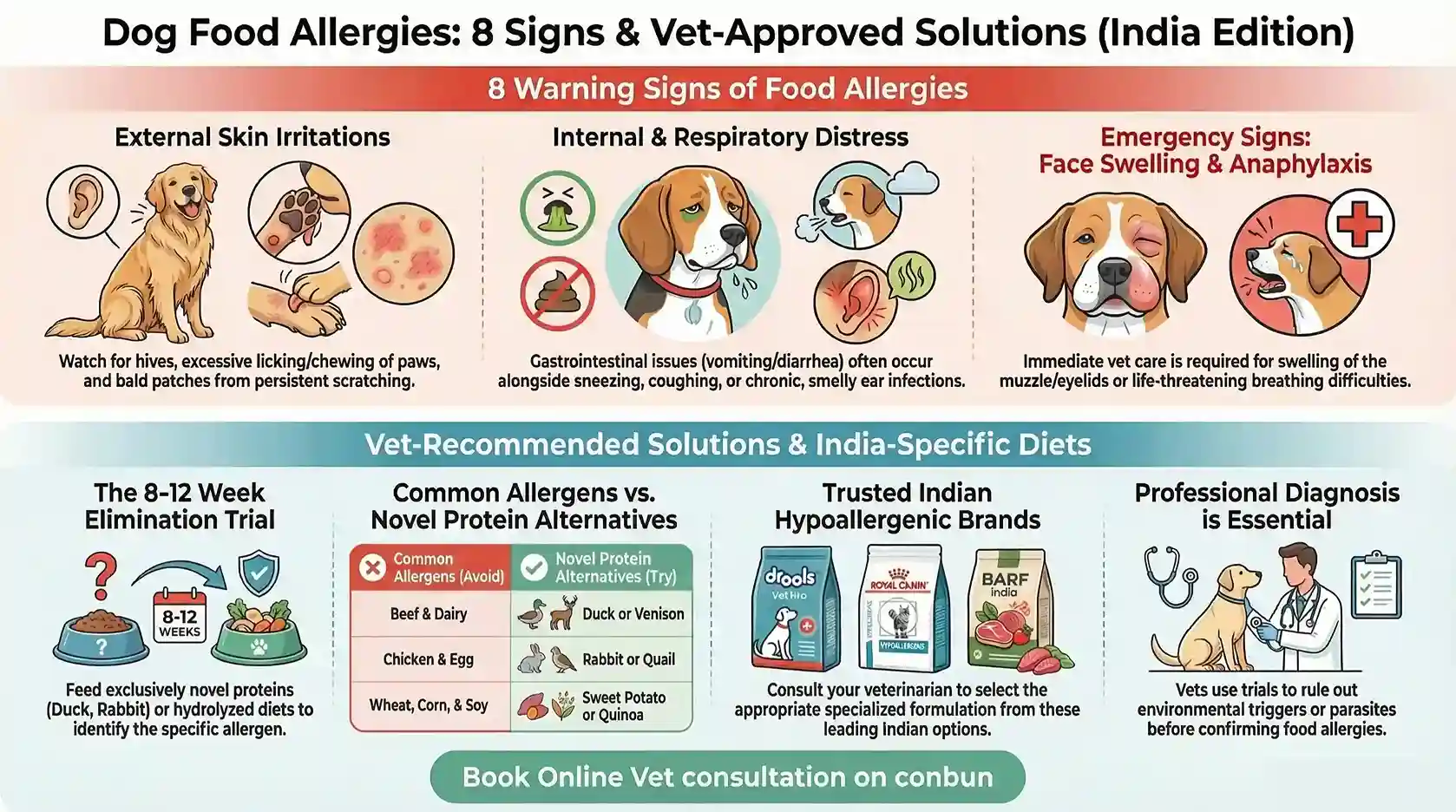
To deal with food allergy in dogs, you need professional guidance, not just a food transition. An 8-12 week structured elimination diet, supervised by a vet, is the only reliable way to identify and treat the trigger. Book a dog food allergy consultation with a BVSc-verified vet on Conbun.
Related Readings: How to Choose the Best Dog Food for Your Dog's Age, Size & Health Needs (2026 Guide)
The Most Common Dog Food Allergy Triggers in India
Let’s talk about the real culprits.
In veterinary practice across India, food allergies don’t come from “exotic” ingredients.
They come from what your dog eats every single day.
India-Specific Trigger Table
AllergenPrevalenceCommon SourceChicken proteinMost commonCommercial kibble, home food, treatsBeef / MuttonVery commonHome-made diets, some premium kibble optionsDairyVery commonIndian food items like roti soaked in milk, paneer, curdWheatCommonLeftover roti as table scrap, kibble fillersRiceModerateHomemade dietsSoyModerateCommercial kibbleEggModerateCommon in treats and home-cooked foodFishLess commonRegional diets (Kerala, Bengal and other coastal areas)
Why Chicken Is #1 in India
Not because it’s “bad.”
But because:
It’s everywhere. Repeated exposure to chicken leads to a higher sensitisation risk.
Switching from chicken as a protein source to other items like rabbit or fish is the basis of an elimination diet.
The Biggest Indian Mistake
Table scraps.
Roti
Milk
Biscuits
Festival sweets
All these items introduce potential allergens.
Even one small treat:
Can restart the allergic cycle.
How to Diagnose Dog Food Allergies - The Elimination Diet Explained
Here’s the truth most people don’t want to hear: There is no shortcut.
No blood test. No instant result.
The gold standard to treat food allergies and globally recommended by WSAVA is an 8–12-week elimination diet.
What Is an Elimination Diet?
By definition, an elimination diet is a short-term diagnostic tool typically spanning across 8-12 weeks, used to identify food sensitivities, allergies or intolerances by temporarily removing specific foods from the diet.
You feed your dog with:
One novel protein
One carbohydrate
And nothing else. No:
Treats
Table food
Flavoured medicines
During this period, original diets are reintroduced one at a time to identify the specific trigger. This is also called the provocation or re-challenge phase.
Two Types of Elimination Diets
1. Novel Protein Diet
Duck
Rabbit
Venison (meat of deer)
In India, it is hard to follow this approach due to the lack of protein variety.
2. Hydrolysed Protein Diet
Commercially prepared food where protein is broken into tiny fragments, too small for the immune system to recognise.
Immune system:
Doesn’t recognise it
Available via prescription brands like Hill's z/d, Royal Canin Anallergenic, Purina, etc
Why It Fails in India
Family members give treats, leftover rotis, etc., unknowingly continuing allergen exposure
Diet stopped at 4–6 weeks. Must follow the protocol for at least 8 weeks.
Switching to a different form of the same protein. For example, normal chicken to hypoallergenic chicken.
Attempting an elimination diet without vet guidance results in nutritional deficiencies
Veterinary insight
An elimination diet works only when the household follows it strictly.
Practical Advice
An elimination diet is not complicated. However, it requires discipline. Everyone who interacts with the dog must know that the dog must not be given anything to eat outside the protocol for 8 weeks.
Use a pet health app or online vet consultation to:
Monitor progress
Avoid mistakes
Stay consistent
Because discipline, not the diet, is the real challenge.
Related Readings: How to Get Your New Dog the Vitamins and Minerals They Need
Managing Dog Food Allergies Long-Term in India - Diet, Treats, and Home Cooking
Once the trigger ingredient is identified pet parents must focus on long-term management. It requires permanently eliminating the ingredient from the dog’s diet, including treats, protein source or any other shared household food.
Due to the home cooking culture in India, it requires special strategies.
Building an allergen free diet
Options:
Commercial
Hydrolysed protein diets from pet clinics and pharmacies
Single-protein formulas from premium importers
Home-Cooked
Safe base:
Duck + sweet potato
Rabbit + oats
Add:
Vet-approved supplements
Important Rule
Don’t think that grain-free diet is equal to allergen free diet. If your dog’s allergy is triggered due to chicken, you need to avoid chicken, not grain.
This is one of the most common misunderstandings in India when it comes to dog food allergies.
If you practice home-cooking, make sure to include only vet-approved homemade dog food recipes.
Safe Treats for food allergic dogs in India
Single-ingredient treats that consist of confirm safe protein source
Vegetable based treats like carrot / sweet potato
Avoid:
Multi-ingredient treats
Bakery items
Communicating with the whole household
Many dogs live with joint families. So there is a need for strong communication between members.
The biggest risk?
“Just one bite” from family
Solution:
Provide clear instructions to everyone who interacts with your pet
Visible “Do Not Feed” note
Conbun Insight
With 24/7 veterinary consultations and BVSc-verified vets, long-term management of dog food allergies becomes structured, not stressful. Canine nutrition specialists on the platform
Dog Food Allergy vs Environmental Allergy - How Indian Vets Tell Them Apart
Food and environmental allergies in dogs produce identical symptoms, especially during the monsoon season. This is where the confusion regarding dog allergies happens.
Key Differences
FactorFood AllergyEnvironmental AllergySeasonalityYear-round, consistentFluctuates, worse in monsoon/springGI symptomsOften presentRareEar infectionsCommonCommonPrimary itch zonesPaws, face, groin, armpitsSimilar + muzzle and eyelidsResponds to steroidsPartial, short-termOften, a better short-term responseDefinitive diagnosisElimination dietIntradermal allergy testing (specialist)India monsoon overlapSymptoms continue post-monsoonUsually improves in dry season
The Indian Reality
Many dogs have:
Both
Which is why:
Partial improvement is common, and thus, dog owners tend to question treatment efficacy.
Vet Insight,
If symptoms continue after the monsoon, food allergy is likely involved.
Veterinarians on Conbun assess both in allergy-related consultations. Consult a veterinarian now on Conbun to know the real cause of allergies and skin infections in your dog.
Real Conbun Case Spotlight
Kavitha, a Labrador parent and an IT professional from Bengaluru, tried everything.
Chicken → switched
Grain-free → switched
Home food → switched
Nothing worked.
Her dog still:
Constantly licked paws
Had ear infections
She booked a veterinary consultation online via a pet doctor app, Conbun.
Diagnosis:
Chicken protein allergy, improper elimination diet earlier
Solution:
10-week hydrolysed diet
Routine online vet consultations every week to track progress
Result:
Itching is reduced completely
Ear infections gone
Lesson
Guessing delays results to a great extent. Structured veterinary guidance solves it.
Related Readings: Dog Nutrition Guide: Best Food, Puppy Feeding Chart & Foods to Avoid
FAQ - Dog Food Allergies India
Q1: What are the most common signs of food allergies in dogs in India?
Answer. Ear infections, red skin, constant paw licking, hair loss, bald patches, loose stools, vomiting, scooting and chronic itching are the common signs of food allergies in dogs in India.
Q2: What foods are dogs most allergic to in India?
Answer. Chicken and beef are considered the primary culprits. Wheat, soy and dairy are also some common triggers.
Q3: How do I test my dog for food allergies in India?
Answer. According to WSAVA nutritional guidelines, an 8–12-week elimination diet is considered the gold standard diagnostic tool and treatment option for dog food allergies in India.
Q4: Can I give my allergic dog home-cooked food in India?
Answer. Yes. Only with structured vet guidance and vet-approved homemade recipes.
Q5: Why is my dog still itching after I switched their food?
Answer, The same allergen is likely present in their diet. Incomplete elimination or environmental allergy may also be the cause.
Q6: Is a grain-free diet good for dogs with food allergies in India?
Answer. Not necessarily, protein source matters more than grains. They are good only if your dog has an allergy to grains.
Q7: How long does it take for a dog food allergy elimination diet to work?
Answer. An elimination diet requires 8–12 weeks for an accurate diagnosis.
Q8: Is dog food allergy the same as food intolerance?
Answer. No. Allergy is an immunological reaction, while intolerance is a digestive system response.
Q9: Can dog food allergies develop suddenly?
Answer. Yes. Dogs can develop allergies to foods they have been eating for years.
Conclusion
If your dog has been itching, uncomfortable, and you’ve been switching foods, hoping for relief, you’re not doing it wrong, but you’re just doing things without a system. Dog food allergies don’t respond to guesswork; they respond to clear symptom recognition, correct diagnosis, and consistent long-term management, backed by patience.
The reality is simple: identify the signs, confirm the cause through a structured elimination diet, and then manage the condition with discipline. Where most Indian pet parents struggle is in random food switching, incomplete diet trials, and a lack of veterinary guidance.
The smarter approach is to rely on expert support, through best online vet consultation india, a trusted pet doctor app, and access to BVSc-verified vets via a reliable pet health app. Because at the end of the day, your dog doesn’t need another food trial; they need a plan.
Table of Content
- What Is a Dog Food Allergy - And How Is It Different from Food Intolerance?
- 8 Signs Your Dog Has a Food Allergy - A Vet-Backed Symptom Guide
- How to Diagnose Dog Food Allergies - The Elimination Diet Explained
- Managing Dog Food Allergies Long-Term in India - Diet, Treats, and Home Cooking
- Dog Food Allergy vs Environmental Allergy - How Indian Vets Tell Them Apart
- Real Conbun Case Spotlight
- FAQ - Dog Food Allergies India
- Conclusion

Anand Sen
Related Articles

Why do dogs roll in the grass? Is this Normal?
Dogs roll in grass to enjoy scents, scratch irritation, cool down, or express happiness. Usually normal unless excessive or uncomfortable.
Read More ↗Why do dogs roll in the grass? Is this Normal?
Dogs roll in grass to enjoy scents, scratch irritation, cool down, or express happiness. Usually normal unless excessive or uncomfortable.
Read More ↗Why do dogs roll in the grass? Is this Normal?
Dogs roll in grass to enjoy scents, scratch irritation, cool down, or express happiness. Usually normal unless excessive or uncomfortable.
Read More ↗Why do dogs roll in the grass? Is this Normal?
Dogs roll in grass to enjoy scents, scratch irritation, cool down, or express happiness. Usually normal unless excessive or uncomfortable.
Read More ↗Why do dogs roll in the grass? Is this Normal?
Dogs roll in grass to enjoy scents, scratch irritation, cool down, or express happiness. Usually normal unless excessive or uncomfortable.
Read More ↗