.webp)
How to Litter Train a Kitten: Step-by-Step Guide That Actually Works (2026)

Written by: Anand Sen; Reviewed by: Dr. Vishwajeet
Congratulations! For bringing home a "Purr-sonal" roommate. While most kittens can be litter trained within 3–7 days, you need to ensure that you have set the stage correctly by placing an open box in a quiet corner, using sandy litter, and guiding them after meals.
From an evolutionary perspective, cats are "Cleanliness Freaks." Their wild ancestors used to bury waste to hide its scent from predators, a ritual your kitten is also hardwired to follow instinctively. You aren't teaching a new skill; you're just pointing out the designated washroom to perform this ritual.
As per feline veterinary literature, litter box habits in cats develop through scent recognition, environmental cues, and early repetition from kittenhood. The sooner a kitten associates the correct location with elimination, the faster the behaviour becomes automatic.
However, our lives aren’t always a Bollywood movie. Sometimes, your kitten treats the litter like a Goa beach playground or decides the space behind your Godrej almirah is a bathroom. Don’t worry; they aren't bad, they’re just learning.
This step-by-step guide aims to make your cat a "Sanskaari billi" with litter training, from choosing the best litter to troubleshooting accidents. Let’s make sure the only thing your kitten leaves behind is a trail of fans!
Related Readings: Wet vs. Dry Cat Food: Which Is Actually Better for Your Cat? (Vet-Backed Guide)
When Should You Start Litter Training a Kitten?
Cat parents can begin litter training after a kitten has reached 3 to 4 weeks of age. If you are a new pet owner and have adopted an older kitten, say at an 8–12-week adoption window, you should start litter training immediately on the day bringing them home.
Understanding the kitten behavioural development timeline helps make sense of this.
Newborn Kittens (0–3 Weeks)
Kittens do not eliminate independently during the neonatal stage. Their mother stimulates urination and defecation by licking the genital area after feeding.
Due to this, new born kittens do not need a litter box yet.
Transitional Stage (3–4 Weeks)
At about three weeks of age, kittens become mobile and curious about their surrounding environment. At this stage, mother cats start introducing kittens to the litter area.
This is the period where cat training actually starts. If you’re raising kittens at home, this is the time when their first shallow litter box should appear so that early association can be fostered.
Adoption Age (8–12 Weeks)
Kittens that are adopted from shelters or breeders typically arrive at 8–12 weeks of age. This is actually the ideal time for litter training in cats.
By this age, kittens:
Can walk confidently
Have developed voluntary elimination control
Become curious about digging behavior
This is the time when the first few days at home determine litter box training success.
Adult Rescue Cats
Even if you have an adult rescue cat who has never used a litter box, they can learn litter box usage quickly. It might take a little longer, often one to two weeks, even in feral cats as the natural burying instinct is still present.
What Do You Need Before You Start Litter Training a Kitten?
You need a few simple supplies to litter train a kitten successfully. These are a small open-top litter box, non-clumping kitten-safe litter, an enzymatic cleaner for accidents, and, of course, a quiet, low-traffic spot in your home.
Checklist:
Small shallow litter box (about 13×9 inches)
Non-clumping unscented litter (for kittens under 8–10 weeks old)
Enzymatic cleaner for accidents (scent should not remain)
Litter mat to reduce tracking
Treats for positive reinforcement
Your kitten may be a high jump athlete, but high litter box walls can still feel like climbing a mountain.
As per veterinary guidelines, you should use a low-entry litter box for young kittens. The sides should be shallow enough that your kitten can step inside easily.
Related Readings: What to Do About Feral Cats: Expert Tips for Safe, Compassionate Care
How Do You Litter Train a Kitten Step by Step?
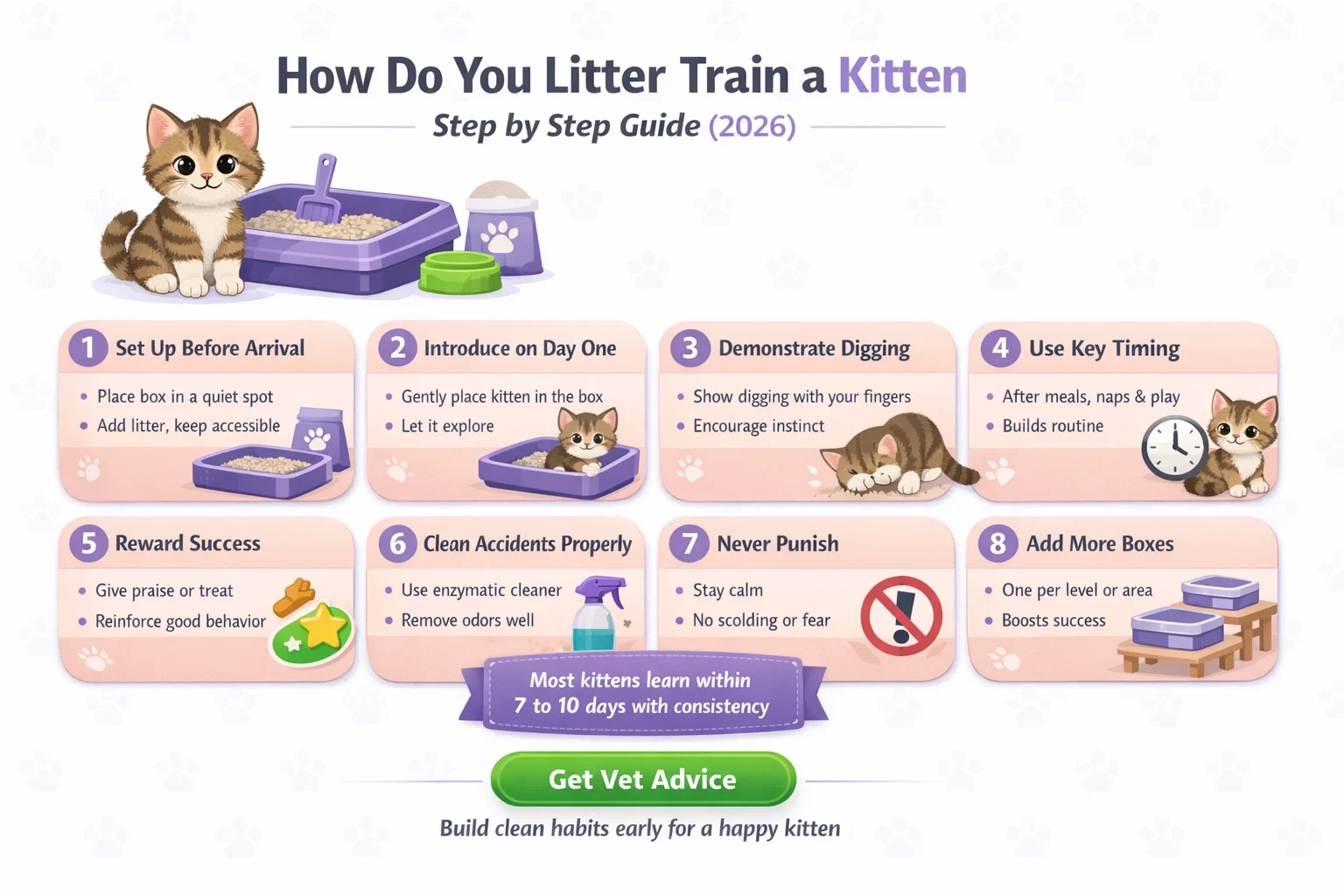
Litter box training is best if you follow a consistent routine.
Step 1: Set Up the Litter Box Before Your Kitten Arrives
Set up the litter box in a quiet corner of the house that your kitten has easy access to. Don’t place it near busy hallways, loud appliances, or dark closets.
Cats prefer privacy while eliminating.
Step 2: Introduce the Box on Day One
On the day you bring a kitten to your home, place them inside the litter box. Let them sniff and explore.
Don’t force them to stay inside the box. Curiosity will do the rest.
Step 3: Demonstrate Digging Behavior
Scratch the litter with your finger gently. Kittens instinctively mimic this digging behavior.
Step 4: Place the Kitten in the Box After Key Moments
Kitten elimination is often associated with key moments and activities. They prefer to eliminate generally after:
Meals
Naps
play sessions
Place them in the litter box during these key moments. This helps create the correct association.
Step 5: Reward Success Immediately
In veterinary literature, positive reinforcement is a gold standard technique to inculcate desired behaviours in pets. It also works beautifully with kittens.
Offer calm praise or a small treat when your kitten uses the litter box correctly.
Step 6: Clean Accidents Properly
If the smell of your kitten's urine remains, it will associate the area with the bathroom as it used the same spot previously.
Use an enzymatic cleaner immediately and never use ammonia-based cleaners. Ammonia has a smell similar to urine, which may attract the kitten back to the same spot.
Step 7: Never Punish a Kitten
Punishment leads to anxiety and confusion. Stress is one of the fastest and most effective ways to fail litter box training.
So, if you don’t want to fail, don’t yell or punish your cat.
Cats are crazy for catnip. You can use Catnip if you have an adult cat. Just sprinkle it in or around the litter box in small amounts to encourage investigation and creating a positive association.
Step 8: Add Additional Boxes as the House Opens Up
The rule veterinarians recommend is one litter box per cat plus one extra.
In multi-level homes, place one box per floor.
Related Readings: 10 Best Automatic Cat Feeders for Busy Cat Parents in 2026
Where Should You Place a Kitten’s Litter Box?
A litter box’s ideal location is quiet and accessible.
Cats do not usually eliminate where they eat. Many owners place the litter box too close to the place kittens eat. This is a common kitten training mistake. A litter box should be separate from food and water bowls.
Important placement rules include:
Keep the box away from loud appliances and noises
Avoid areas with busy household traffic areas
Place it where the kitten can find it easily
Add additional boxes in multi-floor homes (especially for very young kittens)
You can also place a small nightlight near the litter box so that the area is never too dark.
What Is the Best Litter for Kittens?
The best litter you can use for a kitten under 8–10 weeks old is a non-clumping, fine-grain, unscented litter with a sandy texture.
Litter Type | Safe for Kittens | Best For |
Non-clumping clay | Yes | Young kittens |
Clumping clay | Not under 10 weeks | Adult cats |
Corn-based litter | Yes | Curious kittens |
Silica crystals | No | Adult cats |
Scented litter | No | Avoid strong odors |
Pellet litter | Yes | Soft texture preference |
Fine sandy litter is usually the best because it has a texture similar to that of natural soil, which cats instinctively prefer.
How Long Does It Take to Litter Train a Kitten?
As stated earlier, most kittens can be fully litter trained within 3 to 7 days. However, the environment must be set up correctly.
Typical timeline:
Day 1–2: Exploration and introduction
Day 3–5: Consistent litter box use with reminders
Day 7+: Independent litter box use
Week 2–3: Completely reliable behavior
Kittens who learn from their mother (who is also domesticated) may develop proper litter box behaviors within hours. However, orphaned kittens need two to three weeks of practice. Orphaned kittens may develop aggressive behaviours like biting and hissing, which makes litter training difficult.
Consistency, patience, and proper litter box setup make the process surprisingly quick.
If you are having a hard time litter training your kitten, consult an online cat behaviorist or a certified feline veterinarian via cat behaviour consultation online on the Conbun app. Get instant guidance and expert cat behaviour strategies to train your cat quickly.
Why Is Your Kitten Not Using the Litter Box - and How Do You Fix It?
Even if you follow all the litter training rules perfectly, some kittens will still be rebellious against the litter box.
The good news is that litter box problems almost always have a simple explanation.
According to an article published in the Journal of Veterinary Medicine, most kitten litter box accidents happen because there is something about the environment due to which the kitten feel uncomfortable or confused.
It can be an aversive scent signal, a lack of proper access or any other factor in the external environment. A cat just being stubborn is rarely a factor.
Below are the most common problems and how to fix them.
Problem | Likely Cause | Fix |
Kitten goes beside the box | Box walls too high | Use a shallow box or cut a lower entry |
Kitten refuses to enter | Covered box feels scary | Switch to open-top litter box |
Kitten uses corners of room | Box in wrong location | Move box closer to accident spot |
Kitten scratches outside box | Box too small | Upgrade to larger litter box |
Kitten stops using box | Dirty litter | Scoop daily and change litter weekly |
Sudden litter box avoidance | Possible medical issue | Schedule a vet visit |
Young kittens, due to their instincts, are sensitive to litter box cleanliness. As per veterinarians, cats see litter boxes the way we humans see bathrooms. If the cat finds the box dirty, it will simply look for other cleaner options.
Stress is another important factor that messes with a cat’s behavioral development. Loud noises especially due to fireworks during festivals, moving homes, or sudden changes in the daily routine can also temporarily disrupt litter habits.
If your kitten, who was previously well-trained, suddenly stops using the box and experiences house accidents, rule out medical causes first, like urinary tract infections or digestive problems, with your veterinarian.
You can also schedule an online appointment with a veterinarian or a cat behaviour expert consultation. Connect with the vet, explain the symptoms and rule out medical causes to go ahead with behavioral training.
Related Readings: 25 Most Popular Cat Breeds in India with Prices and Care Guide (2026)
How Do You Handle Litter Box Accidents During Training?
House accidents during litter training are normal. How you, as a cat parent, respond to them is what matters the most.
The first rule is simple: never punish your kitten.
Cats do not have a memory like us, so they cannot associate punishment with house accidents or any past behavior, the way humans do. Instead, punishment can create anxiety and make behavioral learning slower.
Clean Accidents Immediately
Use enzymatic cleaners, which are specifically designed for house accidents. These clearers work by breaking down the odor molecules at the chemical level, eliminating the scent that may attract the kitten to the same spot.
Always avoid ammonia-based cleaners. Ammonia’s smell is similar to that of urine, which unintentionally encourages cats to repeat accidents.
Redirect the Kitten
Clean the accident area and gently place the kitten in the litter box. This helps the cat to reconnect the correct location with elimination.
Limit Their Territory During Training
The first few days of training are very important. So, confine your kitten to a single room during this time that contains their litter box, food, and water.
This lowers the number of possible house accidents and also helps the kitten locate the box easily.
If you see improvements in their litter habits, allow gradual access to the rest of the house.
Move the Box If Necessary
Even after repeated attempts, if your kitten continues to use the same incorrect location, place a litter box there temporarily. If you observe that your kitten is using the box reliably, slowly move the box towards your preferred location.
This technique can work surprisingly well as it follows the kitten’s instinct rather than fighting it.
Related Readings: How to Groom a Cat at Home: Shedding, Bathing, Nail Trimming & Schedule Guide
How Do You Litter Train a Kitten Without a Mother Cat?
Orphaned kittens or kittens that were separated early from their mother may need extra help to learning bathroom habits.
Cats learn litter behavior by example from their mothers. Therefore, if there’s no guidance, humans must step into the teaching role.
Neonatal Kittens (Under 3 Weeks)
Kittens under 3 weeks are very young to eliminate independently.
You can help them by gently stimulating their genital area using a warm, damp cloth or cotton ball after feeding.
This mimics the licking behavior of the mother cat. This stimulation should be continued until about three weeks of age. You can stop this after kittens begin eliminating on their own.
Introducing the First Litter Box
When the kitten reaches 3-4 weeks of age, place a shallow litter tray in their living space. Use soft, non-clumping litter or natural corn-based litter.
You should place the kitten in the box every 30–60 minutes, especially after feeding.
Use Kitten Attract Litter If Needed
Litters also contain natural attractants, which are designed to encourage cats to use the box. These help to correct the behavior of stubborn kittens quickly.
Be Patient
Lastly. You have to be patient, as orphaned kittens may take slightly longer to learn correct litter behavior as they lack the natural role model of their mother.
With consistent guidance, most kittens learn within two to three weeks.
Conclusion
While litter training a kitten may feel intimidating, especially for first-time cat owners, in reality, it's one of the easier behaviours to teach. With the right set-up, kitten-safe, nature litter and a little bit of patience, most kittens quickly learn where their bathroom is.
If your kitten continues with house ac cidents, even after proper training, it may be worth consulting a veterinarian to rule out underlying health issues or a cat behaviorist to understand what you can do further.
With best online vet consultation app in india on the Conbun app android and iOS, you can instantly connect with experienced veterinarians and pet behaviourists to receive pet health and behavior guidance without leaving home.
FAQs (People Also Asked)
1. How long does it take to litter train a kitten?
Answer. Most kittens learn litter box habits within 3 to 7 days. Kittens that are raised by their mothers understand the box almost immediately, while orphaned kittens may take a little longer.
2. What age should you start litter training a kitten?
Answer. Litter training should ideally begin around 3 to 4 weeks of age. This is the time when a kitten becomes mobile and starts eliminating independently. Kittens that are adopted between 8–12 weeks should be provided with litter training on the very first day at home.
3. Should I use clumping or non-clumping litter for a kitten?
Answer. Non-clumping litter is usually the safest and most effective, especially for kittens that are 8-10 weeks old as they can ingest litter. Clumping litter can lead to intestinal blockage in very young and small cats.
4. How many litter boxes does a kitten need?
Answer. Use one litter box per cat and have one extra. Place at least one litter box in a multi-floor home.
5. Why does my kitten keep missing the litter box?
Answer. Common reasons could be the litter box being too tall, an unsafe location, or litter texture the kitten dislikes. Adjust the box size, location or litter type to fix these issues.
6. Is it normal for kittens to eat litter?
Answer. Young kittens can sometimes ingest litter out of curiosity. Use natural non-clumping litter to reduce these risks.
7. Can you litter train a kitten in one day?
Answer. Kittens raised by their mothers usually learn within hours. However, most kittens may need several days of consistent guidance.
Table of Content
- When Should You Start Litter Training a Kitten?
- What Do You Need Before You Start Litter Training a Kitten?
- How Do You Litter Train a Kitten Step by Step?
- Where Should You Place a Kitten’s Litter Box?
- What Is the Best Litter for Kittens?
- How Long Does It Take to Litter Train a Kitten?
- Why Is Your Kitten Not Using the Litter Box - and How Do You Fix It?
- How Do You Handle Litter Box Accidents During Training?
- How Do You Litter Train a Kitten Without a Mother Cat?
- Conclusion
- FAQs (People Also Asked)