
How to Train a Cat: Complete Vet-Backed Cat Training Guide 2026
Written by: Anand Sen; Reviewed by: Dr. Ishwar Anand Senapati ( B.V.Sc & A.H, M.V.Sc Veterinary Microbiology )
Oftentimes, when people hear the word cat training guide, they only have one question:
Can Cats Really Be Trained?
The short answer is yes. Cats can absolutely be trained.
The longer and perhaps more important answer is that how they are trained determines whether the training succeeds or fails.
Contrary to popular beliefs, cats are “not untrainable.” But they are surely selective learners. Studies in feline behavioural science show that cats learn through timing, motivation and association.
It has also been established that reward-based positive reinforcement training is the most humane and effective method for training cats. Cats respond better to structured training that respects their autonomy.
Training cats is important because it directly impacts:
Behavioural stability
Human cat bonding
Stress reduction and mental stimulation
Household harmony (especially in multi-pet homes)
Many cat parents, especially first-time owners need cat behaviour advice. So, this guide will explain how to train a cat safely, ethically, and effectively, using modern veterinary-approved methods, not outdated myths.
Related Readings: Is Online Pet Care Consultation Right for Your Pet?
Understanding Cat Behaviour (Before You Try to Train Anything)
How Cats Think & Learn
Cats are attention seekers, not people-pleasers. Unlike dogs, which evolved alongside humans for cooperative tasks, cats evolved as independent hunters, which, to a great extent, shapes how they learn.
According to The International Cat Association (TICA), cats:
Learn through consequences, not commands
Repeat behaviours that benefit them directly
Shut down when faced with fear, force, or inconsistency
This is why, in the case of cats, punishment fails and training based on trust works.
Motivation vs Independence
A cat’s independence is not resistance; it is self-preservation. Training succeeds when motivation is aligned with:
Many new cat owners mistake a cat’s independence for resistance. But it is actually ingrained in their behaviour. It is a way of self-preservation. Therefore, training only succeeds when motivation is aligned with:
Food rewards
Play
Curiosity
Comfort
Bottom line: Cats don’t like authority. They respond to incentives.
Why Patience Beats Punishment
Positive Punishment to cats increases:
Anxiety
Avoidance behaviour
Aggression
Learned helplessness
Veterinary behavioural studies have consistently emphasised that punishment damages learning pathways in cats. A stressed brain cannot learn.
It is essential to note that if a cat is not listening, the problem is never defiance. It is poor timing, communication or inconsistency in commands.
Cat Training Basics (Before You Begin)
For training success, owners must emphasise both preparation and technique.
Tools You’ll Need
According to feline training specialists at Class Act Cats, effective cat training tools include:
Soft, high-value treats (but in limited quantities and pea-sized)
A clicker or consistent verbal marker (“yes”)
A quiet, distraction-free environment
A calm handler
Target sticks
A Treat bag
Always avoid large treats. Cats fill up quickly and lose interest. In addition, it also adds many extra calories to their diet.
Best Time for Training Sessions
Feline behaviour studies have shown that cats learn best:
Before meals (slightly hungry, not starving)
During natural activity peaks (morning or evening)
Avoid training when your cat is overstimulated, sleepy or stressed.
Short Sessions = Better Focus
Cats generally have short attention spans. Optimal session length:
3–5 minutes
1–2 sessions daily
Longer sessions may increase frustration and reduce retention. Therefore, try to end successful sessions, not on exhaustion.
Related Readings: 10 Benefits of booking vet consultation online vs. in-person visits?
How to House Train Your Cat (Step-by-Step)?
It is essential to note that house training is not instinctual. It is environment-dependent.
Introduce the Litter Box Correctly
Key principles:
One litter box per cat plus one extra
Quiet, accessible location
Unscented litter (strong smells repel cats)
If you have a multi-cat household, introduce them properly to avoid the development of inter-cat aggression, fear and anxiety-related behaviours.
Place kittens in the box after:
Eating
Sleeping
Play
This leverages natural elimination timing.
Avoiding house accidents
Consider house accidents as communication, not misbehaviour. Common causes include:
Dirty litter boxes
Poor placement
Stress or medical issues
Never punish cats for house accidents. This creates fear-based avoidance. Instead, training should primarily involve the right environment and positive reinforcement.
If you have an older kitten, you can use Catnip (a herb that has unique calming effects on cats) to reinforce positive behaviours like scratching posts, learning tricks, using the litter box, exploring a carrier, etc.
Cleaning & Placement Tips
Use enzyme-based cleaners only. Ammonia smells like urine and encourages repeated marking.
Avoid placing litter boxes nearby:
Food bowls
Washing machines
Loud appliances
In the case of cats, privacy equals compliance. Therefore, focus on creating a stable, calm and private environment for your cats.
What If the Problem Persists?
Persistent issues may indicate:
Urinary tract disease
Stress-related elimination
Territorial conflict
You must rule out medical issues before going for behavioural correction.
Positive Reinforcement Training Techniques
What Is Positive Reinforcement?
Positive reinforcement holds great importance in pet training. It means rewarding desired behaviour immediately, so the brain links the action with the outcome.
Rewards must occur within 3 seconds, or your cat may not associate it with proper action
Consistency is far more important than treat type
Calm delivery improves retention
Treat Timing & Reward Strategy
Effective timing looks like:
Cat performs behaviour
Marker sound (“click” or “yes”)
Treat immediately
The marker works by bridging the gap between action and reward.
Why You Must Avoid Punishment
Punishment teaches:
Fear of the handler
Avoidance, not understanding
Defensive aggression
As per behavioural studies, cats trained by clickers show higher learning retention and lower stress markers than cats trained by punishment.
Related Readings: How do online vet consultations work: A pet owner’s guide?
Common Commands You Can Teach Your Cat
Yes. Cats can learn commands. The key is breaking them into micro-steps.
Sit
Steps:
Hold the treat above the nose
Slowly move backwards
When hips lower → click → treat
Variation: Train on elevated surfaces first for easier posture control.
Come When Called
Steps:
Start at a short distance
Use name + cue
Reward immediately on arrival
Never call your cat for negative experiences.
Stay
Steps:
Ask for sit
Pause 1–2 seconds
Reward calm stillness
Increase duration slowly.
Walk on a Leash
Use a proper harness, never a collar.
Introduce indoors first
Reward movement, not pulling
Sessions should be brief
High-Five / Wave
Steps:
Hold the treat in a closed fist
Cat paws at hand
Click on contact
This trick helps in strengthening confidence and coordination.
Veterinary science confirms that play-based commands sharpen cognitive abilities in cats.
How to Train Advanced Behaviours?
Leash Training
Leash training provides:
Mental stimulation and physical exercise
Controlled outdoor exploration
Reduced frustration in indoor cats
Prevents boredom and destructive behaviour
Progress slowly. Forcing outdoor exposure increases anxiety.
Door Etiquette
Train sitting before the doors open. This prevents:
Bolting
Anxiety escalation
Escape behaviour
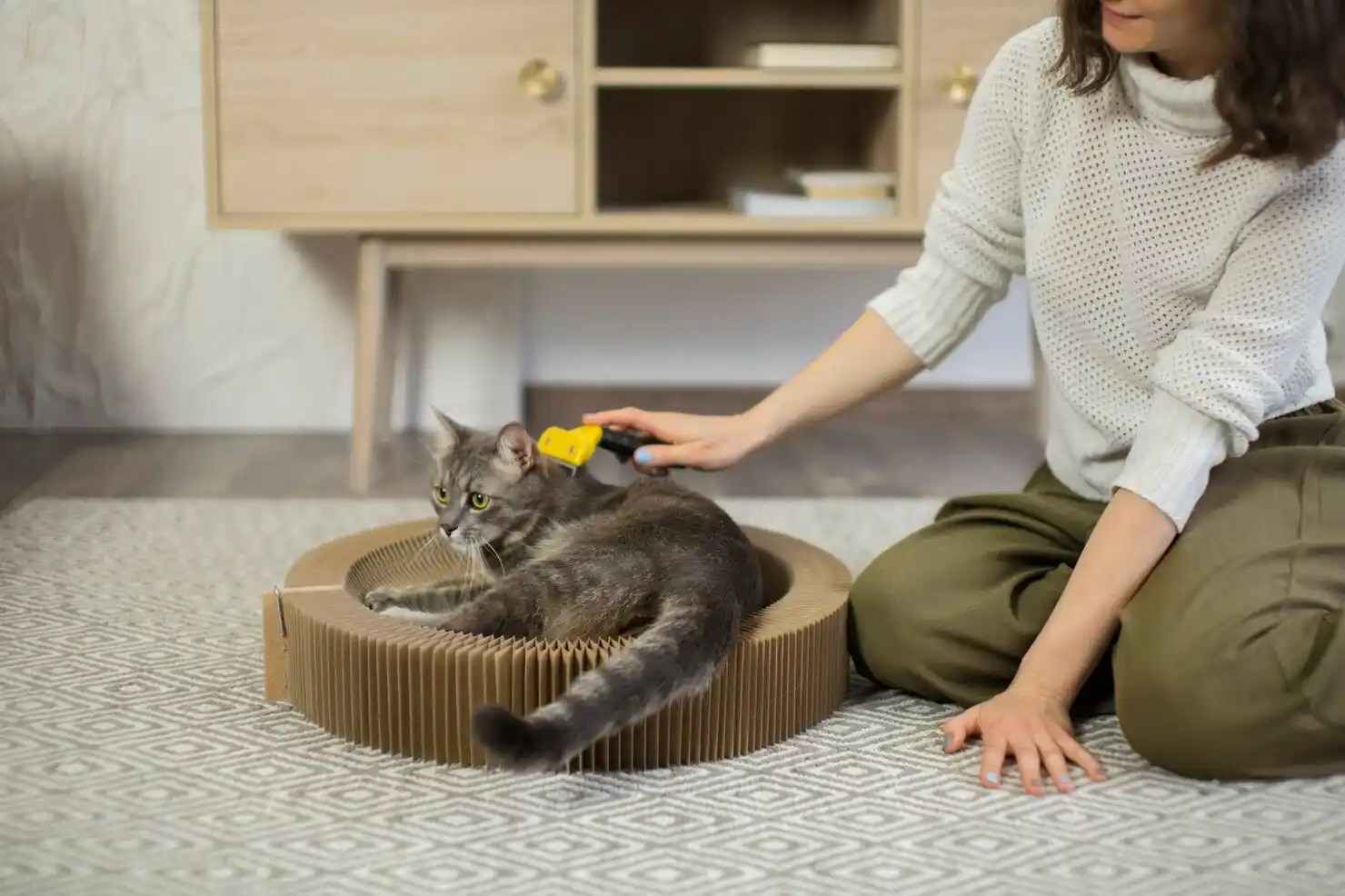
Gentle Grooming Cooperation
Reward:
Brief brush strokes
Paw handling
Calm restraint
This reduces vet-visit stress significantly.
Puzzle Toys & Enrichment
According to VCA Animal Hospitals, puzzle toys:
Reduce destructive behaviour
Improve learning speed
Decrease anxiety markers
As an owner, you must understand that enrichment is not optional; it is a form of behavioural healthcare and training. Training a cat is not about control. It is about communication.
Fixing Common Behaviour Issues in Cats
In most cats, behaviour problems are not “bad habits.” They are communication mismatches, unmet needs, or environmental mismatches, which are often misunderstood.
Veterinary behaviour literature has consistently shown that once the reason behind a problematic behaviour is addressed, the behaviour itself will resolve naturally.
Scratching Furniture
Scratching is a normal behaviour in cats, which is also necessary and non-negotiable. It helps maintain claw health, marks territory and stretches muscles.
Don't just rely on cat behaviour advice from your friends. Instead:
Provide scratching posts in multiple locations
Match the texture your cat prefers (sisal, cardboard, or carpet)
Place posts near furniture that the cat already targets
Reward immediately with treats or praise
Cats should be praised for scratching in a preferred scratching location so that the behaviour is reinforced.
A 2019 study showed that owners who rewarded their cats with a treat, verbal praise, etc., reported that their cat used a preferred scratching post.
Don’t do this:
Don’t declaw (it is a medical amputation that causes long-term pain and worsens behavioural issues)
Don’t yell or spray water
Don’t remove scratching without providing alternatives
Counter Surfing
Cats jump on counters because:
Height feels safe
Food smells are rewarding
Curiosity drives exploration
This is not defiance. It’s their instinctive behaviour.
Do this:
Remove food rewards completely
Feed cats before cooking
Provide high vertical spaces elsewhere (cat trees, shelves)
Focus on positive redirection, not punishment
Don’t do this:
Don’t chase or shout
Don’t use foil or scare tactics long-term (they increase anxiety)
Don’t reward accidentally by leaving food out
From a learning perspective, if a behaviour pays off even once, it strengthens.
Biting & Play Aggression
Play aggression is especially common in:
Kittens raised without littermates
Indoor-only cats
Cats played with their hands
Do this:
Use wand toys to keep distance
End play before overstimulation
Reward calm disengagement
Don’t do this:
Don’t use hands as toys
Don’t punish biting (this escalates aggression)
Don’t ignore early warning signs like tail flicking or ear flattening
Veterinary literature recognises play aggression as a training issue, not a temperament flaw.
Night Activity (“The 3 AM Zoomies”)
Cats are crepuscular that means they are naturally active at dawn and dusk.
Do this:
Schedule intense play in the evening
Feed the last meal after play
Keep routines consistent
Don’t do this:
Don’t respond to night demands
Don’t feed during night wake-ups
Don’t punish vocalisation
Consistency in routine help resetting their internal clock.
Troubleshooting When Training Isn’t Working
Never doubt your cat’s intelligence for training failure.
It is almost always about motivation, environment, or timing.
“My Cat Won’t Respond to Treats”
Possible reasons:
Treats are not high-value enough
Cat is full
Stress suppresses appetite
Solutions:
Try different textures or smells
Train before meals
Reduce environmental distractions
Studies cited by Purina indicate that smell plays a more significant role than taste in motivating felines.
Stress & Environmental Triggers
For cats, stress blocks learning completely.
Common triggers:
Loud noises
Rearranged furniture
Inconsistent routines
In addition to these, seeing a new cat at home can be highly stressful for both the old and the new one. Introduce them properly to avoid fighting and stressful behaviours.
Slow Progress vs Quitting Too Early
Cats learn in micro-steps. Progress may look invisible until it suddenly appears consistent.
What’s normal:
Inconsistent responses early on
Regression during stress periods
Plateaus before breakthroughs
What’s not helpful:
Switching methods weekly
Increasing pressure
Giving up entirely
Behaviour science confirms that slow learning is still learning. Thus, don't bother Chat GPT and instead consult a cat behaviourist online to get science-backed cat behaviour advice.
Training for Kittens vs Adult Cats
When to Start Training
Kittens: as early as 8–9 weeks
Adult cats: anytime (learning ability remains intact)
Early exposure builds resilience—but adults are fully trainable.
Age-Specific Strategies
Kitten training:
Shorter sessions (1–2 minutes)
Gentle handling exercises
Early litter and scratching habits
Adult cat training:
Slower pacing
Higher-value rewards
Clearer boundaries
Adult cats often show better impulse control once engaged.
Socialisation Windows
Kittens have a sensitive socialisation window up to 14-16 weeks.
However, adult cats can still form new associations with gradual exposure and reward pairing.
Training cats early from kittenhood is extremely important. If you are new pet parent consider taking a cat behaviour consultation online to learn easy tips on how to train a kitten.
Tools & Resources for Effective Cat Training
Effective tools include:
Soft-click clickers (lower sound sensitivity)
Verbal markers for noise-sensitive cats
Treat pouches for quick delivery
Consistency matters more than brand.
Puzzle Toys & Lures
An article published in the Journal of Feline Medicine and Surgery shows that puzzle toys:
Reduce stress hormones
Improve focus during training
Decrease destructive behaviour
Interactive pet toys offer essential mental and physical stimulation, tapping into their natural hunting instincts to reduce stress, prevent boredom and destructive behaviour.
Recommended Learning Resources
Evidence-based sources include:
Purina behaviour guides
IAABC-certified trainer content
Veterinary behaviour textbooks
Avoid dominance-based advice. It is outdated and harmful.
Conclusion
Training a cat successfully isn’t about dominance or forcing compliance—it’s about understanding behaviour, building trust, and responding early when things feel “off.” When challenges arise, timely guidance can prevent small issues from becoming long-term behaviour problems.
With Conbun’s online pet care consultation, cat parents can connect with experienced veterinarians and cat behaviourists to get cat behaviour advice, personalised training guidance, and resolve concerns before frustration sets in. Expert insight, consistent support and continuous digital access make modern cat training calmer, safer, and far more effective.
Frequently Asked Questions
Q1. Can cats be trained like dogs?
Answer. Cats can be trained, but training methods differ from those of dogs. Cats learn through reward and motivation, and not hierarchy or obedience.
Q2. What is the easiest command to teach a cat?
Answer. “Sit” and “target touch” are typically the easiest due to natural movement patterns.
Q3. Do cats respond to clicker training?
Answer. Yes. Cats respond to a clicker and training. It has proven to be the most effective and low-stress training method for cats.
Q4. How long does cat training take?
Answer. Basic behaviour may be inculcated within days to weeks, but reliability builds over months with consistency.
5. Can cats have behavioural problems?
Answer. Yes. Without proper training and positive reinforcement issues, you can experiences behavioural issues in cats.
Table of Content
- Beginner Puppy Guide
- Beginner Puppy Guide