.webp)
Written by: Anand Sen; Reviewed by: Dr. Ambika Paul
When the world quiets down at dusk, you may notice a shadow slipping between parked cars or darting under bushes. Those are silent hunters popularly known as feral cats, community cats or outdoor cats. They live independent lives on the edge of human society.
Feline veterinarians treat pet cats who sleep on velvet cushions, and these outdoor cats who survive harsh summers, monsoons, traffic, and winter frost. The difference isn’t in their biology; it’s in their relationship with people. Understanding feral cat behavior, the health risks they are exposed to, and humane solutions like TNR (trap-neuter-return) can help us in transforming confusion into compassion.
If you’ve ever wondered, “What should I do if I find a feral cat?” or “Are feral cats dangerous?” this guide is for you.
Let’s separate myth from medicine and learn how to help feral cat colonies sustain safely and responsibly.
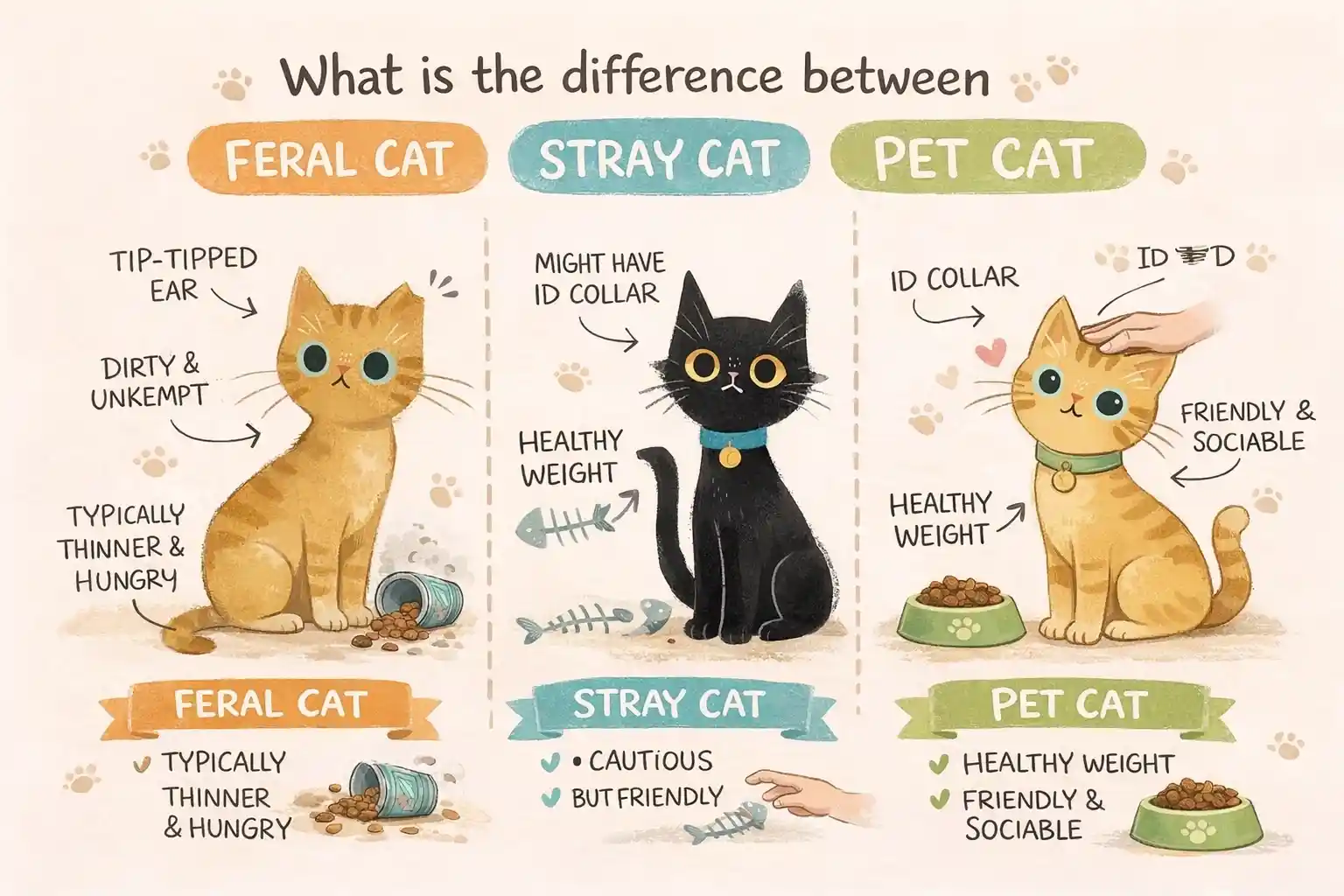
What is the difference between Feral vs. Stray vs. Pet Cat?
Understanding the differences between a feral and a stray cat is the first step in humane feral cat management.
Feral Cats
Feral cats do not socialise with humans. They were either born outdoors or reverted to a wild state, having no contact with humans for long periods. A true feral cat will avoid eye contact with humans, may crouch low and will probably flee when they are approached.
Veterinary literature describes them as “fear-driven, not aggressive.” They are observed to be free-living and non-domesticated. They are not typical wild cats like jungle cats. But they are domestic cats that live outdoors.
Many people have this question: “Can feral cats be domesticated?” And this answer is no. Feral cats can’t be domesticated, as attempts to domesticate them could lead to severe injuries and scratches.
Stray Cats
Stray cat, on the other hand, once had human contact. This is a prominent difference between feral and stray cats. They approach humans but cautiously, and appear lost. Many stray cats can be adopted and re-socialised. Their body language is conflicted. They are curious but afraid.
Outdoor Pet Cats
Outdoor pet cats are owned pets that are allowed outside. They mostly appear well-fed and healthy. Many of them wear collars and approach humans with confidence.
How to identify a Feral Cat?
Body Language Signals (Likely Feral):
- Avoids direct eye contact
- Low body posture
- Silent (rarely meows at humans)
- Active primarily at night
The Food Test:
If you want to know how to tell if a cat is feral, just do this food test.
When you see a cat, place food down and step back. A stray cat may eat while you are watching, while a feral cat will wait until you leave entirely.
Time of Day:
Feral cats are mostly nocturnal or crepuscular. Seeing the same cat only after dark suggests a nearby feral cat colony.
Correct identification of a feral cat matters, as taking them to a shelter often leads to euthanasia due to stress and lack of socialisation. That’s why community-based solutions like TNR programs have become essential.
What Are Some Common Myths About Feral Cats?
Now, let’s debunk common myths related to feral cats using veterinary evidence.
Myth #1: “All feral cats can be tamed and adopted”
Reality:
Adult feral cats rarely adapt to indoor homes.
A study published in Applied Animal Behaviour Science on feline stress markers indicated chronically elevated cortisol levels when confined.
While it is possible to socialise feral kittens under 8–12 weeks, most adult community cats don’t like confinement and thrive outdoors within managed colonies.
Myth #2: “Feral cats should go to shelters”
Reality:
Traditional shelters are built for adoptable pets. Unsocialized feral cats experience extreme stress in cages and are often deemed unadoptable by many shelter owners.
Veterinary literature and animal welfare organisations recommend trap-neuter-release (TNR) instead of intake for healthy feral cats. It has been associated with reduced euthanasia at shelters and improved animal welfare.
Myth #3: “Feeding feral cats makes the problem worse”
Reality:
Feeding alone without neutering and spaying increases the risk of reproduction. However, responsible feeding combined with TNR stabilises and gradually reduces feral cat populations, contributing to animal welfare.
Myth #4: “Feral cats don’t live long”
Reality:
While it is true that unmanaged feral cat colonies have shorter lifespans. With vaccination programs, ear tipping, and ongoing care, many feral cats can live 5–10 years or longer.
Myth #5: “Feral cats are diseased and dangerous to humans”
Reality:
Feral cats instinctively avoid humans, and if bites occur, they are usually because cats were cornered or threatened. The risk of rabies or zoonotic disease transmission is low when cats are vaccinated through TNR programs.
Therefore, if you have ever wondered, “How can I help feral cats safely?” Understanding facts, not fear, helps us answer this real question.
Safety First: Risks and Precautions
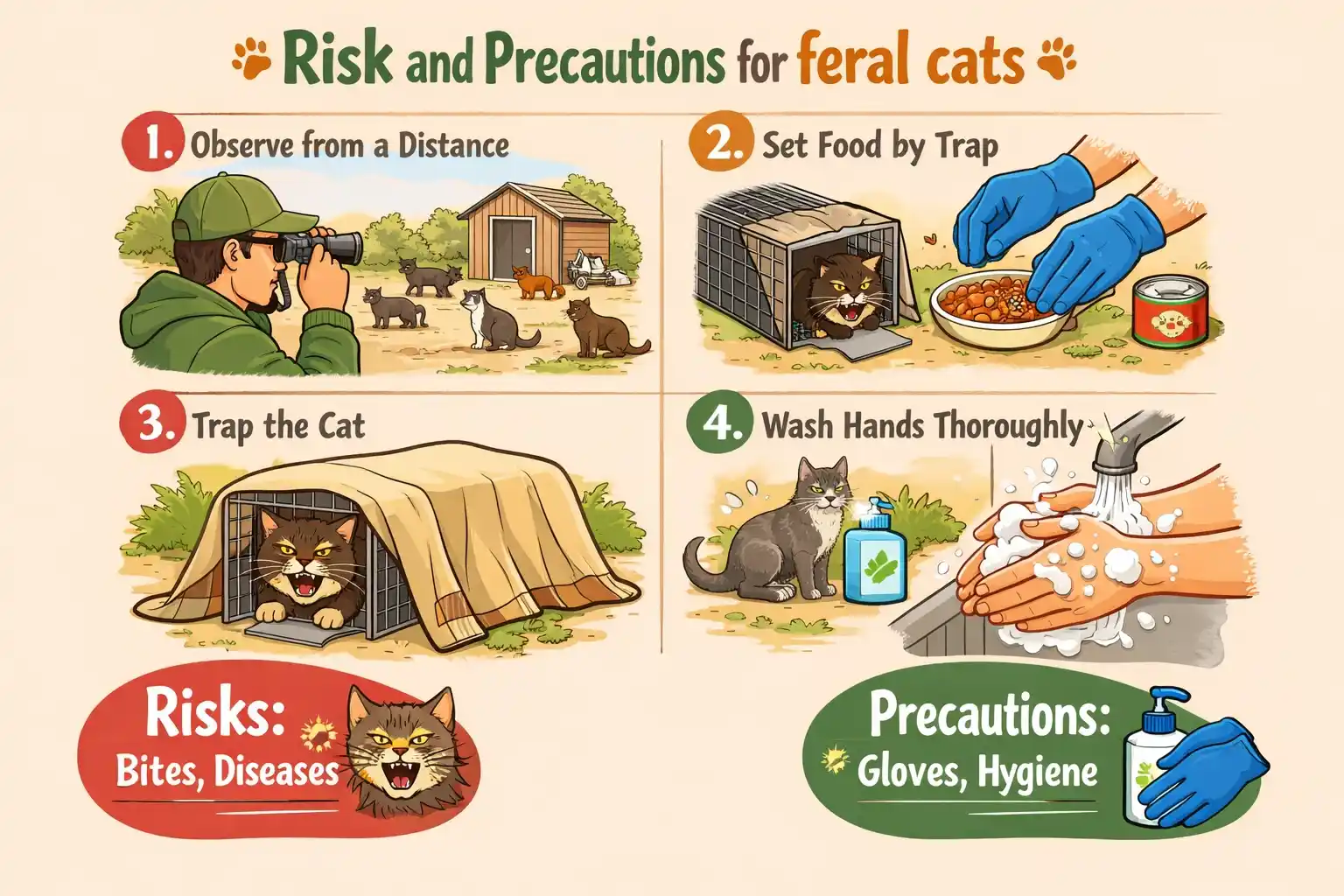
One evening, a well-meaning neighbour of mine tried to pick up a frightened feral cat that was tangled in a fence. The result? Two deep bites, stitches, and a series of rabies shots.
Therefore, compassion must always walk hand in hand with caution.
Understand the Dangers
Feline veterinary literature says that feral cats are not aggressive by nature, but they are defensive. Fear triggers survival instincts, and when cornered, even the smallest feral cat can inflict serious injury.
Health Risks to Humans:
Rabies: Cats rarely transmit rabies, but it is still possible, especially in areas where wildlife transmission exists, and the population of feral cats is higher. Vaccination through TNR programs dramatically reduces this risk.
Cat Scratch Disease (Bartonella): Cat scratch disease is spread via scratches contaminated with flea dirt. It is usually mild but can lead to swollen lymph nodes, non-painful blisters and fever.
Bites and Deep Scratches: Cat bites and scratches can inject bacteria deep into tissue. Infection rates from cat bites are high.
Parasites: fleas and ticks treatment are parasitic infections, common in unmanaged feral cat colonies. Direct contact increases exposure risk.
Risks to Your Pets:
- Transmission of upper respiratory infections
- Feline leukemia (FeLV) and FIV through fighting
- Parasites entering your home
Follow a proper vaccination schedule for your pets and do not allow them to interact with outdoor cats.
When to Call Authorities
Contact animal control, wildlife rescue, or local community cat resources if:
- A feral cat appears severely injured
- There are neurological signs (staggering, seizures)
- Aggression toward people is unusual and escalating
- A kitten is alone and visibly sick
Protect Yourself
- If you decide to help feral cats:
- Never attempt to pet or handle a feral cat
- Use humane trapping equipment for TNR
- Wear thick gloves
- Wash hands thoroughly after contact
- Do not allow children to approach
Legal Considerations
Before starting a feeding program:
- Check community cat ordinance laws in your city
- Understand local regulations regarding feral cat colonies
- Coordinate with local TNR programs
Responsible feral cat care begins with protecting yourself, your family, and your community.
The TNR Solution: How It Works?
Previously, communities used to remove feral cats through “catch and remove.” The result? New cats moved in to capitalise on available resources and capture the territory.
This vacuum effect is well-documented in animal welfare literature. This is the reason why TNR (Trap Neuter Return) has become the gold standard for humane feral cat management.
What Is TNR?
TNR involves:
- Trapping - Humane trapping using special box traps.
- Neutering/Spaying - Surgical sterilisation under anesthesia.
- Ear-tipping - Removing the tip of one ear while under anesthesia (a universal sign the cat is fixed).
- Returning - The cat is returned to its original territory.
- Ongoing Care - Feeding, monitoring, and vaccination boosters.
Ear tipping is crucial for feral cats as it is a universal sign that the cat is fixed through the TNR program.
Why TNR Works?
Population Control:
Neutered feral/spayed feral cats cannot reproduce. Over time, feral cat colonies shrink naturally through attrition.
Behavior Improvement:
Fixed cats:
- Fight less
- Roam less
- Spray less
- Vocalise less during mating season
Studies show that TNR programs significantly reduce the number of feral cat colonies and their population with an average decrease of 36%.
This also reduces nuisance complaints and improves neighbourhood harmony. More importantly, it also supports humane treatment while protecting feline health.
With the correct implementation of a TNR (trap-neuter-return) program, something remarkable happens: the chaos quiets, the midnight yowling softens, and constant pregnancies in the colonies stop leading to a stable population.
Community Benefits:
- Reduced noise from mating behaviours
- Fewer fights and injuries
- Less spraying and territorial marking
- Stabilised feral cat colonies
- Improved public perception of community cats
Veterinary population studies indicate that well-managed feral cat colonies decrease by 30–50% within two years when sterilisation rates exceed 70%.
That’s powerful. Unlike “catch and remove,” which creates the vacuum effect (new cats move in), feral cat TNR programs stop reproduction at the very source.
Vaccination is another hidden benefit. Most TNR clinics administer rabies vaccines during surgery. That directly addresses zoonotic risk, answering “NO” to the common question, “Are feral cats dangerous?”
Thus, managed feral cat colonies are significantly safer than unmanaged ones.
How to Get Started with TNR?
Step 1: Find Local Resources
Search “Feral cat TNR programs near me” or contact:
- Alley Cat Allies
- Local humane societies
- Low-cost spay neuter clinics
- Community cat rescue organisations in your area
Most Indian cities now support official community cat caretaker responsibilities programs.
Step 2: Get Supplies
Most TNR programs provide:
- Humane box traps
- Trap covers (to calm the cat)
- Transfer cages
- Appointment scheduling assistance
Step 3: The Trapping Process
- Withhold food 24 hours before trapping
- Place the trap on flat ground
- Use strong-smelling bait (sardines, mackerel)
- Never leave traps unattended
- Cover trap immediately after capture
Covering reduces stress dramatically, something veterinary behavior science strongly supports. If you notice extreme resistance, what is catnip for cats to calm them
Step 4: Veterinary Care
At the clinic:
- Spay/neuter surgery
- Rabies vaccination
- FVRCP vaccination
- Parasite treatment
- Ear tipping
Recovery of a feral cat usually takes 24-48 hours in a quiet space.
Step 5: Return and Monitor
- Return the cat exactly where trapped
- Resume feeding schedule
- Monitor for health issues
- Continue trapping until the entire colony is fixed
Consistency is key in managing feral cat colonies in the most humane way possible.
Costs and Funding
Average Costs:
- TNR per cat: ₹1,000 to ₹5,000 (often discounted)
- Feeding annually: ₹2,000 to ₹2,500 per cat
- Shelters and supplies: ₹1,500 to ₹3,000per unit
Finding Funding:
- Local grants
- Crowdfunding
- Veterinary clinic partnerships
- Animal welfare donations
Volunteer Opportunities
TNR programs need:
- Trappers
- Transport drivers
- Colony feeders
- Fundraisers
- Foster homes for socialising feral kittens
Helping feral cats isn’t about rescuing them from the outdoors; it’s about improving their outdoor survival through science-backed population control and humane treatment.
How to Feed a Feral Cat?
Now comes the question I hear most often: “Should I feed feral cats?”
Feeding feral cats is not a casual act; it’s a long-term responsibility. Once you start, community cats depend on you.
Should You Feed Them?
Ask yourself:
- Can you commit daily?
- Are you willing to pursue TNR?
- Do neighbors support it?
And if you’ve found a feral kitten also ask “can you overfeed a kitten wet food?”
Consistent feeding without sterilisation leads to rapid population growth. But feeding feral cats in combination with a trap-neuter-release program helps in stabilising colonies and improving overall feline health.
Setting Up a Feeding Station
Location Matters:
- Quiet, low-traffic areas
- Away from children and dogs
- Near natural cover
- Discreet but accessible
Search-friendly setups often include a feral cat feeding station, weather proof structure.
Feeding Schedule:
- Feed once or twice daily
- Remove uneaten food after 30 minutes
- Maintain consistent timing
Routine builds trust and allows easier trapping later.
What to Feed:
- Commercial dry cat food (cost-effective)
- Wet food during cold weather
- Fresh water daily
While feeding feral cats always avoid table scraps; they attract pests and lack balanced nutrition.
Preventing Problems
Pest Control:
- Elevate feeding dishes
- Clean area daily
- Use sealed food containers
Neighbour Relations:
- Communicate openly
- Emphasise TNR efforts
- Keep the area clean
Responsible feeding is part of feral cat care, not the cause of overpopulation. If paired with vaccination and proper sterilisation, it becomes a powerful tool for the management of feral cat colonies.
Winter Care: Building Shelters
Even the toughest feral cat struggles in winter. Veterinarians treat frostbitten ears, cracked paw pads and extremely dehydrated community cats who survive on just frozen puddles.
Cold stress weakens their immunity, increasing upper respiratory infections, which are highly common in unmanaged feral cat colonies. In addition to these, arthritis, joint pain, hypothermia, and chemical burns are also common pet heat safety.
The good news? A simple feral cat winter DIY shelter setup can save lives in winter. Outdoor cat shelters prove to be saviours as they save feral cats from harsh winter winds and freezing temperatures.
DIY Shelter: Styrofoam Cooler Method
Materials Needed (₹300 to ₹5,00):
- Large Styrofoam cooler
- Plastic storage bin (slightly larger than cooler)
- Straw (not hay)
- Utility knife
- Duct tape
Instructions:
- Cut doorway: 5 - 6 inches wide, just large enough for a cat. Smaller openings conserve heat.
- Add straw: Fill interior with straw for insulation. Never use blankets; they retain moisture and freeze.
- Create overhang: Cut an entrance in the outer bin slightly offset to block wind.
- Secure it: Tape the lid and seams to prevent water leaks in the feral cat shelter.
- Face away from wind: Position the entrance opposite prevailing winter winds into the outdoor cat shelter.
Placement Tips:
- Elevate slightly off the ground
- Place against a wall or fence
- Camouflage with leaves if needed
- Keep near the feeding station but separate from high traffic
Well-built outdoor feral cat shelters can stay 10 - 15°F warmer inside than outside ambient temperature.
Alternative Shelter: Plastic Bin
Materials (200–300):
- Two plastic storage bins (one smaller)
- Straw
- Foam insulation board
Instructions:
- Cut matching door holes in both bins
- Place the smaller bin inside the larger
- Fill the gap with insulation or straw
- Add straw bedding inside
- Secure the lid tightly
Additional Winter Care
Water:
- Replace twice daily
- Use dark bowls to absorb sunlight
- Consider heated outdoor bowls if electricity is available
Food:
- Increase calorie intake during winter
- Offer wet food briefly (remove before freezing)
Health Monitoring:
- Watch for limping (frostbite)
- Check for nasal discharge
- Monitor weight loss
Winter survival of feral cats largely depends on human support. Building a feral cat shelter can mean the difference between life and death.
How to Socialize with Feral Cats?
There’s a magic window in feline behavior science, and it closes quickly.
The Age Window
- Under 8 weeks: Highly socializable. Ideal for fostering and adoption.
- 8 -12 weeks: Possible with intensive daily handling.
- Over 12 weeks: Challenging; may require experienced fosters.
- Adults: Rarely domesticated successfully, best candidates for TNR.
If you’re wondering “How to catch feral kittens?”, humane trapping is still safest.
The Process (Socializing Feral Kittens Timeline)
Weeks 1 - 2:
- Confined safe space
- Gentle, short handling sessions
- Introduce human voice and routine
Weeks 3 - 4:
- Hand feeding
- Interactive play with wand toys
- Gradual exposure to household sounds
Weeks 5 - 6:
- Introduce new people slowly
- Begin litter training reinforcement
- Veterinary check, vaccinations
Consistency is critical. Kittens respond to predictable care.
Signs of Success
- Purring during handling
- Seeking attention
- Relaxed body posture
- Playful engagement
If Socialization Fails
Not all kittens adapt. Options:
- Barn cat programs: Placement as working cats
- Return to colony through TNR
- Sanctuary facilities
The goal of feral cat care isn’t to force every outdoor cat indoors; it’s to choose the path that ensures welfare and humane treatment.
If you want to learn more about feral cat behaviour and tips on how to effectively socialise with them, consider talking to an expert through online vet consultation 24/7 on pet care apps like Conbun.
Conclusion
Feral cats, at first glance, seem mysterious, quiet watchers behind fences and shadows in parking lots. But if you understand their health needs, behavior and population dynamics, those shadows become stories of survival.
TNR programs bring transformation with vaccination, responsible feeding, and winter shelters to community cats. Noise decreases. Colonies stabilize. Fighting reduces. And most importantly, suffering declines.
Helping feral cats is not about turning every outdoor cat into a lap pet. It’s about science-based compassion, spaying, neutering, humane trapping, vaccination programs and colony management.
Are you ready to help a feral cat? Find your local TNR program today and join thousands of caretakers supporting community cats nationwide. And if you want guidance on how to care for a feral cat, download Conbun android and iOS and connect to certified veterinarians through Best online vet consult app.
FAQ (People Also Ask):
1. Can you pet a feral cat?
Answer. Generally, no. True feral cats are fearful of humans and never socialise with us. Attempting to pet one may lead to scratches, bites or severe injuries. Some long-managed community cats may tolerate proximity with humans, but handling them is not generally recommended.
2. Will shelters take feral cats?
Answer. Traditional shelters are not equipped for unsocialized outdoor cats. Healthy feral cats are directed towards TNR (Trap Neuter Return) programs.
3. How do you get rid of feral cats?
Answer. Removal creates the vacuum effect. New cats move in to occupy resources and territory. An effective solution and humane solution is feral cat management through TNR, responsible feeding and colony monitoring.
4. What diseases do feral cats carry?
Answer. Like any other outdoor cat, feral cats carry upper respiratory infections, parasites, FeLV, FIV or even rabies (rarely). Vaccination programs with TNR can significantly reduce risks.
5. Are feral cats dangerous to children?
Answer. Feral cats do not socialise with humans and avoid interaction. Risk only occurs if they are cornered or handled.
6. How long do feral cats live?
Answer. Unmanaged colonies may live 2–5 years on average. Managed feral cat colonies with TNR and feeding often see lifespans of 5 -10+ years.
7. Can you move a feral cat colony?
Answer. Relocation is highly difficult and stressful. It should only be done with structured acclimation and expert guidance.