Written by: Anand Sen; Reviewed by: Dr. Shree (B.V.Sc & A.H, M.V.Sc)
According to an article published in Frontiers in Veterinary Science, India’s cat population has crossed 9 million. That means at least 9 million of us are currently living with a tiny, 4kg creature and wondering: What did I even do to you?
If you’re currently Googling “why does my cat bite me?” at 2 AM with a scratch mark on your left cheek, welcome to the club. You aren't a bad cat parent, and your cat is not being mean, and this behaviour is not random.
In India, behavioural problems are amplified. Most urban cats are either:
rescued feral cats adjusting to indoor/apartment life, or
pedigreed indoor cats (like Persian cats) living in high-stimulation apartments
Both groups are more likely to develop behaviour issues.
Here’s the truth: Behaviour problems in pets are their natural tactics of communication, not a personality flaw. When your cat bites you mid-petting or decides that your expensive carpet is their new litter box, they aren't being bad. They are giving you a frantic SOS signal in a language you haven't learned yet.
This is where an online cat behaviour consultation changes the game. Online veterinary platforms like Conbun connect you with specialists who see your cat in their natural habitat (your home!) via video, rather than requiring a terrifying, high-stress clinic visit.
It has been observed that in over 80% of cases, the root cause of a behavioural problem was something the owner didn’t even realise was a trigger.
In this guide, we’ll break down:
Why your cat is biting, hissing, or attacking
The most common aggression triggers in India
When it’s behavioural - and when it’s medical
Is My Cat Being Aggressive - or Is It Just Scared?
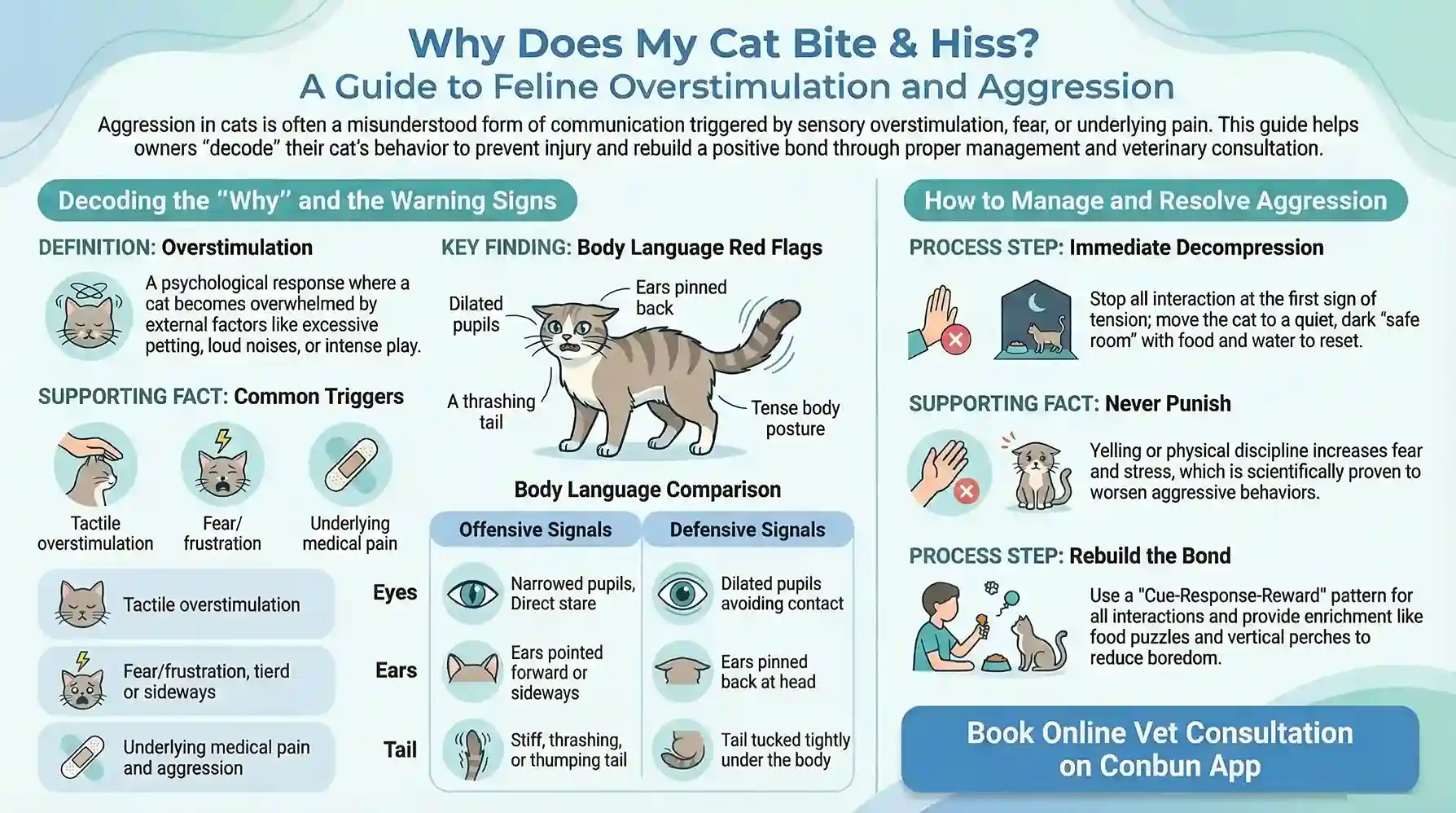
Hissing is rarely aggression; it’s fear.
A hiss is not an attack.
According to the Feline Medical Veterinary Association, hissing is a defensive gesture exhibited by a cat who feels victimised, threatened or antagonised.
It means I feel unsafe. Please stop.
What Hissing Actually Means
Cats generally hiss when:
A stranger enters their space (threatens their territory)
A child moves too fast
Another animal gets too close
You touch a painful area
In Indian homes with:
frequent guests
domestic helpers
multi-generational families
and children
Unpredictability is high, and unpredictable environments lead to more hissing.
When Hissing Is a Medical Concern
If your cat:
Never hissed before
Suddenly starts hissing
Avoids touch
Not eating
Hides more often
Pain could be a reason.
Common medical causes:
Dental disease (very common in India)
Arthritis
Internal illness
According to the Feline Veterinary Medical Association. Sudden behaviour changes may signal an underlying medical issue like pain, stress or other serious health conditions. So, before calling your cat arrogant, rule out a medical cause first.
Why Does My Cat Bite Me When I’m Petting It?
Your cat didn’t bite you “out of nowhere.” You just happen to miss the warning signs.
Cats have a much lower tolerance for petting than dogs.
The 3 Signals Before Every Bite
Signal | What it means |
Tail flick | A sudden and fast tail movement, not a slow wag. This means: Stop! 'I'm getting overstimulated.' |
Skin ripple | You see twitches or ripples on the back of your cat. Means: 'I'm at my limit.' |
Ear rotation | Flattening of the ears sideways or rotation. Means: ‘Do you wanna get choke slammed?’ |
If you notice any of these signs, gradually withdraw yourself, stop petting and move your hand away. Generally, you have 3–5 seconds to save yourself from the bite after these signs show up.
Behavioural aggression in cats is often a training related issue. Lack of early training and socialization can lead to such issues later. If you’re wondering about how to train your cat, check the latest ultimate cat training guide to plan a training program.
Petting-induced aggression vs. play biting vs. pain biting
Types of Biting
Type | How to identify | What to do |
Petting-induced aggression | Cats bite after a period of petting. Warning signals are present before the bite. The cat may walk away after. | Stop petting earlier; learn your cat's threshold. |
Play biting | Biting during/after active play. Especially seen in young cats or cats without play outlets. It is a socialisation issue. | Cease the play session immediately; redirect the aggression to a toy. Never use your hands as toys. |
Pain biting | Biting when a specific part of the body is touched. Generally, you may see hissing or flinching before biting. | Clinical vet assessment, dental, joint, or skin pain. Do not push through. |
The Real Mistake
Most owners, especially the inexperienced ones, continue petting despite signals
From a behavioural standpoint, it's like ignoring the smoke alarm and being surprised when the fire breaks out.
Why Is My Cat Suddenly Attacking Me for No Reason?
A cat attacking suddenly is almost always redirected aggression.
Redirected aggression in cats occurs when a cat is highly aroused or threatened by a stimulus they cannot reach, e.g., seeing an outdoor cat or a loud noise. This causes them to lash out at the nearest person or animal.
Redirected aggression in cats is often sudden, violent, and requires isolating the cat until they calm down, which can take hours or even weeks in overstimulated cats.
What It Looks Like
Your cat sees a stray dog outside
Or hears another cat
Can’t reach it
Arousal builds.
You happen to walk past, and now you are the target.
It’s not because the cat hates you or dislikes your existence. It's because you’re available at an emotionally overwhelming time.
Why This Is So Common in India
In cities like:
Mumbai
Delhi
There’s constant:
stray animal movement visible from balconies
noise
crowded environments
Indoor cats have no outlet, and all these arousal elements build arousal constantly, which is not let out. So, it just builds and spills.
What Actually Helps
Block window view (frost film)
Increase play sessions (hunt simulation)
Use Interactive pet toys to break focus from triggers
Don’t approach post-incident (30–60 min cooldown)
Using catnip as an enrichment tool
Clinical Insight
Redirected aggression is not rare and can even be seen in the most popular cat breeds. Once identified, it is completely manageable
Could My Cat’s Biting and Hissing Be a Medical Problem?
Yes, and this must always be ruled out first.
Medical Causes by Behaviour
Behaviour | Possible Cause |
Sudden aggression | Dental pain, arthritis, hyperthyroidism, internal injury |
Hissing on touch | Local pain, joint or skin condition |
Senior aggression | Thyroid, cognitive decline, hyperthyroidism, cognitive decline |
Aggression combined with hiding | Illness, infection or organ disease |
Sudden attack episodes | Feline hyperesthesia syndrome needs a veterinary assessment |
Why This Matters
Mistaking a medical issue for a behavioural issue delays recovery. Treating behaviour without ruling out medical issues fails completely
The Conbun Approach
Consider taking a cat behaviour consultation online on Conbun for behaviour assessment, medical screening and a clear next-step plan.
Because in cats, behaviour and health are inseparable
Why Is My Cat More Aggressive After Diwali?
Festivals and fireworks are the highest-frequency aggression trigger in Indian cats. The combination of smoke, noise, alteration of household schedules and guests creates an environment stress which can last days after the festival ends.
What’s Happening to Your Cat During Diwali
During Diwali:
Firecrackers trigger the fight-or-flight response, but they cannot source it or run from it, the arousal sustains
Smoke and smell alter the sensory environment
Guests disrupt routine
Noise and loud gatherings compound stress
As the cats can’t escape, stress becomes prolonged
Why Aggression Happens After Diwali
Even days after Diwali:
Arousal remains elevated
Threshold drops
Small triggers lead to big reactions
This often shows up as redirected aggression, where, generally, owners pay the price with
What to do if your cat is still aggressive 3+ days after Diwali
Provide quiet hiding space
Reduce noise, activity
Maintain a strict routine
Use pheromone diffusers
When to Act
If aggression lasts more than 5 days, worsens and affects eating, book an online vet consultation on Conbun.
My Cats Were Fine - Why Are They Suddenly Fighting?
Sudden inter-cat aggression in previously harmonious cats is almost always triggered by an event, not a personality change.
The Two Most Common Causes in India
Cause | What happens | First response |
Redirected aggression | One cat reacts to an external trigger (a stray animal, a loud noise) and attacks the other | Separate immediately; identify the trigger |
Non-recognition aggression | One cat returns smelling different (vet visit, grooming) and is treated as a stranger | Short separation + scent reintroduction |
India-Specific Pattern
While the number of stray rescues is rising, many homes introduce a second cat too quickly.
As per the Journal of Feline Medicine and Surgery, social tension between cats can lead to
Cats must be introduced properly without fighting or aggression. As per AAFP guidelines, the introduction process must be gradual and take at least 2–4 weeks.
Skipping this is the #1 preventable cause of catfights.
What Actually Works
Temporary separation
Scent swapping (blankets, toys)
Gradual visual introduction
Controlled interactions
If conflict persists, use an online vet consultation with behaviour specialists
Can an Online Vet Really Diagnose Why My Cat Is Biting?
Yes, and for cats, online assessments are often more accurate than clinic visits as they are highly stress-sensitive. A clinic environment can suppress their normal behaviour, which makes assessment inaccurate.
Why Home-Based Assessment Works Better
Cats in clinics:
Hide
Freeze
Or overreact
Which means:
You don’t see real behaviour
At home, via video, the trigger is visible, and the environment is real, so the behaviour is authentic which is one of the main benefits of booking an online vet consultation.
What Happens in a Conbun Consultation
Using a veterinary doctor consultation online:
Before:
Behaviour history is submitted, which consists of details like when the problematic behaviour started, and what changed in the household routine.
During (30–45 min):
Video session
Trigger identification
Medical screening
After:
Structured behaviour plan
Follow-up check-in at 2-3 weeks
Why It Works
Because:
Behaviour is environment-dependent, and only a home setting reveals it.
Vet Insight
Consultations with BVSc-verified vets ensure that medical causes are ruled out and behaviour plans are accurate
How Do I Prepare for a Cat Behaviour Consultation?
A good consultation depends on good information.
6-Step Prep Checklist
1. Record the behaviour
20–30 seconds of biting/hissing is invaluable
2. Note timeline
When did it start? What changed?
3. Track routine
Feeding, play, interactions
4. List all pets
Ages, gender, history
5. Map your home
Conflict zones, windows, litter areas
6. Write key questions
Be clear on what you want solved
A 30-second video improves diagnosis significantly, more than a 10-minute explanation.”
Conbun Case Spotlight - Mumbai
Preethi brought a rescue cat and introduced it within 24 hours to Mango, their Persian cat.
Result:
Severe aggression
Hissing, lunging
Owner being bitten
An online vet consultation on Conbun identified:
The Mango was facing territorial insecurity, and as Preethi was the nearest safe target, aggression was being redirected to her.
Management Plan:
A 3-week reintroduction protocol, which consisted of:
Scent swapping
Visual barriers
Separate feeding stations
Controlled positive associations
Outcome:
By Week 4, both cats were sleeping in the same room.
FAQ - Cat Aggression India
Q1: Why does my cat bite me for no reason?
Answer. Usually, it is overstimulation, redirected aggression, or pain and is never random.
Q2: Is my cat hissing because it hates me?
Answer. No. Hissing is a defensive behaviour in cats that signifies fear or discomfort, not dislike.
Q3: Why is my cat suddenly aggressive?
Answer. It is often medical (pain) or environmental change that needs vet assessment.
Q4: My cat attacked me suddenly - why?
Answer. A cat attacking suddenly is likely redirected aggression from an external trigger.
Q5: Can online vet consultation help with aggression?
Answer. Yes. At-home online vet consultations are effective in revealing the real triggers. In-clinic visits may lead to an inaccurate assessment.
Q6: Is post-Diwali aggression normal?
Answer. In India, post-Diwali aggression is common in cats due to noise stress and routine disruption.
Q7: How much does a consultation cost in India?
Answer. Starts from ₹199 via a veterinary doctor consultation online on pet care apps like Conbun.
Q8: Why is my rescued cat biting?
Answer. Rescued cats are more prone to aggression due to stress and past trauma, and it is very common in Indian rescues.
Conclusion
The cat that bites, hisses, or attacks is not bad.
It is a cat with:
an unmet need
an unseen trigger
or an undiagnosed medical issue
And all three are fixable.
In India, where cats live in high-stimulation apartments or transition from streets to homes, behaviour challenges are not rare, they are expected.
What matters is how you respond.
With:
awareness
correct diagnosis
and expert guidance
Using online vet consultation 24/7 and BVSc verified vets, you can identify exactly what’s driving your cat’s behaviour - and fix it at the source.
Because the consultation feels optional today? Is the one that saves months of stress later.