

Written by: Anand Sen; Reviewed by: Dr. Saroja Patil (B.V.Sc & A.H, M.V.Sc)
Scroll through any Indian pet parent group on Instagram or Facebook, and you’ll find them everywhere.
The “Goldador.”
The “Lab-Indie.”
The “Pom-Spitz.”
In India, cross-breed dogs have become the fastest-growing pet category, and honestly, it’s easy to see why. They look unique and are a lot cheaper than a "purebred" import. Additionally, there’s a massive desi belief that "cross-breeds are healthier."
Some of that is true, and some of it is just a very expensive fairy tale that you are being sold while adopting a pet. Veterinarians constantly see families walk in with a 5-month-old designer pup they bought with pure excitement and zero medical guidance, only to realise that their "unique" furbaby has inherited the joint issues of one parent and the skin allergies of the other.
While dog cross-breeding in India is happening at scale, responsible breeding is becoming rare. Behind those Instagram-worthy names lies a world of backyard breeders who skip health screenings, genetic planning and ethical safeguards for a quick buck. The right cross-breed is a dream, and the wrong one is a lifelong vet clinic subscription.
Let’s learn about dog grooming basics make sure that your next companion is a healthy best friend, not a long-term medical responsibility.
In this guide, we’ll break down:
What dog cross breeding actually means
Whether hybrid vigour is real (and when it fails)
The most popular cross breed dogs in India and their health risks
And how to identify a responsible breeder before you commit
What Is Dog Cross Breeding - And How Is It Different From Mixed Breeding?
According to the Royal Kennel Club, dog cross breeding is the intentional mating of two purebred dogs of different breeds to produce an offspring with a mix of traits from both parents. These offspring are often called “designer breeds”. The aim is to create desirable characteristics and temperament, enhance genetic diversity or create healthier dogs.
In India, three terms related to dog breeds are often used interchangeably and incorrectly.
Types of Dog Cross Breeding
Type | Definition | India Example |
Cross Breed / Hybrid | Intentional mating of two specific purebreds | Labrador × Golden Retriever (Goldador) |
Mixed Breed / Mongrel | Unknown or multiple breed ancestry | Most rescued Indie dogs |
Designer Breed | Marketed cross with a “brand name” | Labradoodle, Goldendoodle |
The India-Specific Confusion
In India, the term “Indie cross” is widely used, especially in rescue communities, to describe mixed ancestry dogs with some Indie dog parentage.
But here’s the reality:
These are not intentionally cross-bred dogs but rescued ones with a mixed heritage. Most Indie dogs (INDogs) are not “cross bred” in the designer sense. They are naturally evolved mixed-breed dogs with diverse genetics
This distinction matters.
Because:
Designer cross is planned and intentional (in theory, at least)
Indie dog is naturally selected over thousands of years
Regulatory Reality
The Kennel Club of India, which registers purebred dogs, does NOT recognise cross-breeds as official breeds for the preservation of recognised purebred dog lineages.
They, along with the Indian National Kennel Club, focus on preserving the physical and mental characteristics (breed standards) of specific, established breeds.
So, if next time someone tells you, “This is a certified designer breed”
That’s marketing, not reality.
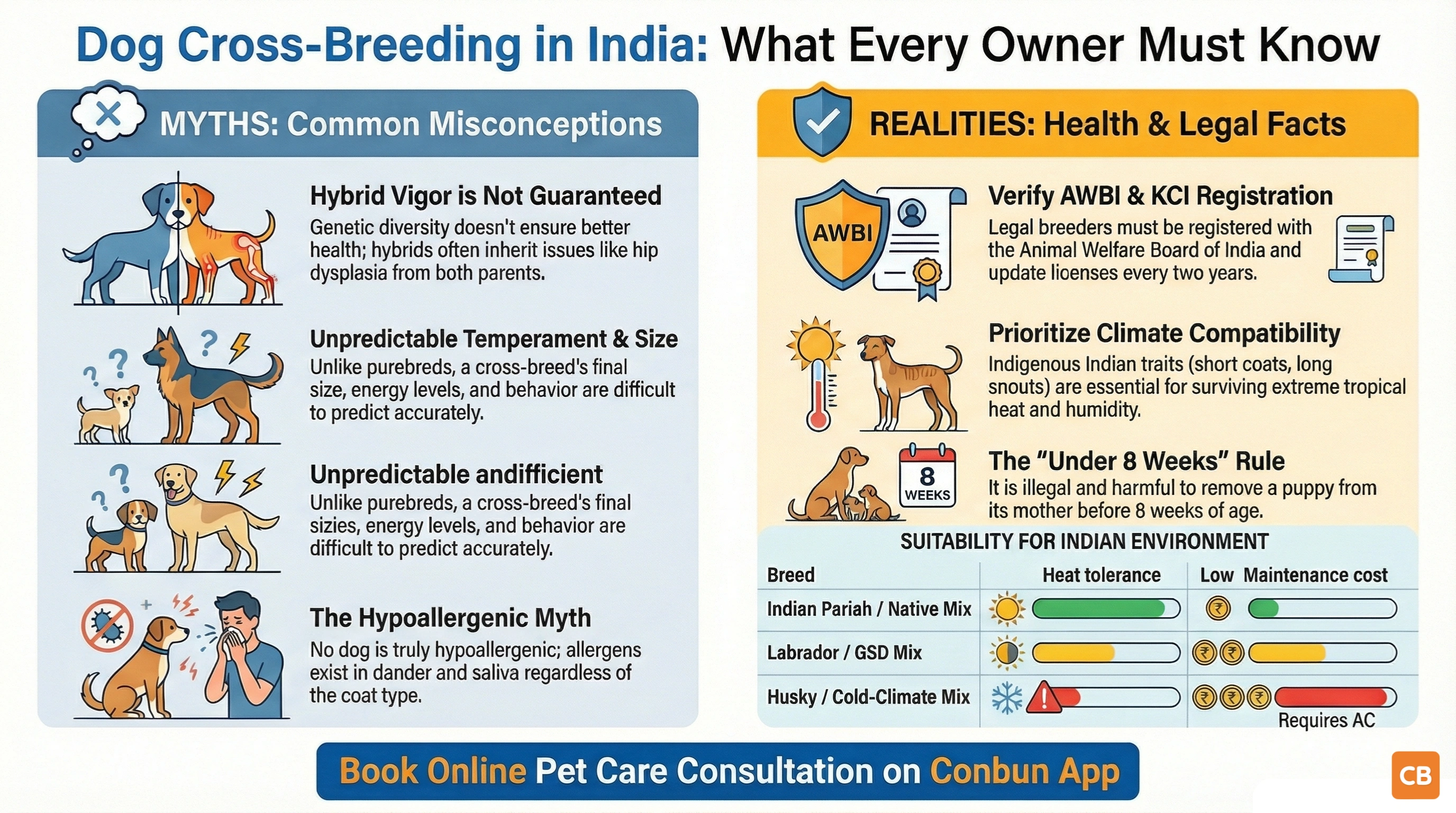
Is Hybrid Vigour Real? What Indian Dog Owners Are Getting Wrong
Let’s address the biggest selling point of cross breeding.
The Science Behind Hybrid Vigour
According to the Journal of Experimental Botany, Hybrid vigour or heterosis is a phenomenon that describes the survival and performance superiority of a hybrid offspring over the average of both its genetically distinct parents.
In simple terms, this theory believes that increased genetic diversity can reduce the chance of inherited diseases
In Theory
A Labrador × Golden Retriever cross:
May have a lower risk of certain inherited conditions like hip dysplasia.
BUT,
The offspring may be at risk of Labrador health problems like Joint Dysplasia or get heart conditions from the Golden retriever parent.
The condition for cross breeding to be successful is that both parents must be healthy and screened.
Why Hybrid Vigour Fails in India's Backyard Breeding Market
Here’s what actually happens:
Parent dogs are rarely screened for diseases
Genetic conditions go undiagnosed
Breeding is done for profit, hence there is no planning
Result?
Instead of reducing health risks, they are combined.
Expert Insight
In responsible breeding systems, hybrid vigour is not just a theory but a scientific reality. However, in India’s backyard breeding market, it is often a myth used to justify higher prices.
The Rule You Must Follow
If a breeder claims, “Cross breeds are healthier”
Ask for the health certificates for both parents, and if they refuse:
Walk away.
Most Popular Cross Breed Dogs in India and Their Health Profiles
Not all cross breeds are equal. Each combination carries: A unique health blueprint. Whether you prefer the top 10 popular dog breeds in India or a hybrid Indie, each cross bred dog carries a specific health risk profile. Knowing these before purchasing is the most important step an Indian buyer can take.
Common Cross Breeds in India
Cross Breed | Parent Breeds | Key Inherited Health Risks | India Climate Suitability |
Goldador | Labrador × Golden Retrieve | Hip/elbow dysplasia, obesity, eye conditions | Moderate, heat management needed |
Lab-Indie Cross | Labrador × INDog | Generally robust, tick-borne disease exposure from Indie genetics | Good due to Indie hardiness |
Goldendoodle | Golden Retriever × Poodle | Hip dysplasia, ear infections, and dog skin conditions | Moderate, grooming intensive |
German Shepherd × Lab | GSD × Labrador | Hip dysplasia (very high risk from both breeds), bloat | Manageable in cooler climates |
Pomeranian × Spitz | Pomeranian × Indian Spitz | Dental issues, patellar luxation, tracheal collapse | Good for India, smaller size |
Beagle × Indie | Beagle × INDog | Epilepsy (Beagle-inherited), generally hardy | Good India suitability |
Beagle × Indie | Labrador × INDog | Hip dysplasia risk from Labrador side, tick exposure | Good, Indie climate adaptation |
Climate suitability is an important factor that determines a breed's adaptability and health. Therefore, it is essential to choose dog breeds suitable for Indian climate.
India-Specific Advantage
The Indie cross-category is unique to India. According to Dailyhunt, INDogs have evolved over 15,000 years for the subcontinent’s climate. Thus, making any cross with this breed brings significant:
Climate adaptability
Disease resilience
Lower maintenance
This makes Indian Pariah Dog crosses more suitable for Indian homes
Veterinary Reality
Every cross inherits:
Not just the best traits
But also the risks
According to the Journal of comparative pathology brachycephalic breeds are at a great risk of health problems related to respiration, thermoregulation, skin and digestion.
Conbun vets strongly advise against brachycephalic crosses, Pug crosses, and Shih Tzu crosses in Indian plains climates.
Cross Breed vs Purebred Dog in India - Which Is Actually Better?
Neither cross breed nor a purebred dog is universally better. The right choice depends on lifestyle, climate, space, budget and how much predictability an Individual wants in temperament and size.
Both have advantages and real limitations in the Indian context.
Honest Comparison
Factor | Cross Breed | Purebred |
Health | Potentially better—but not guaranteed | Predictable risks |
Behaviour | Variable | Predictable |
Size | Uncertain | Consistent |
Price | ₹5k–₹40k | ₹20k–₹2L+ |
Climate Adaptability | Depends on the mix | Depends on breed |
Registration | Not available | KCI registered |
The Real Insight
Cross breeds offer: Diversity
Purebreds offer:
Predictability
The Strongest Recommendation
If you want a cross breed in India:
Adopt a mixed-breed
Because shelters are full of:
Healthy
Resilient
Loving mixed-breed dogs
Adopting also combines the benefit of genetic diversity with lower cost and the welfare of rehoming.
How to Identify Responsible Dog Cross Breeding in India (Red Flags & Green Flags)
The dog breeding market in India is highly unregulated. Identifying a responsible breeder before purchasing a dog is the most important step you should take/
Green Flags - Responsible Breeding
Health screening (hips, elbows and other genetic conditions) for both parents
Parents available for inspection
Puppies > 8 weeks old
Vaccinated and dewormed as per schedule
Written health guarantee
Willing to take puppy back
Red Flags - Backyard Breeding
Multiple “designer breeds” available
No health certificates
Parents not visible
Puppies sold too early
Cheap pricing
No medical records
No understanding of health risks
Conbun Insight
Online veterinary guidance can help owners significantly in identifying a responsible breeder. A simple 20-minute pre-purchase consultation can help you:
Ask the right questions
Identify red flags instantly
Avoid lifelong health issues and veterinary care costs
Caring for a Cross Breed Dog in India - What's Different
Caring for crossbreeds requires owners to know about dog diseases and symptoms. Cross-breed dogs in India need targeted care based on parent breed risks.
The moment you understand which parent contributes what risk, you move from reactive care to proactive health management.
Care Priorities by Breed Mix
Labrador / Golden crosses
Start joint monitoring early from the 1st 1 year
Strict weight control (high obesity risk)
Exercise only during cooler hours in Indian summers
Indie crosses
Year-round tick, flea and worm prevention is critical
Pre-monsoon parasite protocol is non-negotiable
Poodle crosses (Doodles)
Monthly at-home dog ear cleaning (infection-prone)
Grooming every 6–8 weeks
Flat-faced crosses (Pug/Shih Tzu)
AC living is essential in plains
Limited outdoor activity
Universal Care Non-Negotiables
Annual vet check + breed-risk screening
Pre-monsoon parasite update
Season-based exercise planning
Diet aligned to adult size
A quick virtual vet consultation helps personalise all of this instead of guessing.
Real Conbun Case Spotlight
Siddharth from Pune bought Raja from a breeder popular on Facebook. No records, no health screenings and the puppy was sold at just 6 weeks.
At 4 months:
Difficulty climbing stairs
Anxiety and destructive behaviours
Abnormal sitting posture
He opted for a veterinary doctor online consultation on Conbun, a pet care app.
Diagnosis:
Suspected hip dysplasia
As suggested by the veterinarian, Siddharth went from X-ray screening, which also confirmed hip dysplasia.
What Went Wrong?
No parent health screening
Early separation from mother, which led to behavioural problems in the dog.
No pre-purchase vet guidance
Key Lesson
Taking vet advice online before purchasing could have prevented this.
Takeaway
Pre-purchase vet consultation is not optional.
It’s your first and most important decision filter.
Conclusion
Cross breed dogs in India can be incredibly resilient, adaptable, and well-suited to our homes especially, if they are indie cross breeds. But assuming that they are “low-risk by default” could be a mistake. Cross breed dogs are a blend of two genetic histories. This means that your responsibility doubles, not reduces.
Before you bring one home:
Understand both parent breed risks
Verify breeder health screening
And most importantly, seek expert guidance early
A simple veterinary doctor online consultation can tell you exactly what to ask, what to check, and what to expect.
And if you’re open to it, India’s shelters are filled with exceptional cross breed dogs waiting for informed and responsible owners.
Whether you adopt, buy, or already have one, getting the health decisions right from day one matters.
Download Conbun and take right online vet advice at right time. Because you don’t just raise a dog. You raise a healthy one.
FAQ - Dog Cross Breeding India
Q1: What is dog cross breeding?
Answer. Intentional mating of two purebred dogs to produce an offspring with desirable traits from both parents.
Q2: Are cross breeds healthier than purebred dogs in India?
Answer. Not necessarily. They will be healthy if both parents are healthy.
Q3: What are the most popular cross breed dogs in India in 2026?
Answer. Goldador, Lab-Indie, Goldendoodle, Pom-Spitz are popular cross breeds in India
Q4: What health problems do cross breed dogs get in India?
Answer. Joint issues, infections, breed-specific disorders and respiratory issues are common health risks in cross breeds.
Q5: How to find a responsible breeder?
Answer. Willing to show Health tests, parents, and selling at the right age are some green flags.
Q6: Is cross breeding dogs legal in India?
Answer. Yes, but unethical breeding violates animal welfare laws.
Q7: Should I adopt a cross breed or buy one in India?
Answer. Adoption is more ethical and cost-effective.
Q8: Can I get online vet advice before buying?
Answer. Yes, use a pre-purchase virtual vet consultation for clarity before buying a cross breed.