
Why Does My Dog Do That? 15 Dog Behaviour Problems Decoded
Written by: Anand Sen; Reviewed by: Dr. Vinod Kumar Jain ( B.V.Sc & A.H )
Things usually start small. Your flip-flop goes missing. You assumed that you misplaced them somewhere, but later find its remains on the balcony, looking like it went through a mixer-grinder.
Then, the stakes start getting higher. A sofa cushion explodes while you’re out buying milk. Your dog is standing in a cotton cloud, barking at a passing activa like it’s a sworn enemy of the state. You stare at him, he stares back with a wagging tail, looking as innocent as a Tollywood hero in the first half of a movie.
“Why does my dog do that?”
Every Indian pet parent has screamed this question at least once, usually while holding a piece of what used to be a very expensive Sheesham wood dining chair.
The "Mann Ki Baat" of Dogs
Here’s the truth that vets and expert behaviorists know, but your neighbour Sharma-ji (who hates your dog) probably doesn't: Your dog isn't "bad."
They aren't taking revenge for that bath you gave them last Sunday. Its their way of communicating.
According to behavioural research published in Frontiers of Veterinary Science, 72%-85% of pet dogs exhibit at least one significant behavioural issue during their lifetime. These problematic behaviours can range from excessive barking and chewing to anxiety-related behaviors.
Your dog is rarely the problem; It’s usually their unmet physical or mental needs, inconsistent training, or misunderstood canine instincts. The Good News is that most of these behaviors have clear, science-backed causes and solutions.
So, put down the rolled-up newspaper and cancel the "Dog Hostel" inquiry. We’re going to decode the 15 most common dog behaviors and give you practical dog training tips and fixes that actually work.
1. Excessive Barking - My Dog Won’t Stop Talking
The behaviour
Dogs bark. It’s their version of WhatsApp voice notes.
However, if your dog barks excessively and constantly at noises, people, or nothing at all, it usually signals one of four things:
Boredom
Territorial alerting
Anxiety
Attention-seeking
Veterinary literature shows that barking increases when dogs lack adequate mental stimulation and structured exercise.
In simple terms: a bored dog is a loud dog.
What to do
Increase daily exercise, both physical and mental.
Teach a “quiet” cue: reward silence after barking stops.
Identify and desensitise triggers, for example, doorbells, crowding and street noises.
Avoid yelling; dogs often interpret it as the owner joining the barking.
Pro dog training tip:
Indian dogs living in high-rise apartments bark out of frustration. 30-minute walks twice a day can help you dramatically reduce nuisance barking.
2. Separation Anxiety - He Falls Apart When I Leave
The behaviour
When you grab your car keys. Your dog immediately knows, and within minutes of you leaving, neighbours report:
Nonstop barking
Scratching doors
Destruction
Whining
In addition, excessive drooling, house accidents, and food refusal are also signs your dog has separation anxiety.
According to research on canine behaviour, separation anxiety affects 20–40% of companion dogs. Dogs have co-evolved with humans as social animals for over 14000-30000+ years. Being alone can trigger genuine panic in some individuals.
What to do
Start gradual departure training, leave them for 1–2 minutes, and return calmly.
Always avoid dramatic goodbyes and reunions.
Provide long-lasting enrichment toys (like stuffed KONGs).
Use white noise or calming pheromone diffusers.
If your dog has severe separation anxiety, it may require behaviour therapy combined with veterinary-prescribed medication.
The key: teach independence slowly.
3. Destructive Chewing - Why Is Everything a Chew Toy?
The behaviour
Chewing is a completely normal behaviour in dogs as it allows them to explore the world with their mouths.
However, excessive chewing is not normal.
Your dog chooses the most expensive object in the house to chew. Shoes, furniture legs, cushions, and remote controls.
Destructive chewing often signals:
Teething (in puppies)
Boredom
Anxiety
Excess energy
Veterinary literature on dental research also confirms that chewing helps maintain oral health and stress relief in dogs.
What to do
Provide appropriate chew outlets (KONGs, nylon bones).
Try to rotate toys weekly to maintain novelty.
Increase daily physical activity
Use interactive pet toys like smart puzzle feeders and eco-rope tug toys to offer mental enrichment
Use taste deterrents like bitter apple spray on furniture to manage chewing
Proper management is key: don’t leave temptation within reach. A bored dog + unattended sofa = crime scene.
4. Leash Pulling & Leash Reactivity - Walking Him Is a Full-Body Workout
The behaviour
As soon as you start the walk, within seconds, you’re being dragged like a sledge. Leash pulling happens because your dog knows that pulling works. Dogs learn quickly that tension moves them forward.
Leash reactivity, lunging or barking at other dogs is often a result of frustration or fear.
Dogs living in urban areas experience restricted socialisation, which intensifies these reactions.
What to do
Use a front-clip harness instead of a collar.
Practice the stop-and-go method: stop walking when pulling begins.
Reward loose leash walking so that your dog can positively associate it.
Maintain distance from triggers while walking.
Walking your dog should feel like a partnership, not a tug-of-war.
5. Dog Aggression - He Growls at Everyone
The behaviour
Aggression is one of the most misunderstood dog behaviours.
Growling, snapping, or lunging can arise from:
Fear
Pain
Territorial instincts
poor early socialisation
Veterinary literature emphasises that growling is communication, not bad behaviour.
A dog that growls is saying:
“I’m uncomfortable.”
Punishing your dog actually works in a negative way and removes the signal. However, it does not curb the emotion behind it.
What to do
First rule out medical causes with a veterinary exam.
Avoid punishment or force-based training.
Use counter-conditioning and controlled exposure.
Work with a certified behaviourist if aggression escalates.
Aggression is treatable in the most aggressive dog breeds. However, it requires structured training, consistency and a predictable routine.
6. Jumping Up on People - My Dog Has No Concept of Personal Space
The behaviour
Guests enter, and your dog greets them like a furry missile.
Jumping is a natural canine greeting behaviour. Dogs greet face-to-face, unfortunately our faces are higher up.
But the real reason jumping persists?
It works. People laugh, talk, or touch the dog, which reinforces such behaviour.
What to do
Always ignore jumping, don’t make eye contact, laugh or touch your dog.
Reward the dog only when all four paws are on the ground.
Teach an alternative greeting while sitting
Ask guests to participate in the training.
Dogs tend to repeat behaviours that earn attention. Change the reward, change the behaviour.
7. House Soiling - He Was Trained. I Thought.
The behaviour
Your dog was house-trained. But suddenly, accidents start appearing. Before deeming it as bad behaviour, always rule out medical causes first.
Health conditions like urinary infections in dogs, diabetes, gastrointestinal illness, or kidney diseases can lead to sudden house soiling.
Consult a vet online through online dog behaviour consultation on the Conbun app to rule out these medical conditions.
If the vet gives a clean chit, then it's likely one of these:
Stress or change in routine
Incomplete house training
Urine marking
As stated earlier, dogs thrive on predictability. A disrupted schedule, a new pet, a new home, travel, all can trigger house accidents.
What to do
Reinstate a strict toilet schedule.
Take your dog out immediately after meals or naps.
Reward correct elimination outside.
Always clean indoor accidents with enzymatic cleaners to remove scent cues.
Punishing accidents only creates fear. House training is less about inculcating discipline and more about implementing consistent routines and enhancing communication.
8. Food Guarding & Resource Guarding - Touch His Bowl and Die
The behaviour
You reach toward your dog’s bowl. He stiffens, growls, and maybe even snaps.
This is a resource guarding behaviour, deeply ingrained in survival instincts. If seen from an evolutionary perspective, animals that protected their food lived longer.
Dogs may guard:
Food bowls
Bones
Toys
Sleeping spots
Favourite human
Studies in veterinary behavioural science suggest that resource guarding is linked to early food insecurity or competition, especially during puppyhood. However, it can also appear in otherwise well-adjusted dogs.
What to do
Never punish your dog for guarding, as it can increase anxiety and escalate aggression.
Practice “trading games”, exchange the item for something better.
In multi-dog households, feed dogs separately.
Focus on building positive associations with human presence during feeding.
The goal is simple. Your dog must associate your presence with good things, not loss of resources.
9. Fear of Loud Noises - Diwali Is His Worst Nightmare
The behaviour
As soon as fireworks explode, your dog disappears like Dr Strange disappearing with a sling ring.
Noise phobias are extremely common in dogs. Research from the Applied Animal Behaviour Science estimates up to 50% of dogs show fear responses to loud sounds.
In India, traffic, industrial machinery and fireworks, etc., are common triggers.
Signs include:
Trembling
Pacing
Drooling
Hiding
Attempts to escape
As dogs hear frequencies nearly twice the range of humans, fireworks can feel overwhelming to them
What to do
Create a safe den space in the house where your dog can relax.
Close windows and play calming background noise or white noise.
Use pressure wraps like ThunderShirts.
Provide calming chewable toys
And most importantly: Stay calm yourself. Dogs read your emotional cues.
10. Digging - He’s Excavating the Garden Again
The behaviour
Your dog is not destroying your lawn to take revenge on you for not letting him eat your socks. He is recreating ancient canine instincts.
Digging originates from:
Prey hunting
Temperature regulation
Boredom
Nest building
Many dogs like digging simply because it’s fun.
What to do
Increase physical exercise and play sessions.
Offer a designated digging zone in the garden.
Bury toys in there to encourage appropriate digging.
Block access to areas you want protected.
11. Chasing - Vehicles, Cats, Squirrels, Feet
The behaviour
A scooter passes. Your dog turns into Orion Spacecraft and launches. This is predatory chasing, part of the natural canine hunting sequence (Predatory Motor Pattern).
Some breeds demonstrate a stronger prey drive, especially herding and hunting breeds.
Urban environments can amplify this instinct because:
Fast-moving vehicles mimic prey motion
Leash restrictions increase frustration
What to do
Train your dog for a strong recall command.
Use long-line training in open spaces.
Reward attention to you when distractions appear.
Provide controlled outlets like fetch or flirt pole games.
Remember: you cannot remove prey drive.
But you can teach impulse control.
12. Mounting Behaviour - This Is Embarrassing, Please Stop
The behaviour
Your dog humps another dog. Or a pillow. Or your visiting uncle. You’ve seen this many times, and now you feel extremely annoyed.
Mounting is often assumed to be sexual behaviour, but veterinary behavioural research shows it’s also commonly linked to excitement or stress.
Triggers include:
overstimulation
play escalation
lack of social boundaries
hormonal influence
What to do
Interrupt your dog calmly and redirect them to another activity.
Increase physical exercise to reduce excess energy.
Teach impulse control commands like “settle.”
Consider spaying/neutering if this bothers you to that extent.
Embarrassing? Yes. Uncommon? Not at all.
13. Excessive Licking - He Licks Everything, Including the Wall
The behaviour
Dogs have a tendency to lick things. But excessive licking signals deeper issues. Veterinary behavioural research links compulsive licking to various causes, such as:
Allergies, ticks, fleas or worms (most common in India due to diet and weather)
Anxiety or compulsive disorder
Nausea or gastrointestinal issues (floor/wall licking specifically)
Boredom
What to do
Schedule a dog behaviour consultation online to rule out any medical condition.
Skin allergies need a proper diet and treatment.
Increase enrichment and exercise to prevent boredom.
Provide structured licking outlets like LickiMats to help soothe their anxiety.
Licking can be soothing for dogs; the goal is healthy outlets, not harmful surfaces.
14. Begging at the Table - The Eyes, The Eyes
The behaviour
You sit down for dinner. Your dog appears with those eyes. But you say no.
Five minutes later, you give in. Begging works as it is intermittently rewarded. It is considered the strongest reinforcement pattern in behavioural psychology.
What to do
Never feed your pets from the table.
Train a “place” command where the dog must relax during meals.
Offer a chew toy or puzzle toy during dinner time.
Consistency matters more than discipline. One dropped roti can undo weeks of training.
15. Zoomies & Hyperactivity - He’s Running Laps at Midnight
The behaviour
Suddenly, your dog explodes into motion. Running circles or laps. These bursts are known as FRAPs (Frenetic Random Activity Periods), commonly called zoomies, and dogs do these to release pent-up energy or excitement.
Zoomies are normal, especially in young dogs.
What to do
Ensure that your dog is getting daily exercise.
Provide mental enrichment with training games and puzzles.
Maintain structured routines.
Avoid encouraging hyperactivity indoors.
A tired dog is a well-behaved dog.
Quick Reference: 15 Dog Behaviour Problems at a Glance
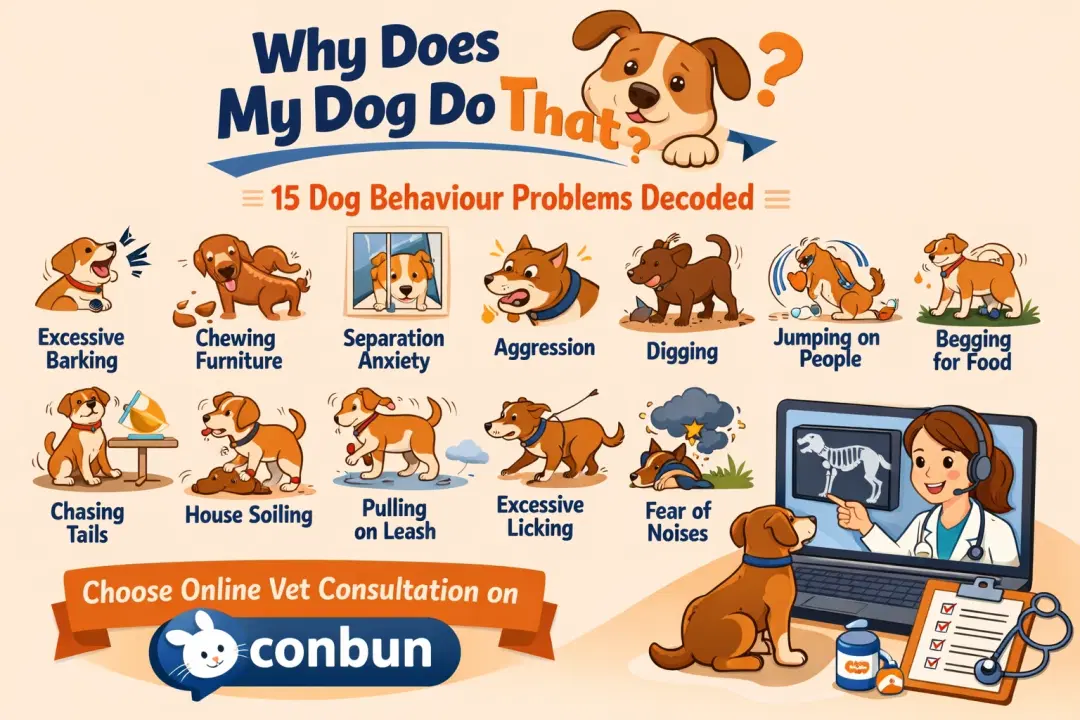
No. Behaviour ProblemPrimary CauseTop Fix1.Excessive BarkingLack of mental stimulation, fear, and territorial threat"Quiet" command + daily exercise + desensitisation2.Separation AnxietyExtreme attachment, lack of independenceGradual departure training + Stuffed KONG toys+ No dramatic goodbyes or reunions3.Destructive ChewingTeething, anxiety, boredomChew toys + increased physical and mental stimulation4.Leash PullingPulling rewarded, fear and frustrationFront-clip harness + stop and go method5.Dog AggressionPoor early socialisation, fear and painCounter-conditioning and certified Behaviorist6.Jumping UpAttention as rewardIgnore jump, teach an alternative greeting, and reward sit7.House SoilingStress, or a medical issueReinstate a toilet schedule + vet check to rule out medical conditions8.Resource GuardingNatural instinctsTrading games, separate feeding in multi-dog households9.Noise PhobiaSound sensitivity, fearSafe den + calming aids + chewable toys10.DiggingInstinct, boredomDesignated dig zone, other physical exercises11.ChasingPrey driveRecall training + Long line training in open spaces12.MountingExcitement, stressInterrupt + redirect + Spaying13.Excessive LickingAllergy, anxietyOnline veterinary exam + enrichment+ proper diet and treatment14.BeggingFood rewardZero table feeding + Chew toy during dinner time15.ZoomiesEnergy surplusExercise + mental stimulation
When Should You See a Vet or Behaviourist?
Consider a dog behaviour consultation online if:
aggression escalates suddenly
behaviour appears linked to pain
anxiety leads to self-injury
training attempts show no improvement
Many behavioural issues actually have underlying medical triggers, from thyroid imbalance to chronic pain.
A evaluation by a dog behaviourist online should be safest first step.
Top Products to Help with Dog Behaviour Problems
Here are vet-recommended tools that genuinely help:
ProductBest ForNotesThunder Shirt ClassicNoise anxietyPressure wrap; ~80% effectivenessAdaptil DiffuserSeparation anxietyDog-appeasing pheromoneKONG ClassicDestructive chewingStuff with foodPetSafe Easy Walk HarnessLeash pullingFront clip designLickiMatAnxiety reliefCalming licking activityPuzzle FeederBoredomMental enrichmentZylkeneAnxietyVet-approved supplementBitter Apple SprayFurniture chewingTaste deterrentSnuffle MatHyperactivityNose work enrichmentCalming Dog BedAnxietyEnclosed comfort design
These products are widely available on Amazon India, Heads Up For Tails, and Zigly.
The Bottom Line
Your dog isn’t trying to annoy you. He’s trying to communicate the only way he knows how.
When you see behaviour problems appearing in your dog, they’re usually clues, clues about needs, stress, instincts, or health.
Decode the message, and the solution becomes clearer.
Your dog is doing his best.
Are you doing yours?
To do your best, you need to first understand the behavioural cues your dog gives. If you are still unsure about a specific behavioural trait, expert pet behaviourists are just a tap away with Conbun.
Download Conbun android and iOS to connect with certified veterinarians and dog behaviourist online to understand your dog the way he understands you. Get expert dog training tips to prevent dog behaviour problems before they become difficult to solve.
FAQs: Your Dog Behaviour Questions, Answered
1. What are the most common dog behaviour problems in India?
Answer. Excessive barking, leash pulling, separation anxiety, destructive chewing and noise phobia are the most frequently reported dog behaviour problems in India.
2. Why is my dog suddenly aggressive?
Answer. Sudden aggression in dogs indicates fear, pain or a medical issue. An online veterinary exam should always be the first step.
3. Are calming products safe for dogs?
Answer. Most vet-approved products like pressure wraps and pheromone diffusers are safe for dogs if used correctly.
4. How do I help my dog with separation anxiety?
Answer. Enrichment toys, gradual independence training, calming aids and behavioural therapy (for severe cases) can be helpful for dogs with separation anxiety.
5. When should I see a behaviourist?
Answer. If you see severe anxiety, aggression or compulsive behaviours in your pets despite training efforts, you should consult a behaviourist to learn how to train a dog and practical dog training tips.
Table of Content
- 15 most common dog behaviors
- Quick Reference: 15 Dog Behaviour Problems at a Glance
- When Should You See a Vet or Behaviourist?
- Top Products to Help with Dog Behaviour Problems
- The Bottom Line

Anand Sen
Get Conbun in your Google results
Add Conbun as a preferred source and Google will show our vet-written guides more often in your Search results and AI answers.
Conbun – Your Trusted Pet Consult App for Dogs & Cats
Being a pet parent comes with daily questions and concerns. From sudden vomiting and itching to food confusion or unusual behaviour, every pet deserves quick and trusted care. With busy schedules and limited access to vets, finding reliable pet guidance at the right time can feel stressful. At Conbun, we make pet parenting easier with instant online vet consultations, expert advice, and trusted support for dogs and cats - all from your phone.