
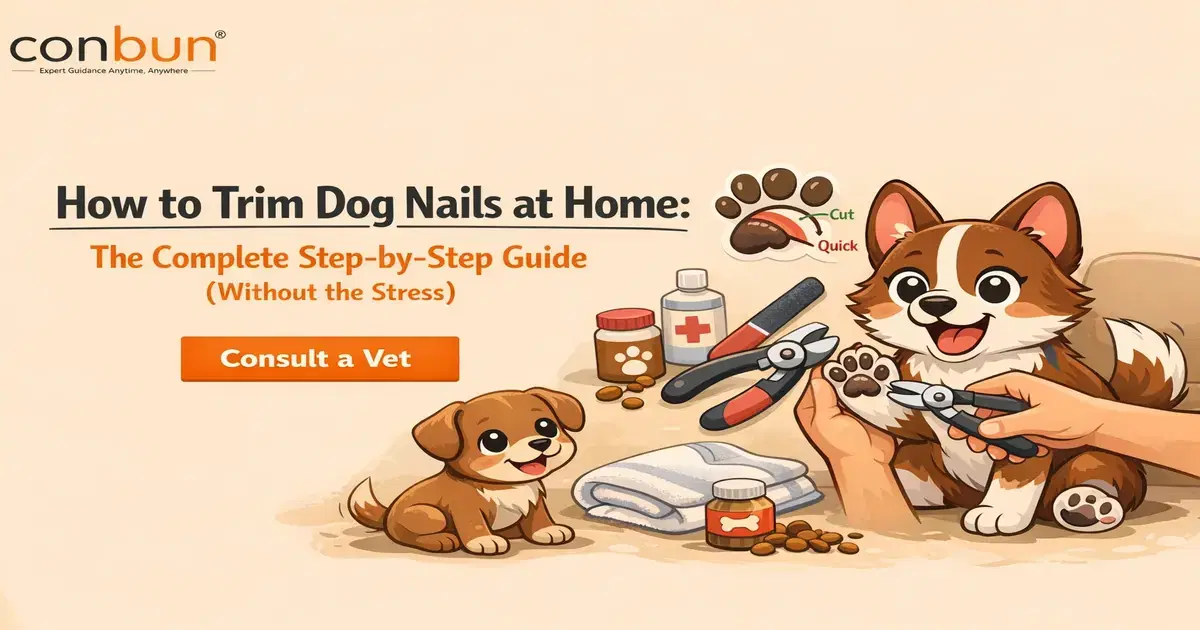
Written by: Anand Sen; Reviewed by: Dr. Ishwar Anand Senapati (B.V.Sc & A.H, M.V.Sc)
Why Nail Trimming Matters More Than You Think
If you have lived with a dog for long enough, you are probably aware of the sound.
Click.
Click.
Click-click-click.
Your dog strolling across the floor, sounding like a background dancer in Bollywood doing a tap routine. However, those paws aren't just loud. They’re a health hazard. Overgrown nails in dogs force toes to twist, leading to joint pain and “Jodon ka dard” arthritis that malish can’t fix.
A 2026 study argues that overgrown nails alter a dog’s natural paw posture, which may force the toes to twist slightly upward. Over time, this may shift weight onto joints in unnatural ways, leading to discomfort, arthritis, and even spinal strain.
But still, nail trimming is one of the most dreadful tasks, even more than a surprise visit from picky relatives. Dogs panic, you panic, and suddenly there’s “Wrestlemania” in the living room and clippers disappear mysteriously into kitchen drawers for six months.
With the right tools, technique and a little bit of patience, you can learn how to trim your dog's nails at home safely.
This guide will cover:
How often you should trim dog nails
The best tools professional groomers use
A step-by-step method for trimming safely
What to do if you accidentally cut the quick
Let’s start with the question every dog parent asks first.
How Often Should You Trim Dog Nails?
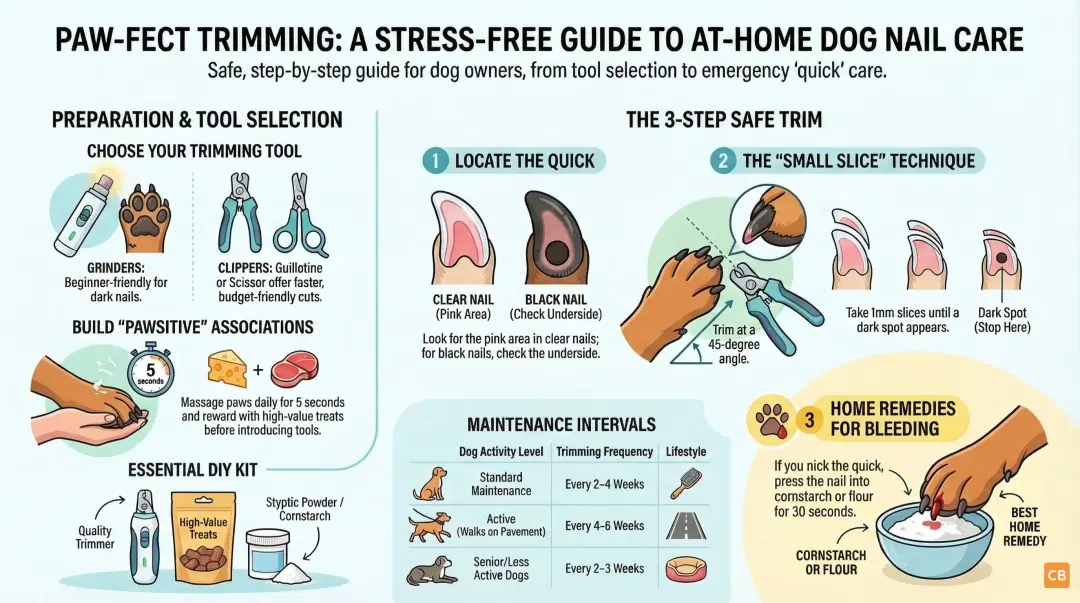
General veterinary recommendations regarding trimming dogs' nails are simple: For most dogs, nail trimming every 3-4 weeks is enough.
However, the exact timing still depends on your dog’s lifestyle.
Dogs that are physically active and walk frequently on pavement naturally wear their nails down. On the other hand, if you have a dog who likes to meditate like a Buddhist Monk and believes that walks are optional, grow claws that rival velociraptors.
Here’s an easy rule of thumb used by groomers: If you hear your dog’s nails clicking on hard floors, they’re too long.
A critical warning sign that you should watch out for is when nails begin curving downward toward the paw pad.
In extreme cases, which veterinarians unfortunately witness more often than you think, neglected nails can actually grow into the paw pad, which leads to extreme pain and infection.
Breed and age also play a critical role.
Active dogs and high-energy breeds like Border Collies need nail trimming less often. But small indoor dogs and senior dogs need more frequent nail maintenance.
Small trims done regularly are far less stressful than waiting until your dog looks like they’re auditioning for Jurassic Park.
Related Reading: Pet Care Goes Digital: How Apps Are Making Vet Consultations Faster, Cheaper & More Reliable
Tools You Need to Trim Dog Nails
If you are considering grooming guide your dog at home, gathering the right equipment is important.
Professional dog groomers view nail trimming as a tiny surgical procedure; Therefore, preparation matters.
Here are the essential tools you will need
Guillotine Clippers vs Scissors vs Grinders
Guillotine Clippers
Guillotine clippers have a loop where a dog’s nail passes through before a blade slices downward.
These work best for small to medium dogs with thinner nails.
However, they are not very suitable for dogs with thick nails in larger breeds.
Scissor Clippers
Plier-style clippers or scissors should be preferred for large dogs.
They offer better leverage and control when trimming thick nails like those of large breeds like Labradors or German Shepherds.
As per professional groomers, this is a versatile option.
Nail Grinders
A grinder is like a tiny rotary that sands down the nail.
Benefits include:
Smoother edges
Lower risk of cutting the quick
Useful for dogs afraid of the “snap” sound of clippers
The downside? Some dogs still dislike the vibration.
Styptic Powder
Styptic powder is the emergency parachute of nail trimming.
If you accidentally cut the quick (the pink area that has sensitive blood vessels inside the nail), styptic powder is an effective solution that helps stop bleeding quickly.
Veterinary clinics and dog grooming salons never trim nails without it nearby.
Treats and a Calm Environment
While this may sound less technical, it’s just as important. Offering your dog high-value treats during nail trimming sessions helps create positive associations.
Your dog’s POV should be:
“Oh great, the weird nail tool is out again, snacks incoming.”
Not:
“THIS IS SPARTA”
Related Readings: Winter Dog Grooming Guide: Prevent 30% of Skin Issues With Smart Seasonal Care
How to Trim Dog Nails Step-by-Step
This is the most important part that most owners worry about.
The good news? Nail trimming is mostly about patience and tiny cuts.
Professional groomers never remove large chunks of nail. Instead, they trim gradually.
Follow this simple method.
Step 1: Get Your Dog Comfortable with Paw Handling
Do not touch the clippers right away and start the session. Just spend a minute gently holding your dog’s paws.
Massage the toes.
Handle the nails.
One of the main reasons dogs often resist nail trims is that they’re not used to paw handling.
Being gentle with them reinforces in their heads that nothing scary is going to happen.
Step 2: Identify the Quick
As stated earlier, every dog nail has an area called the “quick” that contains tiny sensitive blood vessels.
In light-colored nails, it appears as a pink centre.
However, in dark nails, it’s hidden, which makes trimming hard. Thus, trimming gradually becomes essential.
Cutting the quick is extremely painful and causes bleeding.
Step 3: Position the Clipper at a 45-Degree Angle
Always angle the clippers slightly downward from the nail. Start trimming from the tip of the nail.
Never cut straight across near the base to save time. This technique follows the natural curve of the nail and reduces the risk of accidentally cutting the quick.
Step 4: Cut in Small Increments
This is the golden rule of nail trimming that every dog parent must follow while trimming their dog’s nails at home.
Never remove the entire length in one big snip. Instead, gradually cut the nail in very small increments.
Trim 1–2 mm at a time
Pause between cuts
Observe the nail centre
Slow trimming keeps the quick safe.
Step 5: Reward Immediately After Each Nail
This is the most important step, especially for a dog parent who wants more episodes of “the at-home nail trimming show” to air.
Rewarding your dog after each nail transforms nail trimming from a battle into a training exercise.
After each nail:
Give a treat.
Offer praise.
Pause briefly.
Dogs quickly learn that nail trims bring good things. And that’s a technique with which groomers manage even nervous dogs.
Related Readings: Is Online Pet Care Consultation Right for Your Pet?
How to Trim Dark or Black Dog Nails
Dark nails are where most dog owners lose confidence in at-home dog nail trimming. While with light-colored dogs, “the quick” is visible, it’s hidden with black nails. This makes nail trimming feel like defusing a tiny bomb.
However, professional groomers generally rely on a simple trick, which they call the “chalk ring” method.
Trim small portions of nail at a time, approximately 1-2 mm and examine the freshly cut surface every time. At first, you’ll notice that the nail will look chalky and dirty. But as you approach the depth of the nail, you’ll notice a slightly moist or small grey oval appearing in the centre. This is the signal to stop.
Another helpful trick you can use is shining the nail under a flashlight. This reveals the internal structure. This is best for thinner nails.
What to Do If You Cut the Quick
Even experienced groomers occasionally nick the quick. In such situations, the key is to stay calm, as dogs react more to our panic than to the actual injury.
If bleeding occurs:
Apply styptic powder immediately to the nail tip.
Hold gentle pressure for 2–3 minutes.
Keep your dog calm and still.
Styptic powder helps in the rapid clotting of the blood. If you don’t have Styptic powder, cornstarch, or flour can also be used as a temporary solution.
Most quick cuts look dramatic, but stop bleeding quickly.
If bleeding continues for more than 10 minutes and your dog appears unusually distressed, contact your veterinarian. While a physical visit to a veterinarian is advised, you can also connect to a certified veterinarian through online pet care consultation on the Conbun app to understand dressing and medication options if the situation is not serious.
A quick nick may be painful and unpleasant, but it is rarely dangerous.
How to Desensitize a Dog Who Hates Nail Trims
While most dogs will be just fine if you use the above-described techniques and tools for dog trimming. Some dogs treat nail clippers like they’re instruments of medieval torture.
Owners mistake this reaction as stubbornness. But it’s generally a conditioned fear response, which is often a result of one bad trimming experience.
The solution for this is counter-conditioning, not forcing the trim.
Follow this gradual desensitisation plan:
Week 1: Paw Handling Only
Ignoring early socialization is one of the most common puppy training mistakes owners make. Start handling your puppy in the initial weeks to make the habituated to grooming.
During the first week, spend time touching your dog’s paws daily during playtime and relaxed moments. Reward their calm behaviour with treats.
Week 2: Introduce the Clippers
Introduce the clipper and allow your dog to sniff them. Offer treats, rewards and praises so that they associate clippers with positive experiences. Do not start trimming yet.
Week 3: Practice One Nail
Trim a single nail per session and reward generously.
Week 4: Build Toward a Full Trim
Gradually increase the number of nails trimmed per session.
Veterinary behavior studies suggest that slow positive exposure dramatically reduces grooming anxiety in dogs.
Eventually, your dog learns that nail trimming is simply another routine, not a crisis.
Related Readings: Online Vet Consultation vs Clinic Visit in India - Real Cost Comparison
Final Thoughts
Dog nail trimming at home is one of those dog-care tasks that feels intimidating until you understand the mechanics behind it.
If done regularly with care and generosity, it’s quick, safe, and incredibly beneficial for your dog’s long-term health. Proper nail length helps them maintain natural posture, healthy joints, and comfortable movement.
Remember the essentials:
Trim every 3–4 weeks
Use the right tools
Cut in small increments
Reward generously
And if your dog absolutely refuses to cooperate, there’s no shame in asking for help from a professional groomer or a veterinarian online through the Conbun android and iOS app. Just one online pet care consultation, and your dog’s grooming anxiety will vanish for life.
After all, the goal isn’t to prove bravery with nail clippers.
The goal is to have a dog who can walk comfortably, without sounding like they’re tap dancing across the kitchen floor.
FAQs (People Also Asked)
1. How often should I trim my dog's nails?
Answer. For most dogs trimming nails every 3–4 weeks is enough. If you hear a clicking sound on hard floors, they're overdue. Dogs that are active physically or those that walk on pavement may need trimming less often.
2. What happens if I never trim my dog's nails?
Answer. If you never trim your dog's nails, they can overgrow and curl under the paw, cause pain, alter gait, and lead to joint issues. In extreme cases, they grow into the paw pad, which requires vet care.
3. How do I find the quick in dark nails?
Answer. Practice the chalk ring method or shine a flashlight under the nail and cut 1–2mm at a time. Stop when you see a small grey or pink oval in the centre. This means that you're close to the quick.
4. What do I do if I cut the quick?
Answer. Apply styptic powder or cornstarch (if that’s not available) immediately and hold gentle pressure for 2–3 minutes to stop the bleeding. Keep the dog calm, and if bleeding doesn't stop within 10 minutes, consult your vet for the next steps.
5. Is a nail grinder better than clippers?
Answer. Grinders offer a smoother finish. They are great for dogs who hate the snapping sound of clippers. However, they are slow and make trimming sessions longer. They can also cause vibration sensitivity.
6. At what age can I start trimming my puppy's nails?
Answer. Trimming nails can be started as early as 3–4 weeks. Introduce clippers around 8 weeks. Early habituation is effective for preventing nail-trim anxiety as an adult.
7. Can I use human nail clippers on my dog?
Answer. Only for very small puppies or tiny toy breeds. For adult dogs, always use clippers designed for pets; they're angled correctly for the shape and thickness of dog nails.
8. How do I get my dog to stop fighting nail trims?
Answer. Use counter-conditioning. Touch paws daily during playtime. Introduce clippers with treats, clip one nail per session initially and try to build positive associations over 2–4 weeks before attempting a full trim.