.webp)
Written by: Anand Sen; Reviewed by: Dr. Iswar Anand Senapati
Meera adopted a two-month-old kitten from a shelter in Pune. She bought toys, a soft bed, tiny bowls and even an automatic cat feeder, which the kitten completely ignored.
But she skipped the vet visit.
“She's indoors,” Meera thought. “What’s the risk?” A common misconception that many new pet owners in India have.
Just two weeks later, the kitten stopped eating, developed a high fever and upon diagnosis it was revealed that she had feline panleukopenia, a serious viral condition that feline veterinarians across India still see far too often in unvaccinated kittens.
This is the reality of many first-time cat parents. They are unsure:
When should vaccines start for cats?
Which vaccines are actually necessary?
How much do cat vaccines cost in India?
And whether indoor cats even need vaccination?
The following cat vaccine guide offers a complete cat vaccination schedule in India, clearly and practically.
Cat Vaccination Schedule in India
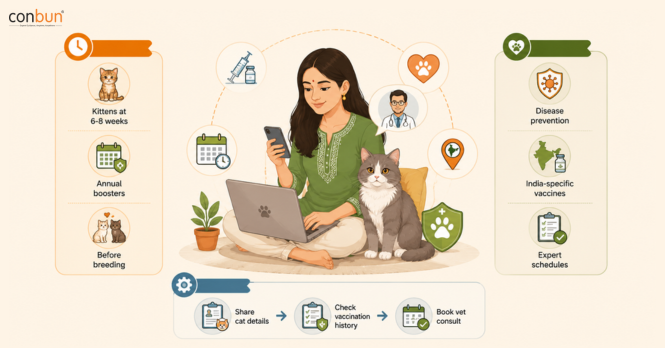
Vaccination is a crucial part of preventive care. Kittens need 3 doses of the CRP/FVRCP vaccine starting at 6–8 weeks of age, plus 2 anti-rabies vaccines completed by 16–18 weeks. Adult cats require annual booster vaccines. Total cat vaccine cost in India typically ranges from ₹2,000–₹6,000 for kittens and ₹1,200–₹2,400 annually for adults.
Why Cat Vaccination Matters in India
Many cat owners in India have a belief that indoor cats are automatically safe. But, as per veterinarians, this is not true.
According to guidelines from the World Small Animal Veterinary Association and The Journal of Feline Medicine and Surgery, indoor cats remain exposed because viruses travel through:
Shoes
Clothing
Food
Formites
Hands
Shared environments
In addition, climatic conditions in India create an especially difficult environment for infection control.
Why India Increases Risk
Three major factors increase infectious disease spread among cats in India:
1. High Stray Cat Population
Community or stray cat populations frequently carry:
Feline panleukopenia (FPV)
Calicivirus
Herpesvirus
These viruses continuously circulate through urban areas.
2. Tropical Climate
Humid, warm conditions allow viruses to survive longer on:
Floors
Food bowls
Outdoor surfaces
The feline panleukopenia virus, a condition similar to parvovirus in dogs, is especially resistant to environmental conditions.
3. Rabies Risk
India bears the highest rabies burden in the world. As per the WHO, around 18000-20000 people die from rabies annually in India.
Although it is commonly transmitted through dog bites, cats can also:
Contract rabies
Transmit it to humans
This makes rabies vaccine protocols in cats critically important.
Important Note for Indoor Cat Owners
Feline herpesvirus and calicivirus can survive on contaminated surfaces for days.
Meaning: Your cat never has to “go outside” to be exposed.
Thus, vaccination is not about lifestyle alone. It’s about risk reduction. It doesn't matter if you have a feral cat or the most popular breed, harmful pathogens do not discriminate. So, getting vaccinated your cat is a smarter and safer option.
Core Vaccines for Cats in India
In India, veterinarians consider two vaccines to be “core,” meaning every cat should receive them regardless of breed and their indoor/outdoor status as it is a crucial part of cat preventive care.
A. CRP Vaccine (FVRCP Cat Vaccine)
The FVRCP cat vaccine protects against three major diseases:
Feline Rhinotracheitis (FHV-1)
A feline herpesvirus infection causing:
Sneezing
Eye discharge
Fever
Chronic respiratory disease
If infected severely at a young age, kittens can develop lifelong flare-ups.
Feline Calicivirus (FCV)
This virus causes:
Mouth ulcers
Drooling
Respiratory symptoms
Fever
Some aggressive strains trigger severe systemic disease and may also compromise lifelong immunity.
Feline Panleukopenia (FPV)
This is one of the deadliest feline diseases. As per the Journal of Veterinary Medicine, panleukopenia is highly fatal in unvaccinated kittens, with the clinical symptoms ranging from subclinical infections to a peracute syndrome with sudden death.
It attacks:
Bone marrow
White blood cells
Intestinal lining
Leading to:
Bloody diarrhea
Immune collapse
And unlike bacterial infections, there is no direct cure. Only supportive treatment.
B. Anti-Rabies Vaccine (ARV)
Rabies remains 100% fatal after symptoms begin. That applies to:
Humans
Cats
Dogs
The rabies vaccine protocols used in India today are designed for both animal and public health protection. Even senior cats should continue receiving annual boosters.
What about the FeLV Vaccine?
The Feline Leukaemia Virus vaccine is less commonly available in India, but may be recommended for:
Outdoor cats
Multi-cat homes
Shelter rescues
Typical cost:
₹400–₹800 per dose. Often free/subsidized at government veterinary hospitals.
Cat Vaccination Schedule in India - Kitten (6 Weeks to 16 Weeks)
Kittens are not born fully protected. They initially rely on maternal antibodies from their mother’s milk.
The problem? Those antibodies eventually fade, and during that transition period, kittens become extremely vulnerable.
That’s why kitten vaccination schedules are similar to dog vaccination schedules in India, requiring multiple doses.
Standard Kitten Vaccination Schedule
Age | Vaccine | Purpose |
6–8 weeks | CRP/FVRCP Dose 1 | Starts protection |
10–12 weeks | CRP Dose 2 + Rabies Dose 1 | Strengthens immunity |
14–16 weeks | CRP Dose 3 + Rabies Dose 2 | Completes primary series |
12 months later | Annual booster | Maintains protection |
Why Multiple CRP Doses Are Needed
Maternal antibodies interfere with vaccine response early in life. This implies that one vaccine dose is never enough.
Boosters improve immune memory as maternal protection declines. Veterinary immunology research strongly supports this staged approach.
Deworming Before Vaccination Matters
Always deworm kittens: 7-10 days before vaccination.
Why? Heavy parasite loads weaken immune response and reduce vaccine effectiveness.
Deworming typically costs:
₹50–₹300 in India.
What Happens If You Miss a Vaccine?
Missing a booster can significantly impact immunity. A kitten receiving only one CRP vaccine remains incompletely protected against:
Panleukopenia
Calicivirus
Herpesvirus
This is one of the most common mistakes veterinarians see after adoption.
Cat Vaccination Schedule in India - Adult Cats
Adult vaccination is simpler, but still essential. If your cat has completed the kitten series, during adulthood, they require:
Annual CRP booster
Annual rabies booster
As generally recommended by most Indian veterinarians.
What If the Cat Was Never Vaccinated?
Very common with:
Rescue cats
Stray adoptions
Shelter adoptions
In those cases, veterinarians usually follow an adult cat vaccination catch-up protocol:
Two CRP doses (30 days apart)
One rabies vaccine alongside the second CRP
Annual boosters afterwards
Is It Too Late to Vaccinate an Older Cat?
No. Vaccinations can begin at any age if the cat is healthy enough.
Most veterinarians first perform:
Basic physical exam
Temperature check
General health assessment
Before beginning the schedule.
Why Adult Boosters Matter
Immunity is not always lifelong.
According to feline vaccination literature:
Protection gradually declines over time
Booster schedules maintain immune memory
Skipping boosters for years increases infection risk substantially.
Cat Vaccination Cost in India
The biggest surprise for many cat owners?
Vaccinations are usually far cheaper than treating the disease it prevents. And dramatically less traumatic. Also, there are no costs or suffering involved.
Average Cat Vaccine Cost in India
Vaccine | Cost Per Dose |
CRP / FVRCP | ₹500–₹1,000 |
Anti-Rabies | ₹250–₹500 |
FeLV (if available) | ₹400–₹1800 |
Estimated Total Costs
Kitten Vaccination India Cost
Vaccination costs for kittens in India usually range from ₹2,000 to ₹6,000.
Depending on:
City
Clinic type
Vaccine brand
If you choose to go with government veterinary clinics, these costs can be significantly reduced.
Adult Annual Booster Cost
Typically, the cost of annual boosters is ₹1,200–₹2,400 yearly.
Affordable Vaccination Options in India
Government veterinary hospitals often provide vaccination for free of cost or offer subsidized. Many NGOs and adoption drives in cities like:
Mumbai
Bengaluru
Delhi
Hyderabad
Focus on organising low-cost or free vaccination camps periodically.
Important Tip
Always request: A vaccination card. It becomes critical for:
Booster reminders
Boarding facilities
Travel records
Emergency veterinary history
And honestly, it is one of the simplest ways to protect your cat from diseases that are still frighteningly common across India.
Vaccine Side Effects in Cats - What Is Normal and What Is Not
Most cats can tolerate vaccines extremely well. In fact, severe reactions against vaccinations are uncommon. But mild post-vaccine changes?
Very normal. Vaccines generally work by stimulating the immune system. Temporary fatigue and soreness may happen for 24-48 hours.
Common (Normal) Vaccine Side Effects
You may observe the following side effects in your cat after vaccinations:
Mild lethargy
Sleeping more than usual
Slight fever
Reduced appetite
Small lump at the injection site
The lump often disappears within 1–2 weeks.
According to feline vaccination guidelines from the American Association of Feline Practitioners, these mild reactions are expected signs of immune activation.
Side Effects That Need Immediate Vet Attention
Contact a veterinarian immediately if you see the following signs:
Facial swelling
Difficulty breathing
Persistent vomiting
Extreme lethargy/ inability to get up
Collapse
Visible/large swelling at the site of the injection
These reactions are very rare, but you should take them seriously if you see them.
About Vaccine-Associated Sarcoma (VAS)
In feline medicine, one of the most discussed vaccine-related concerns is vaccine-Associated Sarcoma.
It is a kind of tumour that develops at injection sites. It is very rare, but the complete surgical removal is very difficult.
Modern non-adjuvanted vaccines have significantly reduced the risk of VAS, which is why many veterinarians now prefer them.
A useful rule veterinarians follow: If there is a lump that has lasted beyond 3 weeks, it should be examined.
When Online Consultation Helps
Post-vaccine symptoms may lead to panic, especially in first-time cat owners. A veterinary consultation online can be useful in determining:
What is normal
What needs monitoring
When immediate clinic care is necessary
For mild side-effects and vaccine-associated symptoms like lethargy or appetite reduction, an online veterinary consultation is often sufficient.
When Cat Vaccines May Not Work - Limitations to Know
Vaccines are highly effective. But keep in mind that they are not magical force fields. There are situations where protection becomes incomplete or weaker than expected.
1. Missed Kitten Boosters
Skipping a dose in the kitten series can lead to serious complications. Kitten bodies are vulnerable during their development stage, and thus, the immune system needs continued exposure during this period. One incomplete vaccine round can leave gaps in immunity.
2. Sick or Malnourished Cats
Cats fighting fever, parasites, and severe malnutrition may often develop weaker vaccine responses. For this reason, veterinarians recommend deworming first and vaccinations next.
3. Poor Vaccine Storage
Vaccines are temperature-sensitive. Improper refrigeration can reduce the effectiveness significantly. This is one reason reputable clinics matter. This is one of the reasons many pet parents prefer reputed clinics instead of government vaccination centres.
4. Delayed Annual Boosters
In cats, immunity fades gradually over time. A cat vaccinated “years ago” may no longer have adequate protection. This makes boosters extremely important.
5. Immunocompromised Cats
Cats with:
FeLV
FIV
Severe chronic illness
May not develop full immune protection even after vaccination.
Important Clarification About FVRCP
The FVRCP cat vaccine does not always prevent infection completely.
Instead, it often:
Reduces severity
Reduces complications
Shortens recovery time
Which is still extremely valuable clinically.
Is Overvaccination a Risk for Cats?
Yes. Responsible veterinarians have always acknowledged this concern. Vaccinating a cat too frequently does not offer any extra protection.
Adequate immunity, not excessive stimulation, should be the goal.
What Current Veterinary Literature Says
The World Small Animal Veterinary Association supports extending some booster intervals internationally.
However, many veterinarians in India advocate for annual schedules because:
Disease exposure is higher
Stray animal density is higher
Environmental contamination risk remains elevated
Potential Problems with Excessive Vaccination
Repeated unnecessary vaccination may contribute to:
Chronic inflammation
Injection-site reactions
Immune-mediated disease risk
While these are uncommon, a cat may still develop these.
What Is Titer Testing?
A titer test measures the current antibody levels. This helps understand whether immunity is still present. Titer testing, while not routine in most Indian veterinary clinics, is becoming more and more available in larger cities.
When to Visit a Vet in Person vs When Online Consultation Is Fine
The inception of veterinary telemedicine is changing feline care dramatically.
Many cat owners today first seek guidance from online pet doctors before visiting clinics. And practically, this approach can be very effective if used correctly.
Visit a Veterinary Clinic in Person For:
First kitten vaccination
Severe vaccine reaction
Persistent fever after vaccination
Large swelling at the injection site
Extremely weak or dehydrated cats
And most importantly, whether the vaccines for dogs or cats must always be administered by a licensed veterinarian.
Online Veterinary Doctor Consultation Is Suitable For:
Understanding the cat vaccination schedule India follows:
Clarifying missed booster timing
Discussing post-vaccine lethargy
Planning vaccination catch-up schedules for rescue cats
Deworming guidance before vaccination
An online veterinary doctor consultation can be especially useful for:
First-time pet parents
Owners in smaller cities
Cats stressed by travel
Why Online Consultation Helps Cats Specifically
Cats often experience significant travel anxiety.
Many develop:
Stress vomiting
Fear aggression
Rapid breathing during transport
For non-emergency vaccine questions, an online pet doctor consultation can reduce unnecessary stress.
What Online Vets Cannot Replace
Teleconsultation cannot replace:
Physical examination
Vaccination administration
Emergency treatment
Think of it as emergency guidance, not emergency treatment.
Real Scenarios - What Indian Cat Owners Ask
Scenario 1: I Adopted a Street Kitten at 6 Weeks
Start the kitten vaccination schedule in India immediately. Do not wait for the kitten to “grow stronger.” Maternal immunity fades quickly at this age.
Scenario 2: My Adult Rescue Cat Has No Vaccine Records
Treat the cat as unvaccinated. Veterinarians usually recommend:
2 CRP doses
1 rabies vaccine
Annual boosters afterwards
Scenario 3: My Cat Was Sick During Vaccine Time
Never vaccinate a visibly ill cat. Wait until:
Appetite returns
Fever resolves
Energy normalizes
Then restart according to veterinary advice.
Scenario 4: My Cat Scratched Someone
If rabies vaccination is current, the risk is extremely low. Still, the injured person should consult a physician immediately. Always keep vaccine records accessible.
Conclusion
Cat vaccination in India is not complicated once you understand the schedule.
The important thing is consistency.
Remember These Core Points
Start vaccinations at 6-8 weeks
Complete all kitten boosters
Rabies vaccination matters, even for indoor cats
Deworm before vaccination
Annual boosters remain important in India
Mild side effects are normal; severe reactions need immediate care
And perhaps most importantly:
Vaccination is far easier than treatment.
Far cheaper than hospitalisation.
And infinitely less painful than losing a preventable life.
Not Sure About Your Cat’s Vaccine Schedule?
An online veterinary doctor consultation can help clarify:
Which vaccines does your cat need
Booster timing
Missed dose catch-up plans
Post-vaccine concerns
If you are a first-time cat owner, speaking with an online pet doctor is among the easiest ways to build a safe vaccination plan before you visit a clinic.
FAQs (People Also Asked)
Q. 1: What is the first vaccine given to kittens in India?
Answer: FVRCP or CRP is the first vaccine given to kittens at 6-8 weeks of age. It offers protection against feline Calcivirus, Rhinotracheitis, and Panleukopenia. The anti-rabies vaccine starts at the second visit (around 10-12 weeks).
Q. 2: Is cat vaccination mandatory in India?
Answer: While there is no central law that makes cat vaccinations mandatory across India, rabies vaccination is legally mandated in several cities and states. More important than legal requirements, it is essential for your cat’s health, and it is also a public health responsibility.
Q. 3: How long does a cat vaccine last?
Answer: Kitten vaccine series builds immunity that lasts roughly one year. Annual boosters maintain protection. International guidelines allow CRP boosters every 3 years in adults, but Indian vets generally recommend annual boosters due to heavy disease risk. Rabies boosters are to be administered annually.
Q. 4: Can I give my cat the vaccine at home?
Answer: No. Vaccines must always be administered by a licensed veterinarian. Improper injection technique or incorrect storage makes vaccines ineffective or even harmful in some cases. In-clinic vaccination also allows vets to monitor for allergic reactions.
Q. 5: What if I miss a booster date by a few weeks?
Answer: Missing by 2-4 weeks is usually fine. Just get the booster as soon as possible without restarting a series. However, if missed by several months, you may be required to restart the two-dose adult series. Always consult a vet rather than skipping the booster shot entirely.
Q. 6: Do cats need vaccines for cat flu?
Answer: Cat flu is the result of feline herpesvirus (FHV-1) and calicivirus, both of which are covered by the CRP/FVRCP vaccine. So yes, the standard vaccination schedule protects your cat against the flu.