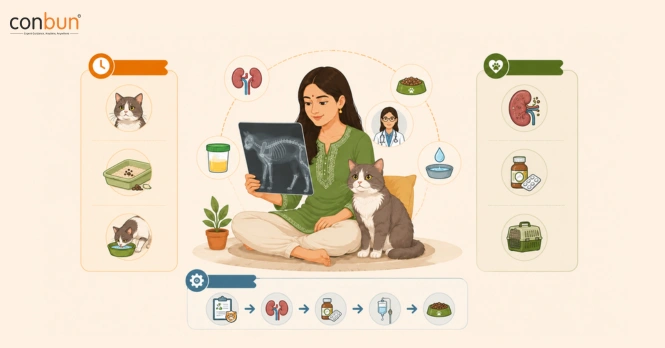
Reena, a cat owner from Pune, noticed her 8-year-old Persian cat Mochi was spending a suspiciously long time beside her water bowl. At first, she blamed the summer heat. Then she stopped eating, one who inhaled meals like a vacuum cleaner.
A few weeks later, weight loss became obvious, her cat was vomiting repeatedly, and the coat lost its fluffy shine.
Blood tests confirmed that it was stage 3 chronic kidney disease. And unfortunately, this story is painfully common.
Kidney disease is one of the most frequent and most overlooked conditions veterinarians diagnose in older cats across India. Cats are masters of subtle suffering. They rarely limp dramatically or cry loudly. Instead, they quietly stop doing tiny things like grooming, eating enthusiastically or jumping to favourite spots.
And by the time kidney disease becomes obvious, significant kidney damage has often already developed. But the good news is that early detection can influence health outcomes significantly.
With proper diet, hydration, monitoring and veterinary support, many cats with chronic kidney disease (CKD) continue living comfortably for years. The following article will explain the early warning signs, causes, diagnosis, and realistic long-term management for Indian cat owners.
What Is Cat Kidney Disease?
The kidneys are tiny multitasking overachievers.
They:
- Filter waste from blood
- Balance fluids
- Regulate blood pressure
- Support red blood cell production
- Maintain electrolyte balance
With the decline of kidney function, waste products begin accumulating inside the body, which slowly affects nearly every organ system in a cat’s body.
There are two major forms of kidney disease in cats.
Chronic Kidney Disease (CKD)
Chronic kidney disease in cats is a progressive condition where the kidneys gradually lose their ability to filter waste products properly. It is especially common in senior cats and requires long-term management through diet, hydration, medication, and regular veterinary monitoring.
It is the most common kidney-related condition in cats, which develops gradually over months to years. Usually affects cats over 7 years old. Chronic kidney disease in dogs is fundamentally the same as that in cats, as it cannot be cured, but it can often be managed long-term.
Acute Kidney Injury (AKI)
According to the Journal of Feline Medicine and Surgery, Acute Kidney Injury may develop due to several causes, including ischemia, toxins, infection, neoplasia, obstruction or the effects of sepsis.
This clinical condition develops suddenly and is commonly triggered by:
- Lily toxicity
- Antifreeze poisoning
- Severe dehydration
- Certain medications
AKI is a life-threatening condition and requires immediate and aggressive intervention.
Early Signs of Kidney Disease in Cats: What to Watch For
Early signs of kidney disease in cats are easy to miss, as they rarely announce illness dramatically. Instead, you have to notice small behavioural and physical changes.
Drinking More Water Than Usual
One of the earliest signs of kidney disease in cats is that they might start spending more time near their water bowl. As kidneys lose concentration ability, cats compensate by drinking more.
Owners often notice:
- Empty water bowls faster
- Increased interest in taps
- Cats seeking cooler water sources
Many Indian owners mistake this for: Just summer dehydration. Sometimes it is not.
Urinating More Frequently
More drinking usually means more urination.
Some cats begin:
- Missing the litter box
- Urinating larger volumes
- Visiting the tray more often
Do not immediately assume behavioural problems. Kidney disease should always be ruled out first.
Appetite Loss and Weight Loss
As kidney function in cats declines, waste starts accumulating. Waste buildup causes:
- Nausea
- Reduced appetite
- Food aversion
Cats may:
- Sniff food and walk away
- Eat dramatically less
- Lose muscle along the spine and hips
And because cats wear fur like tiny deceptive sweaters, Weight loss often hides until advanced stages. Cats may also have a fever, which is not a direct symptom of chronic kidney disease (CKD) itself, but it can occur if your cat has a concurrent infection
Vomiting and Lethargy
Occasional vomiting happens in healthy cats. Repeated vomiting combined with:
- Sleeping more
- Hiding
- Reduced playfulness
Extreme lethargy is a serious red flag and is a sign that you should rush your pet to the vet.
Bad Breath with an Ammonia Smell
Bad breath with an ammonia-like smell is one of the more specific signs veterinarians look for if they suspect kidney disease in cats. Advanced CKD often causes: Uremic breath.
Owners describe it as:
- Metallic
- Chemical
- Urine-like
This happens because urea accumulates in the bloodstream.
Poor Coat Quality
Healthy cats groom obsessively. A dull or greasy coat usually means: The cat feels unwell enough to stop self-care.
And cats are meticulous creatures. When grooming stops, something is wrong.
Causes of Kidney Disease in Cats
CKD rarely develops from a single cause. Usually, multiple factors slowly damage kidney tissue over time.
Age-Related Degeneration
The most common cause. Kidney function naturally declines as cats age, especially after 7–8 years.
Chronic Dehydration
Very important in India. Many cats eat: Dry kibble only.
Cats naturally have low thirst drive because they evolved from desert animals. Chronic mild dehydration over the years stresses the kidneys significantly.
Infections
Kidney infections like pyelonephritis may develop after:
- Urinary tract infections
- Untreated bladder inflammation
Toxin Exposure
Cats are extraordinarily sensitive to toxins. Dangerous triggers include:
- Lily plants
- Antifreeze
- Ibuprofen
- Vitamin D overdose
- Certain human medications
India-Specific Emergency: Lily Toxicity
Lilies are extremely toxic to cats and can be fatal. Ingestion, even in tiny amounts like licking pollen from fur or chewing a leaf or drinking vase water, can lead to rapid kidney failure in cats.
Lilies are extremely common in:
- Bouquets
- Religious rituals
- Decorative arrangements
And every part of the plant is toxic. Even: Pollen or vase water exposure can trigger acute kidney failure.
According to toxicology references from the Merck Veterinary Manual, treatment delays beyond 18–24 hours drastically worsen survival chances.
How Is Cat Kidney Disease Diagnosed?
Kidney disease diagnosis relies on blood tests, urine analysis, blood pressure assessment, and imaging. SDMA testing helps detect kidney dysfunction earlier than traditional creatinine measurements.
Veterinarians diagnose CKD using:
- Bloodwork
- Urine testing
- Clinical signs
- Imaging when necessary
Blood Tests
Key markers include:
Creatinine
Rises after significant kidney function loss.
BUN (Blood Urea Nitrogen)
Another waste marker is elevated in kidney dysfunction.
SDMA
Symmetric Dimethylarginine (SDMA) is a newer and more sensitive marker used to evaluate kidney function.
According to an article published in the Journal of Veterinary Internal Medicine, SDMA may detect kidney dysfunction 17 months earlier than creatinine. Ask your veterinarian whether SDMA testing is available.
Urinalysis
One of the earliest abnormalities: Dilute urine. Healthy kidneys concentrate waste effectively. Diseased kidneys cannot.
Ultrasound
Ultrasound helps assess:
- Kidney size
- Shape
- Structural damage
Small, irregular kidneys often indicate chronic disease. Advanced imaging is available in metro cities like Mumbai, Delhi, Bengaluru and Hyderabad. There is still an access gap in veterinary imaging in tier 2 and 3 cities.
Stages of Chronic Kidney Disease in Cats (IRIS Scale)
Veterinarians classify CKD using the International Renal Interest Society (IRIS) staging system.
|
IRIS Stage |
Creatinine Level |
Meaning |
|
Stage 1 |
<1.6 mg/dL |
Early disease |
|
Stage 2 |
1.6–2.8 mg/dL |
Mild-moderate |
|
Stage 3 |
2.9–5.0 mg/dL |
Significant symptoms |
|
Stage 4 |
>5.0 mg/dL |
Severe/end-stage |
Most Indian cats are diagnosed at Stage 2 or 3. Usually, because early signs were missed. Regular bloodwork after age 7 changes this dramatically.
Long-Term Care for Cats with Chronic Kidney Disease
A CKD diagnosis is frightening. But it is not hopeless. Many cats continue living happily for 2–4 years or longer with proper management.
The four pillars of care are:
- Diet
- Hydration
- Medication
- Monitoring
Diet: The Biggest Game-Changer
Renal diets matter enormously. Key goals:
- Lower phosphorus
- Controlled high-quality protein
- Increased moisture
Prescription diets available in India include:
- Royal Canin Renal
- Hill’s k/d
- Purina NF
If cats refuse prescription diets (and many do dramatically, because cats are tiny, opinionated food critics), Transition gradually.
Hydration Matters More Than Most Owners Realise
Helpful strategies:
- Wet food instead of only kibble
- Multiple water bowls
- Water fountains
- Low-sodium broth additions
In advanced stages, veterinarians may recommend subcutaneous fluids at home. Yes, it sounds intimidating initially. Most owners adapt surprisingly quickly.
Medications Veterinarians Commonly Prescribe
Depending on disease stage:
- Phosphorus binders
- Blood pressure medication
- Potassium supplements
- Appetite stimulants
- Anti-nausea medication
There is no universal protocol because every cat progresses differently.
Monitoring Is Non-Negotiable
Recommended recheck frequency:
- Stage 1–2: Every 6 months
- Stage 3: Every 3 months
- Stage 4: Monthly
At home, monitor:
- Appetite
- Weight
- Water intake
- Vomiting frequency
- Litter box output
Tiny changes matter.
When to Visit a Clinic vs. When Online Consultation Is Fine
Immediately visit a clinic if your cat:
- Stops eating for over 48 hours
- Vomits repeatedly
- Becomes weak or disoriented
- Has toxin exposure
- Produces little or no urine
Online Consultation Is Appropriate For:
Talk to a veterinarian online for
- Discussing blood test results
- Stable CKD follow-ups
- Online pet nutrition guidance
- Mild appetite changes
- Medication clarification
For smaller Indian cities without feline specialists, online veterinary consultation apps like Conbun often prove extremely valuable.
Quality of Life: The Conversation Every Cat Owner Eventually Faces
This is the hardest part emotionally. Owners naturally ask: “How much time does my cat have?”
Truthfully: It depends. Cats with a good quality of life still:
- Eat voluntarily
- Groom themselves
- Respond affectionately
- Use the litter tray independently
Warning signs of decline include:
- Persistent food refusal
- Hiding constantly
- Difficulty walking
- Laboured breathing
At that stage, compassionate veterinary discussion matters deeply. And no loving owner should feel guilty for prioritising comfort.
How to Prevent Kidney Disease (Or Slow It Down)
But you can reduce risk significantly. Important prevention steps:
- Feed wet food regularly
- Encourage hydration
- Avoid lily exposure
- Schedule annual bloodwork after age 7
- Maintain dental hygiene
- Manage hypertension and thyroid disease early
According to preventive feline medicine literature, early detection remains the single biggest factor influencing long-term CKD outcomes.
Conclusion
Kidney disease in cats is serious, but it is not hopeless. The biggest challenge is that cats hide discomfort incredibly well, which means small signs like increased thirst, weight loss, vomiting, or reduced appetite are often noticed late. Early diagnosis, proper hydration, kidney-friendly nutrition, and regular monitoring can dramatically improve both lifespan and quality of life.
For Indian pet owners managing a cat with CKD, consistent care matters far more than perfection. And when questions arise between check-ups, a reliable veterinary consultation online on Conbun can help owners understand symptoms, review reports, and make informed decisions without unnecessary delays.
FAQs (People Also Asked)
Q.1) At what age should I start getting my cat's kidneys checked?
Answer: Most vets recommend annual bloodwork starting at age 7, which is considered senior for cats. If a cat has a history of urinary issues or is a breed that is prone to kidney disease, like the Siamese or Persian, you have to start early, around age 5.
Q.2) Can I give my cat with kidney disease regular commercial cat food?
Answer: Regular cat food is generally too high in protein and protein for a cat with kidney disease. Therefore, it is important to switch to a vet-approved renal diet as soon as possible. A certified veterinary practitioner can help you transition if your cat is a picky eater.
Q.3) Can I give my cat natural or Ayurvedic remedies for kidney disease?
Answer: There is no scientific evidence that advocates for herbal or natural remedies in place of veterinary treatment for CKD. Some herbal products can actually harm the kidneys. Consult a qualified veterinarian before adding supplements to your cat’s routine.