It always begins with a small change. A change so small, you almost ignore it.
Your cat, who rules your house like a tiny, judgmental monarch, suddenly skips her evening jump onto the sofa. She eats, but you don’t see the same enthusiasm. She still looks at you, but her eyes feel quieter.
You shrug it off, saying, “Maybe she’s just tired.”
Three weeks later, the veterinarian tells you that she’s been in pain all along.
Say hello to the strange and unfair world of feline biology, where suffering is subtle, silent, and dangerously easy to miss.
In India, there are over 3.5 million pet cats. Even with rising adoption rates in cities like Mumbai, Delhi, and Bengaluru, one issue remains consistently underdiagnosed. Pain in cats. Not because it’s rare, but because cats are extremely good at hiding it.
Cats have an evolutionary trait of masking discomfort because, in the wild, showing weakness means becoming prey. This trait hasn’t disappeared just because your cat now naps on a ₹10,000 sofa.
So, when cat parents search, “how to tell if my cat is in pain” or “is my cat suffering?”, they’re not overthinking. They’re asking the right question.
By knowing the signs your cat is in pain, you are drawing a line between early treatment and long-term suffering.
At Conbun, where veterinarians handle hundreds of cat health consultations every month, one pattern has emerged again and again: most pet cat owners don’t notice pain because they’re careless or lazy. They miss it because it is hidden.
This is the reason why veterinary science uses tools like the Feline Grimace Scale (FGS), which is a structured way to detect pain in cats through their facial expressions and behaviour. Yes, your cat has a “pain face.” And no, it doesn’t look dramatic.
In this guide, we will decode what your cat cannot say out loud:
Why cats hide pain
The subtle (but real) signs of pain in cats
And how you can spot them at home before it’s too late
Your cat won’t ask for help. But she will show you, and you just have to know where to look.
Why Cats Are Masters at Hiding Pain (And Why It Matters for You)
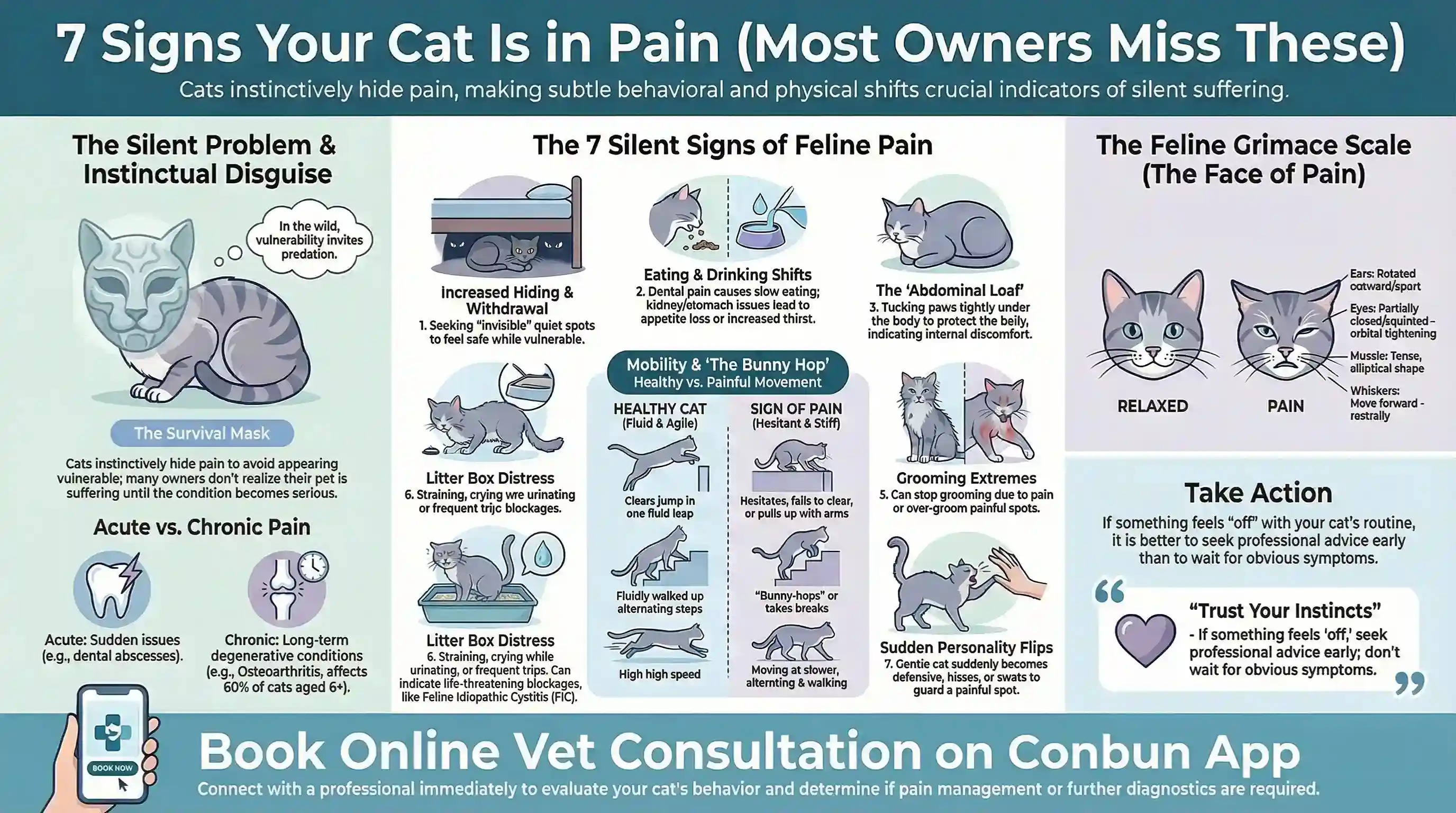
You might think that cats are mysterious. But they are not. They’re strategic.
In the wild, a limping cat is a dead cat. A vocal and visibly weak animal is an easy target for predators. So, evolution did what it does best: it rewarded the quiet sufferers.
That instinct is still deep-rooted in your indoor cat.
Even if she:
Sleeps on your bed
Eats from a stainless-steel bowl
Has never seen the “wild”
She tends to hide pain by default.
This is the single biggest difference between cats and dogs.
Dogs can externalise pain, but cats won't. It is difficult to identify cat health problems because they instinctively hide pain.
And this is exactly why cat pain symptoms are often detected late, especially chronic ones like:
Arthritis
Dental disease
Urinary issues
These conditions will not appear overnight. They creep in gradually, blending into what you assume is “normal cat behaviour.”
This challenge is even more complex in India.
Many domestic cats are:
Rescued strays with no recorded medical history
Living in compact apartments with confinement and limited movement
Eating diets that predispose them to dental, urinary problems or chronic conditions like obesity
So, if your cat is hiding more than usual, eating a little less, or has stopped jumping on your sofa, it’s easy to misread it as personality.
At Conbun, our vets and feline health experts are trained specifically in feline behaviour and pain assessment, something general veterinary practice often underemphasises.
Because with cats, the rule is simple: If you’re noticing obvious signs of pain, you’re already too late.
Related Readings: Dog vs Cat Vaccinations: 2026 India Vet Guide
The 7 Signs Your Cat Is in Pain - A Vet-Backed Breakdown
The following are the 7 signs your cat is in pain, based on clinical guidelines like WSAVA pain protocols, tools like the Feline Grimace Scale and real-world patterns observed in Indian households. FGS is a renowned protocol that helps you understand the signs of illness in cats.
Sign 1 - Hiding or Social Withdrawal
Cats never isolate for drama. They isolate for survival.
If your cat suddenly:
Disappears under the bed
Avoids her favourite sleeping spots
Stops greeting you
These are the earliest signs of a cat hiding pain.
In Indian homes, this looks like a cat:
Hiding behind water tanks
Slipping into cupboard gaps
Staying in rarely accessed corners
If this behaviour lasts more than 24 hours without a clear reason like guests, noise, or relocation, it’s not mood; it’s a clinical signal.
Sign 2 - Changes in Facial Expression (Feline Grimace Scale)
Yes, your cat has a pained face. It’s just so subtle that you might not notice it.
The Feline Grimace Scale (FGS) is a 5-point Action Unit (AU) tool that evaluates five facial features:
Squinting eyes (orbital tightening)
Flattened or rotated ears
Tense muzzle
Whiskers pulled forward or stiff
Lowered head position
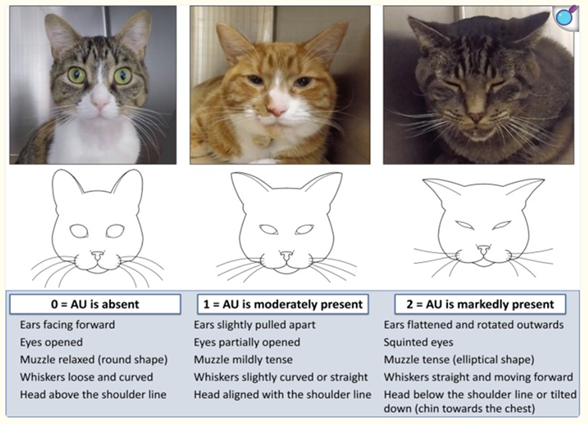
Source: (Evangelista et al., 2020)
If a cat is relaxed, it looks soft and open. A cat that is in pain looks guarded, tight and slightly withdrawn.
This is amongst the most scientifically validated ways to detect pain in cats, and also one of the most missed by owners.
A simple tip:
Take a photo of your cat when she’s relaxed. Compare it when you suspect discomfort. The difference is often revealing.
Sign 3 - Loss of Appetite or Reduced Water Intake
Your cat is the Gordon Ramsay of the animal world. But refusing food doesn’t always mean that she is being picky.
Pain, especially dental, abdominal, or systemic, directly suppresses appetite or the will to eat.
Watch for:
Skipping meals
Eating less than normal
Avoiding favourite treats
In Indian contexts, common causes include:
Dental disease from carb-heavy diets
UTIs are linked to inadequate water intake (very common in urban cats)
If your cat hasn’t eaten anything for more than 24 hours, it’s no longer a wait-and-watch situation.
Sign 4 - Vocalisation Changes
Pain changes the way cats vocalise.
Some cats become unusually vocal. You may listen to them yowling, growling and hissing.
Others do the opposite. They become unusually silent. And both are red flags.
A normally talkative cat going quiet is just as concerning as a quiet cat suddenly vocalising.
In India, there are seasonal triggers that may cause such responses.
For example, during Diwali, events or loud festivals:
Stress can amplify pain perception
Cats may vocalise due to anxiety-linked discomfort
Compare your cat’s normal behaviour to these changes, and you’ll notice the difference.
Sign 5 - Altered Posture and Movement
A cat’s movement is affected by pain before anything else.
Look for:
Hunched sitting posture
Reluctance to jump
Limping or stiffness
Guarding a specific area
Cats suffering from abdominal pain may adopt a “tucked” posture to alleviate the symptoms. Cats with joint pain may stop climbing or jumping.
A cat that has suddenly stopped jumping onto window ledges, especially in Indian urban apartments, is a classic sign.
Owners may call it laziness. But, according to veterinarians, it is early-stage arthritis.
Sign 6 - Grooming Changes
We all know that cats are meticulous groomers. So, when grooming behaviour changes, it means there’s something wrong.
There are two patterns you should watch:
Over-grooming (excessive licking):
Usually focused on one area
Indicates localised pain or irritation
Under-grooming (neglect):
Dull, messy coat
Indicates systemic discomfort or fatigue
In humid Indian climates, especially in coastal areas like Mumbai and Chennai, skin issues can lead to pain-driven grooming changes.
Related Readings: How do online vet consultations work: A pet owner’s guide
Sign 7 - Sudden Personality or Behaviour Change
This could arguably be the most misunderstood sign.
A friendly cat is becoming aggressive. A calm cat started hissing. A litter-trained cat avoids the litter box completely.
For cat owners, it is: “Attitude problem.” But in many cases, it’s pain.
Common cat health problems:
UTI (pain while urinating leads to litter box avoidance)
Injury leads to aggression when touched
Chronic pain leads to withdrawal or irritability
Behavioural changes are even harder to detect in the case of rescued stray cats because baseline behaviour is already complex.
What Our Vets See Most Often
Across hundreds of consultations on Conbun, two signs stand out as the most missed by owners:
Facial expression changes
Personality shifts
Both subtle. Both critical.
And often undetectable.
If you notice even two of these signs together, don’t ignore them. Consult a veterinarian on Conbun to understand the signs of illness in cats and how you can treat them.
How to Use the Feline Grimace Scale at Home
The Feline Grimace Scale (FGS) is a scientifically validated tool used by veterinarians worldwide to assess pain in cats using facial expressions.
The good news? You don’t need a veterinary degree to use the simplified version of this tool at home.
It observes five facial features, or what the tool refers to as Action Units (AU):
Eyes (orbital tightening): Are they squinting or half-closed?
Ears: Are they flattened or rotated outward?
Muzzle: Does the muzzle look tense instead of relaxed?
Whiskers: Are they stiff and pushed forward instead of loose?
Head position: Is the head lowered or tucked?
Each feature is scored:
0 = Normal
1 = Slight change
2 = Obvious change
Add them up:
0–3: Low or no pain
4–7: Moderate pain, monitor closely, consult a vet
8–10: Severe pain, needs immediate veterinary attention
Important: The FGS is to be used as a screening tool and not as the basis of diagnosis. It helps you understand the signs of illness but is not a reliable tool to diagnose a cause.
Think of it like a thermometer; it displays the body temperature and nothing else. There are no conclusions you can draw from the result.
A simple thing you can implement. Take a photo or short video of your cat’s normal resting face so that you can compare. Even better if you can share it with a vet. Trained eyes can detect subtle changes easily.
Book an instant veterinary appointment on the Conbun app and talk to a vet online to share the symptoms and pictures of your cat. With verified vets on Conbun, understand why your cat might be in pain. This will help you act faster and smarter.
Related Readings: How to Groom a Cat at Home: Shedding, Bathing, Nail Trimming & Schedule Guide
Common Causes of Pain in Indian Cats You Shouldn’t Ignore
Here are the most common causes of pain in cats seen in Indian homes. Understanding cat diseases and symptoms can help pet parents detect the causes of pain.
Dental Disease (Very Common): Usually linked to diet. Signs include excessive drooling, bad breath, and food avoidance.
Urinary Tract Issues (FLUTD/UTI): Especially in male cats. Caused by cats not drinking enough water, especially during summer. Dry food diets also lead to inadequate hydration. Straining while urinating and crying in the litter box are some signs.
Arthritis (Underdiagnosed): Common in older cats over 7 years of age. This generally shows up as reduced jumping or stiffness.
Trauma/Injury: Often observed in rescued strays or cats with outdoor exposure. Look for limping or excessive guarding behaviour.
Abdominal Pain (Parasites, IBD): Excessively common in India due to environmental exposure. Signs of abdominal pain include vomiting and a hunched posture. Overfeeding a kitten could also lead to abdominal distress.
Post-Surgical Pain: After spaying/neutering. Watch for lethargy or reluctance to move.
Ear Infections (Monsoon Spike): Head shaking, scratching ears, and sensitivity to touch are signs of illness in cats.
A key India-specific insight:
Cats on dry food, with low water intake, are prone to urinary pain conditions. It’s one of the most common issues seen in urban veterinary practice.
What NOT to Do If You Think Your Cat Is in Pain
When a cat is in pain, instinct kicks in, and sometimes, instinct gets it wrong.
Here’s what to avoid:
1. Never give human painkillers
Paracetamol (Crocin, Dolo), ibuprofen, and aspirin are all toxic to cats. Even a small dose can be fatal and can damage the stomach and kidneys.
2. Don’t force-feed
A cat’s refusal of food may be due to nausea or pain. Force-feeding may lead to choking or aspiration.
3. Don’t repeatedly touch the painful area
It will not only increase stress but may also worsen the injury. One gentle check is enough.
4. Don’t “wait it out” for too long
Cats deteriorate quietly, but quickly.
5. Don’t rely only on online guesses
Misreading symptoms can delay the right treatment.
Follow this safest approach:
Observe, document, consult.
When Is Cat Pain an Emergency? Red Flags That Need Immediate Action
Some signs don’t wait for your monitoring. Cat health problems demand action. Look for the following symptoms:
Difficulty breathing or open-mouth breathing
Collapse or inability to stand
Pale, blue, or white gums
Straining to urinate with no output (life-threatening in male cats)
Not eating or drinking for 48+ hours
Seizures or disorientation
Visible trauma (fall, accident)
These are not mild concerns. They are emergencies. Consult a vet immediately if you see any of these signs. If a physical vet visit is not possible, go for a veterinary doctor online consultation on Conbun to learn what you must do immediately.
Related Readings: 25 Most Popular Cat Breeds in India with Prices and Care Guide (2026)
Case Spotlight: The Cat Who “Just Got Lazy”
A 34-year-old professional, Reena from Mumbai, noticed that her Persian cat Milo stopped jumping onto the balcony railing, which had been a daily ritual for years.
Reena thought that her cat was just getting older. Just a few days later, Milo also stopped grooming his hind legs. His coat started to look messy, and he also moved less.
Still, nothing dramatic.
On a late evening, she decided to book online vet consultation on conbun app.
Within minutes of observation, just by looking at Milo’s posture and facial tension, the vet suspected hip pain linked to early arthritis.
Further tests confirmed it.
With early intervention:
Pain management
Joint support
Environmental changes
Milo was back to his balcony routine within weeks.
The Takeaway
Cats don’t always scream in pain. Sometimes, they just stop doing the things they love.
And that silence? That could be the loudest signal.
Conclusion
Your cat will never walk up to you and tell you that she is in pain.
But she will:
Hide more
Eat less
Move differently
Look differently
The blog discussed 7 signs of pain in a cat. Regarding these signs as your cat’s language. They’re quiet, subtle and easy to dismiss.
In Indian homes, where diet, climate, and rescue histories all influence feline health, early detection isn’t just helpful, it’s preventive healthcare.
Because the earlier you act:
The easier the treatment
The lower the cost
The better your cat’s quality of life
If you can tell that something is off, you are already a knowledgeable pet parent. Download the Conbun app android, iOS and chat with a certified veterinarian online to get guidance on such key signs that tell you about your pet’s health, learn cat healthcare tips, and expand your pet parenting knowledge.
Frequently Asked Questions
1. How can I tell if my cat is in pain at home?
Answer. Look for signs like hiding, appetite loss, or a hunched posture. You can use the Feline Grimace Scale to check for squinting or flat ears. If these signs persist for more than 24 hours, an online vet consultation can provide a quick remote assessment via video.
2. Do cats cry or vocalise when they are in pain?
Answer. Not necessarily. Some cats may become vocal and yowl, while many become unusually quiet. Any shift from their baseline, vocal or silent, should be considered a red flag.
3. Can I give my cat paracetamol or ibuprofen for pain?
Answer. No. Human meds like Paracetamol are toxic to cats and may cause irreversible organ damage. Always talk to a vet online to get safe, feline-specific pain management medications.
4. Why is my cat hiding but seems otherwise okay?
Answer. Yes. Hiding is a primary survival instinct in cats, which they practice to mask pain. If your cat has been hiding for over 24 hours, they aren't just being moody; they likely need a veterinary doctor online consultation.
5. Is online vet consultation reliable for cat pain assessment in India?
Answer. Yes, for triage. Vets use video to observe movement and facial tension. It can help determine if a cat needs an immediate clinic visit or at-home monitoring.
6. What causes pain in cats most commonly in India?
Answer. Urinary tract issues (FLUTD), dental disease, arthritis in senior cats, monsoon-related infections and skin infections are the most common cases handled during a 24/7 veterinary consultation.
7. My cat is a rescued stray - is it harder to tell if they are in pain?
Answer. Yes. Because cats are experts at masking weakness. Look for subtle shifts in their behaviour, routine or appetite, as these are the prominent indicators of distress.
8. At what age do cats start getting arthritis in India?
Answer. Around age 7, though it is frequently misdiagnosed as slowing down. If you see your cat hesitating to jump on the sofa, a vet can assess their mobility remotely.
9. How quickly should I act if I think my cat is in pain?
Answer. For subtle signs, consult within 24 hours. For emergencies like inability to urinate or open-mouth breathing, seek a veterinary doctor online consultation immediately for urgent triage.
10. What is the Feline Grimace Scale, and can I use it at home?
Answer. Feline Grimace Scale, a validated tool assessing five facial areas (ears, eyes, muzzle, whiskers, head position). If your cat gets a score of 4+, it suggests pain. Share a photo of your cat's face with a Conbun vet for a more professional assessment.