Written by: Anand Sen; Reviewed by: Dr. Saroja Patil B.V.Sc & A.H, M.V.Sc
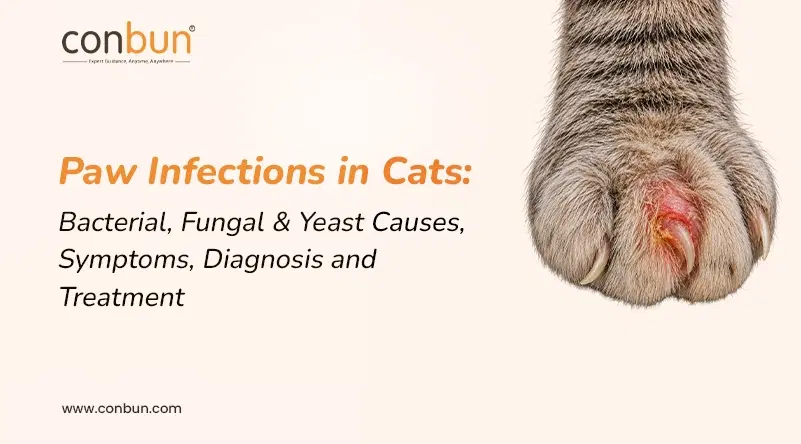
A cat paw infection is typically caused by bacteria, fungi or yeast entering a cat’s paw through a scratch, cut, puncture or a broken nail. A cat’s paws are sensitive and essential to its everyday life as they allow walking, grooming and scratching. When a paw infection develops, it makes the cat uncomfortable, anxious and reluctant to move.
This guide covers the causes of cat paw infections, their symptoms and how you can treat them to save your cat from discomfort.
What Are Paw Infections in Cats?
Paw infections in cats develop when bacteria, yeast or fungi enter inflamed or damaged skin on the paw pads, around the claws or between the toes. As paw pads lack protective fur and are in constant contact with floors, outdoor surfaces, litter boxes, minor irritation can quickly turn into an infection.
Why paws are prone to infection
A cat’s paws are uniquely susceptible to infections because of their specialised anatomy.
Paw pads
Paw pads (foot pads) are in a state of constant mechanical trauma, taking the brunt of jumping, landing and walking across rough terrain. All these activities cause burns, micro-tears or punctures from thorns or splinters, compromising the skin barrier.
In addition, cats only sweat through their paw pads. Excess moisture softens the thick keratinised skin, thereby creating a damp environment which is beneficial for bacteria and yeast, allowing them to multiply.
Interdigital spaces (Webbing between toes)
Tight folds of furred skin between toes lack airflow. They trap moisture and heat, which makes them ideal incubators for yeast (Malassezia) and bacteria. Fine dust, faecal bacteria, scented chemicals, and debris get packed tightly into the interdigital webbing, leading to an infection.
Claw folds
Feline claws are retractable and sit inside deep, narrow skin sheaths called claw folds. Once dirt, bacteria, and litter get pushed inside these pockets, it becomes impossible to clean them out naturally.
A cat’s claw is fused directly to the third phalanx. A torn claw, or overly short nail trim or deep paronychia allows bacteria a direct pathway to the underlying bone, increasing the risk of severe conditions like osteomyelitis.
Paw infection vs. paw injury vs. allergy: how to tell
Feature | Paw Infection | Paw Injury | Paw Allergy |
Onset | Often gradual or develops days after a cut, moisture, or irritation | Usually sudden (after a fall, jump, thorn, or burn) | Often recurring, seasonal, or ongoing |
Behavior & Pain | Limping or licking; may have lethargy or fever if worsening | Sudden limping, avoiding weight on the paw, or guarding when touched | Frequent licking, chewing, or biting the paw; usually normal energy and appetite |
Skin & Pad Look | Redness, swelling, warmth, crusting, scaling, or hair loss | Swollen toes, spread toes, cuts, punctures, torn nails, or a stuck foreign object | Redness or fur thinning from licking; skin often looks dry or clean without wounds |
Discharge & Smell | Pus, oozing fluid, or a musty/foul odour (bacterial or yeast/fungal) | Fresh blood or clear/colored fluid right after trauma | Usually, no pus or bad odour unless a secondary infection starts |
Affected Area | One or more paws, between toes, or pads | Typically, a single paw or specific toe | Often multiple paws, ears, face, neck, or belly |
Seek urgent veterinary care if your cat refuses to bear weight, has severe swelling, bleeding or pus discharge. Avoid home remedies.
Types of Cat Paw Infections: Quick Comparison Table
Let’s understand the different types of cat paw infections.
Type | Primary Cause | Typical Signs | Contagious? | Common Vet Tests |
Bacterial (e.g., Abscess, Paronychia) | Staphylococcus or Pasteurella entering via bites, scratches, splinters, or ingrown nails | Localised swelling, warmth, redness, pus/bloody discharge, limping, fever | No (unless spread via a fresh bite/scratch wound) | Physical exam, cytology (swab), bacterial culture & sensitivity, X-ray (for foreign bodies) |
Yeast | Malassezia overgrowth triggered by trapped moisture or underlying allergies | Brownish/rusty nail bed staining, greasy skin, musty "corn chip" odour, intense licking | No (opportunistic overgrowth of normal skin flora) | Tape prep or skin swab cytology |
Fungal (Ringworm) | Dermatophyte fungi (most commonly Microsporum canis) | Circular hair loss, scaly/crusty skin, brittle or deformed claws, thickened paw pad calluses | Yes - highly contagious to other pets and humans | Wood's lamp exam, fungal culture, PCR test, or plucking hairs for microscopy |
Parasitic (Secondary infection) | Mites (Demodex, Notoedres, Otodectes) or hookworm larvae penetration | Intense itching, red/inflamed skin between toes, crusting, secondary bacterial sores | Yes - spreads easily to other cats/animals (and occasionally humans) | Deep or superficial skin scrapings, faecal exam |
Viral (Systemic with paw signs) | Feline Calicivirus (FCV) or Feline Herpesvirus | Ulcerated or sloughing paw pads, limping, paired with sneezing, mouth ulcers, or watery eyes | Yes - highly contagious to other cats | Clinical symptom evaluation, PCR swab (oral/nasal/lesion) |
Seek a vet promptly if your cat refuses to put weight on the leg, the swelling spreads up the limb or you notice, fever or loss of appetite.
Bacterial Paw Infections in Cats
Bacterial paw infections in cats develop when bacteria enter damaged or irritated skin between toes, on the paw pads or around the nails. Most of these bacteria live harmlessly on a cat’s skin, mouth or claws until the skin barrier is damaged or local defences are compromised.
Common bacterial causes
Staphylococcus Species (e.g., S. pseudintermedius, S. aureus): Skin bacteria that can cause deep infections (pyoderma) when paw skin is irritated or damaged.
Pasteurella species (e.g., P. multocida): Commonly found in a cat’s mouth or upper respiratory tract. Enters through puncture wounds and causes pain, swelling or abscesses.
Streptococcus: Found on mucous membranes, the respiratory tract or claws; these bacteria can cause soft-tissue infections in cats with weakened immunity.
Abscesses, pododermatitis, paronychia (claw-fold infection)
Condition | Primary Location | Typical Signs | Common Causes |
Paw Abscess | Soft tissue of the paw, toe, or pad | Sudden single-paw swelling, heat, severe pain, limping, pus drainage | Cat bites, splinters, thorns, or deep puncture wounds |
Pododermatitis | Paw pads and skin between the toes | Soft, puffy, or ulcerated pads ("pillow foot"), crusting, scaling, bleeding | Allergies (food/environmental), mites, immune-mediated diseases (e.g., plasma cell pododermatitis, pemphigus foliaceus) |
Paronychia | The claw fold (skin surrounding the nail bed) | Redness, swelling around the nail base, waxy or purulent discharge, brittle or peeling claws | Torn/ingrown claws, secondary bacterial or yeast (Malassezia) infections, autoimmune skin disease, or neoplasia |
How do bacteria enter?
Bacteria commonly enter through:
Scratches, bite wounds, splinters, or overgrown claws puncturing the pads
Excessive licking that breaks down the skin barrier
Wet surfaces or chemicals damaging the skin
Weakened immunity or endocrine issues like diabetes
Symptoms of a bacterial paw infection
Symptoms of bacterial paw infections in cats include:
Inflamed, raw, crusty skin between the toes or around the claws
Oozing pus, blood seepage, foul smell, a lump/abscess
Cracked, ingrown or painful claws
Limping
Fever, lethargy or hiding
Fungal Paw Infections in Cats
Fungal paw infections in cats happen in cats when fungi or yeast overgrow on the paw pads, around the claws or between the toes, generally after skin damage, moisture exposure or underlying cat allergies.
Ringworm (Microsporum canis) on paws and claws
Microsporum canis is a pathogenic dermatophyte fungus that causes ringworm in cats (dermatophytosis). It is a contagious fungal infection that can also develop on a cat’s paws and claws. M. Canis spreads easily to other pets and humans via direct contact, shed hair and can survive in the environment for up to a year.
Other fungi (Sporothrix, Cryptococcus, Aspergillus)
Other fungi that cause paw infections in cats include Sporothrix, Cryptococcus, Aspergillus.
Feature | Sporothrix (Sporotrichosis) | Cryptococcus (Cryptococcosis) | Aspergillus (Aspergillosis) |
Primary Entry | Traumatic inoculation via scratches, bites, thorns, or soil. | Inhalation of spores (soil/bird droppings) or wound contamination. | Inhalation of spores; rarely secondary wound inoculation. |
Paw & Skin Appearance | Firm nodules that ulcerate and ooze serohemorrhagic fluid; lesions around claws; "corded" nodules tracking up the leg's lymphatics. | Raised, firm or fluid-filled nodules that may ulcerate into raw surfaces. Often secondary to nasal spread. | Ulcerative or necrotic skin plaques/nodules; very rare on paws unless systemically disseminated. |
Other Common Signs | Ulcerated crusts on the face/ears, swollen lymph nodes, sneezing. | "Roman nose" bridge swelling, chronic nasal discharge, eye changes, or neurological signs. | Chronic sinusitis, facial swelling, pneumonia, or gastrointestinal/neurological signs. |
Zoonotic Risk | High. Directly transmissible from infected cats to humans via scratches, bites, or wound fluid. | None. Not contagious from cats to humans (acquired from the environment). | None. Not contagious between cats and humans |
Is cat paw fungus contagious to humans and other pets?
Yes. Some types of cat fungus are contagious to humans and other pets, while others are not. Ringworm and infections caused by sporotrichosis are contagious to both humans and other pets.
Signs of fungal infection
Signs of fungal paw infections in cats include:
Hair loss and patchy bald spots
Redness and swelling between the toes and around the nail beds
Reddish-brown paw pads, stained fur
Ulcers, open sores or lumps that ooze fluid
Foul smell
Overgrooming or pain
Yeast Infections (Malassezia) in Cat Paws
According to Frontiers in Cellular and Infection Microbiology, Malassezia Yeast infections in cats' paws happen when normal skin yeast overgrows, causing itchy, inflamed skin between the toes and around the claws
What causes yeast overgrowth?
Malassezia yeasts live naturally on healthy cats in small numbers. However, they can sometimes rapidly multiply out of control due to trapped moisture, weakened immune response or skin irritation.
Symptoms of yeast infections in cat paws
Redness and swelling
Distinct color
Excessive licking or chewing
Discolouration and debris
Skin texture and changes
Shaking or limping
Why do my cat's paws smell like corn chips?
A corn chip smell on your cat’s paws is usually a harmless byproduct of bacteria and yeast mixing with sweat on their paw pads.
Yeast vs. bacterial infection: key differences (table)
Yeast and bacterial cat paw infections may look similar at first, so veterinarians typically use skin cytology to tell them apart before starting a targeted treatment.
Feature | Yeast Paw Infection | Bacterial Paw Infection |
Common Culprits | Overgrowth of normal skin yeast like Malassezia (or occasionally Candida). | Staphylococcus, Pasteurella, or secondary bacteria from wounds, bites, or allergies. |
Typical Signs | Redness, persistent licking/itching, brown or rust staining on fur/claws, greasy or flaky skin. | Swelling, noticeable heat, pus or cloudy discharge, pain/limping, or a localised abscess. |
Smell | Often a distinct musty, sweet, or "old sock" odour. | Odour varies; foul or purulent smell is more likely if pus or dead tissue is present. |
Main Triggers | Moisture, humidity, skin oil changes, allergies, or weakened immunity. | Cuts, scratches, bite wounds, foreign objects, or secondary infection from licking/allergies. |
Primary Treatment | Antifungal shampoos/wipes or oral antifungals (often 4–6+ weeks), plus managing moisture/allergies. | Vet-prescribed antibiotics (often 7–14+ days), wound/antiseptic care, and treating underlying triggers. |
Do not use home disinfectants or harsh human antiseptics. Seek prompt veterinary attention if your cat is reluctant to move, develop lethargy or loss of appetite.
Symptoms: When Is a Cat's Paw Infected? (checklist)
Cat paw infections can develop quickly, and cats, being stoic in nature, generally hide pain and discomfort. This makes it important to detect symptoms for prompt action to avoid serious complications.
Early signs:
Limping or favouring one paw
Refusing to bear weight
Excessive licking and chewing of the paw
Reluctance to jump or use the litter box
Flinching, pulling away when the paw is touched
Swelling and redness, puffiness on the toe, pad or around the claw
Pus discharge or crusting
Scaling, hair loss or callused pads
Advanced signs
Pus or blood discharge
Abscesses or open ulcers
Strong, foul odour
Severe pain or discomfort
Fever or lethargy
Loss of appetite
Mobility changes
Contact a veterinarian immediately if you observe any of these signs. If you are unable to visit a clinic right away, connect to a cat veterinarian online for a virtual diagnosis, prescription antibiotics, topical creams and management advice.
How Vets Diagnose Paw Infections
Veterinarians generally diagnose paw infections in cats with a combination of physical exam and targeted lab tests to find the exact cause, like bacteria, yeast, ringworm or an immune issue.
Physical exam
Visual and tactile check of redness, swelling, heat, pus, crusting or hair loss on the pads, toes or nails
Evaluation of background history, outdoor access, recent scuffles or injuries, recurring allergies
Cytology (tape/swab), skin scraping
The vet presses a slide against the skin to look for bacteria, yeast or inflammatory cells under a microscope.
Needle aspirate is used to collect cells from swollen pads to check for immune-related changes
Fungal culture & Microbial testing
Samples are grown in the lab to identify the exact organism and understand which antibiotics and antifungals work best
Wood’s lamp test is used, where a special UV light helps screen for ringworm.
Biopsy
A small tissue sample is taken under sedation and anaesthesia if tests are inconclusive or a chronic condition like plasma cell pododermatitis needs confirmation.
In India, diagnosing a paw infection in cats typically costs between ₹800 – ₹3500 for a standard visit with basic tests, while complex cases that require imaging or sedation may reach ₹5000 - ₹10000
Treatment Options
Treatment of a cat paw infection can be started only after its cause (bacteria, yeast or fungi) is identified.
Bacterial infections and abscesses are treated with oral or topical antibiotics like (amoxicillin-clavulanate) and sometimes surgical drainage for deep abscesses.
Yeast and fungal infections are treated with antifungal medication and medicated shampoos like itraconazole. Ringworm requires prescribed antifungals for weeks.
Secondary infections from food or environmental allergies requires treating the root cause of allergy with elimination diets.
Vets generally prescribe anti-inflammatory or pain relief medication for pain management and support.
Vets also recommend supporting accessories like E-collar to prevent self-trauma.
Home Care: What Is Safe and What Is Not
Proper home care is needed alongside veterinary intervention to treat and manage paw infections in cats.
Step-by-step: cleaning an infected paw
Set up your supplies in a quiet environment. Approach your cat gently and wrap them loosely in a towel (purrito)
Wipe the paw with lukewarm water, sterile saline or diluted chlorhexidine to clear dirt and discharge
Do not scrub aggressively.
Gently dab the paw and between the toes with clean gauze or a soft towel to remove moisture
Put an e-collar right away to prevent licking
Keep your cat indoors on a clean surface.
Use only safe soaks like saline water or vet-approved chlorhexidine. Never use unsafe home remedies like tea tree oil, essential oils or human creams.
Can I use apple cider vinegar, coconut oil, or Betadine?
Out of these three, diluted Betadine can be used for cleaning an infected paw. Do not use apple cider vinegar or coconut oil.
When to See a Vet
A paw infection in cats may become serious if not managed on time or if the infection advances deep into the paws, causing severe discomfort and other behaviour issues.
Emergency signs
Loss of appetite
Fever
Unusual lethargy
Vomiting
Multiple swollen limbs
Unpleasant odour
Keep your cat strictly indoors and prevent licking. Do not use human creams or give human medications to relieve pain. Seek veterinary intervention promptly.
How to prevent paw infection in cats
Paw infections in cats can be prevented with daily & weekly paw care, environment and hygiene and treating underlying health conditions.
Check paws weekly. Look at the pads and between the toes for cuts, swelling, debris, splinters, redness, thorns, etc
Dry wet paws promptly after outdoor time or baths.
Clip nails every 2-3 weeks
Apply a cat-safe paw balm or moisturiser if paws are dry or cracked
Limit outdoor exposure and avoid interaction with stings and contaminated surfaces
Maintain clean living spaces. Wash bedding regularly and keep litter boxes clean
Keep cats away from hot surfaces and stinging insects
Manage allergies and parasites
Paw injuries can also lead to infections and abscesses. Act early on injuries. Clean minor surface debris and see a certified vet promptly if you notice limping, swelling, pus or deep wounds.
Complications of Untreated Paw Infections
Untreated paw infections in cats can progress from localised irritation to painful abscesses, deeper tissue damage and systemic illness.
Bacteria trapped under the skin can form a painful, pus-filled pocket that swells and may eventually rupture.
Ongoing bacterial, fungal or yeast infections can cause persistent sores, crusting, hair loss, calluses or chronic lesions
Compromised paw skin or underlying immune/allergic conditions can lead to severe pad swelling, ulceration and secondary infections
Pain and deep tissue inflammation can make walking difficult. Walking on sore paws in litter can cause discomfort, leading to avoidance, reduced activity and may complicate excretory functions.
Act promptly and seek veterinary attention to prevent complications.
Paw Infections in Kittens, Senior Cats, and Special Cases
Kittens have immature immune systems, making them uniquely susceptible to contagious pathogens and sensitive to standard medications.
Kittens frequently develop fungal infections from Microsporum canis, which causes hair loss, scaly skin and thickened paw pads that are highly contagious to humans and other pets.
Immune and organ decline in seniors makes them susceptible to bacterial and yeast infections. For example, diabetes is a condition where wounds take time to heal, allowing bacteria to multiply rapidly.
Cats with a compromised immune system are also vulnerable to bacterial and yeast overgrowth.
Conclusion
A cat’s paw infection is typically caused by fungi, bacteria or yeast entering into the paws through a cut, puncture or scratch. Cat paws are sensitive and are constantly exposed to the environment. Thus, prevention of paw infections becomes essential for pet owners to prevent critical complications. Talk to a vet online on Conbun to learn more about paw infections in cats.
Book an online veterinary appointment to get a virtual diagnosis, prescription antibiotics/antifungal treatments and recovery/supportive care guidance.
Frequently Asked Questions
How to treat cat paw infection at home?
True paw infections, especially bacterial abscesses, deep punctures, and fungal/yeast issues, cannot be treated at home and require veterinary care. At home, you can only provide temporary first-aid care and recovery management.
What does an infected paw in cats look like?
An infected cat paw typically shows swelling, redness, warmth, discharge or pus and a noticeable odour. You may also see limping or a cat frequently licking the paw.
Can a cat’s paw heal on its own?
No. A true bacterial, fungal or yeast infection will not heal on its own. Cat paw infections require veterinary care, antibiotics, antifungal treatments, pain relief and wound drainage to heal.
What can I give a cat for a swollen paw?
Only give medications prescribed by a veterinarian. Do not give human painkillers, antibiotics or other home remedies without veterinary guidance.
Are cat paw infections contagious?
While most infections are not contagious, fungal infections like ringworm are zoonotic and can spread to both humans and other animals.
References
Frymus, T., Gruffydd-Jones, T., Pennisi, M. G., Addie, D., Belák, S., Boucraut-Baralon, C., ... & Horzinek, M. C. (2013). Dermatophytosis in cats: ABCD guidelines on prevention and management. Journal of feline medicine and surgery, 15(7), 598-604. https://journals.sagepub.com/doi/pdf/10.1177/1098612x13489222
Loeffler, A., & Lloyd, D. H. (2018). What has changed in canine pyoderma? A narrative review. The Veterinary Journal, 235, 73-82. https://unasaludchile.uchile.cl/wp-content/uploads/2020/10/loeffler2018.pdf