Written by: Anand Sen; Reviewed by: Dr. Saroja Patil (B.V.Sc & A.H, M.V.Sc)
During playtime with your dog, everything seems cute.
The zoomies. The happy growls.
The play bow that melts your heart.
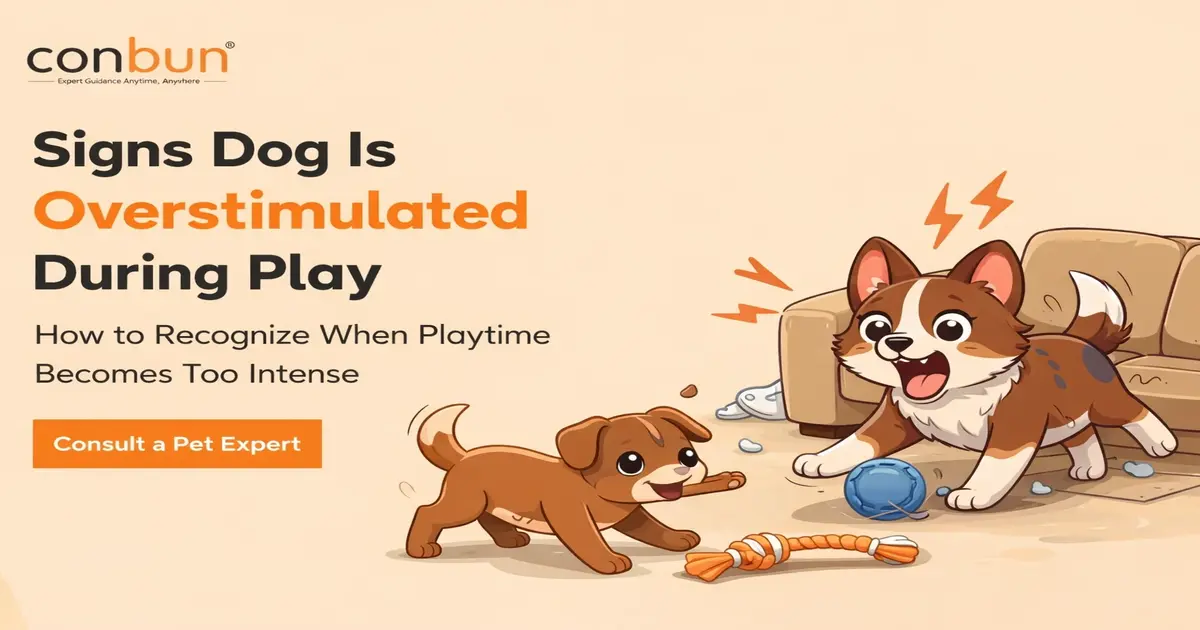
But then, suddenly, your sweet dog turns into a furry tornado. Ignoring commands. Nipping hands, and the body slamming the sofa. Eyes wide like they’ve just had three espressos.
Pet owners often term it “bad behavior.” But that’s overstimulation.
Many dog parents confuse hyper-excitement with happiness. But according to the MSD Veterinary Manual, overstimulation during play can turn into stress, loss of impulse control, and even aggression if it is not managed properly.
The following guide will help you decode what overstimulation exactly is, why it happens and how you can stop it before fun turns frantic.
What Is Overstimulation in Dogs?
Overstimulation happens when a dog’s nervous system is flooded with too much excitement, arousal, or sensory input.
In simple words, an overstimulated dog has encountered too much sensory information at once that their brains cannot handle, and they enter into a hyper-arousal or restless state.
This sensory overload is a result of loud noises, new environments and certain interactions, making it challenging for the dog to remain in a calm state.
While you are playing with your dog, their body releases dopamine and adrenaline. These are the chemicals that fuel excitement and engagement. However, when arousal climbs too high, especially in high-energy breeds and puppies, the brain temporarily “forgets” impulse control.
Veterinary literature describes this as crossing the arousal threshold, the point where a dog can no longer process cues calmly.
Signs often include:
Faster movements
Rougher play
Ignoring commands
Sudden nipping
Overstimulation is not aggression but the dysregulation of excitement.
Therefore, the goal of dog parents should not be to stop play but to keep it below that threshold.
Related Readings : Signs Your Dog Has Separation Anxiety
7 Signs Your Dog Is Overstimulated During Play
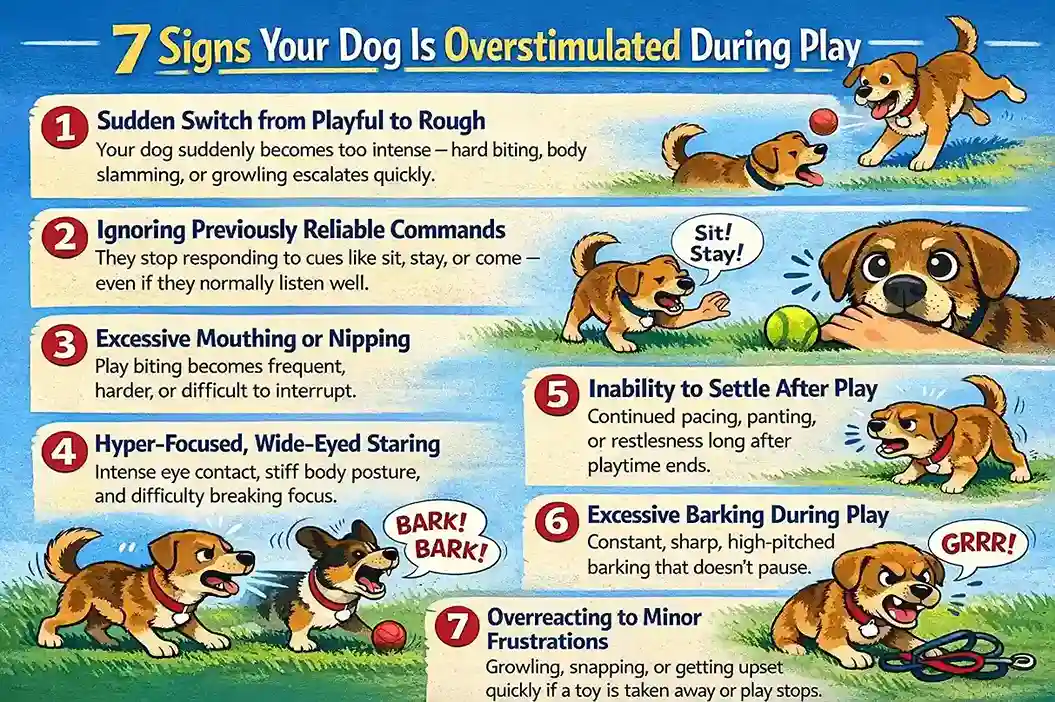
1. Sudden Switch from Playful to Rough
One minute, your dog is bouncing like a cartoon character. The next? They choke-slam the other dog. They are nipping harder, grabbing clothes and jumping higher.
This rapid escalation is the clearest sign of overstimulation.
According to canine behavioral studies, when arousal exceeds the sweet spot, their motor control decreases. Dogs literally lose fine control of their movements.
And as their motor control is lost, gentle mouthing becomes harder biting and light chasing becomes frantic lunging.
You may notice:
Play bows disappear
Movements become faster and less bouncy
Facial expressions shift from loose to intense
When your dog enters this state, you’ll be able to differentiate their behavior clearly. Healthy play feels rhythmic and back-and-forth. On the other hand, overstimulated play is one-sided and chaotic.
If you notice your dog’s energy spiking suddenly instead of flowing naturally, your dog may have crossed their arousal threshold. Such energy spikes can be particularly dangerous if you have an aggressive dog breed.
This is a cue that you should pause the game before things escalate further.
2. Ignoring Previously Reliable Commands
Your dog knows “sit.”
They know “leave it.”
They know “come.”
But suddenly? Nothing works. It feels like they’ve entered the airplane mode.
When overstimulation kicks in, the rational part of the of their brain (the prefrontal cortex equivalent in dogs) takes a backseat and the emotional brain starts dominating.
Veterinary behaviorists often call this being “over threshold.”
You may see:
Repeated cue ignoring
Delayed response to name
No response to commands
Increased distraction
Frantic scanning
Dog parents think it is resistance or disobedience, but it is neurological overload that your dog cannot deal with on their own.
If you think your dog is not following simple commands which they usually perform easily, that’s not due to stubbornness but due to overstimulation, which has shut down their impulse control.
Therefore, at this point, by adding more commands, you are actually making things worse. Lower the intensity first. Then expect calm behavior.
3. Excessive Mouthing or Nipping
A playful nip is normal, especially in puppies and high-energy breeds. But if your dog is overstimulated, you will notice changes in pressure and frequency.
What to watch for:
Faster, repetitive nipping
Targeting hands, ankles, or clothing
Harder jaw pressure
Growly, high-pitched vocalisations
As their nervous systems are still developing, puppies are more prone to excessive mouthing or nipping.
According to an article published in Animal Cognition, in dogs, impulse control matures gradually, which implies that excitement overwhelms them faster.
Many dog owners describe this moment as:
“He just goes crazy.” That “crazy” is arousal overload.
If you notice that mouthing is becoming harder instead of softer and redirection attempts fail, it's time to wrap the session up.
Continuing beyond this point will only teach the dog that creating chaos is normal.
4. Hyper-Focused, Wide-Eyed Staring
Playful eyes are soft and blinking, but overstimulated eyes are different.
They become:
Wide
Intense
Unblinking
Fixed on target
Instead of loose movements, your dog becomes sharp as if he were a special ops officer with a stiff body.
According to the book Animal Behavior for Shelter Veterinarians and Staff, soft body language indicates social engagement. On the other hand, if your dog has a stiff body language, it indicates rising arousal.
The hackles may raise, and the tail is above spine level. Their body weight is shifted to the front legs in a forward position. If you see your dog freezing before pouncing or has become laser-focused in a way that feels intense rather than being playful, pause the session.
That frozen moment is often the nervous system bracing for explosive movement. This is especially important in multi-dog play. Many scuffles begin after that stiff pause.
Picture it as a “storm brewing” signal.
Related Reading: Why Is Vet Care So Expensive in 2026?
5. Inability to Settle After Play
Healthy play usually ends with:
Shaking off
Lying down
Drinking water
Sniffing calmly
However, an overstimulated dog shows extremely opposite signs. They continue barking, pacing, zooming, jumping and grabbing their toys repeatedly.
If your dog seems unable to reset, even after 10-15 minutes after the play has stopped, it indicates elevated cortisol levels lingering in their system.
According to veterinary neuroscience, arousal chemicals may take time to metabolize especially in young or high-drive dogs.
In fact, it has been observed that Cortisol levels may stay elevated for 72 hours or more, creating a pressure cooker type situation, where if the dog is re-exposed to similar stressors behaviors can escalate again. This is called trigger stacking.
If your dog is unable to self-regulate after these bursts of excitement, you need to implement structured cooldown routines.
This is common in:
Border Collies
Belgian Malinois
Young Labradors
Adolescent dogs
Playtime should end in calm. If it ends in chaos, it probably means that stimulation exceeded healthy limits.
6. Excessive Barking During Play
If your dog is barking with excitement, it is normal. But overstimulated barking becomes:
Rapid
High-pitched
Non-stop
Paired with jumping or lunging
As arousal increases, barking becomes high-pitched.
As per a 2018 article published in Animals vocalization intensity correlates strongly with increased emotional arousal in dogs.
If barking is escalating rather than decreasing, your dog is probably struggling to regulate their excitement levels.
This is highly common during fetch games, where anticipation builds repeatedly without a pause.
When barking shifts from playful bursts to frantic noise, your dog’s nervous system is likely overloaded.
If barking shifts from playful bursts to frantic high-pitched noises, your dog’s nervous system has probably overloaded. Interrupt or pause the game gently before frustration develops.
7. Overreacting to Minor Frustrations
This one may surprise many dog owners. If your dog is in an overstimulated state, small triggers may cause big reactions.
Examples:
Missing the ball - snapping at air
Other dog bumps them - immediate growl
Toy taken briefly - sudden possessiveness
Why?
As the nervous system is already in a high alert state, tolerance drops. In simple neuroscience terms, your dog’s stress bucket is full, and therefore, minor inconveniences during play may spill it over.
According to veterinary behaviorists many dog fights during play start not because of aggression but because overstimulation lowers frustration tolerance.
This is also called redirected aggression, where a dog, unable to address the actual source of frustration or arousal, transfers that energy to a target easily accessible.
If your dog overreacts to small setbacks or minor frustration, it’s a sign that you need to pause the game.
Related Readings: How do online vet consultations work: A pet owner’s guide?
How to calm an overstimulated dog?
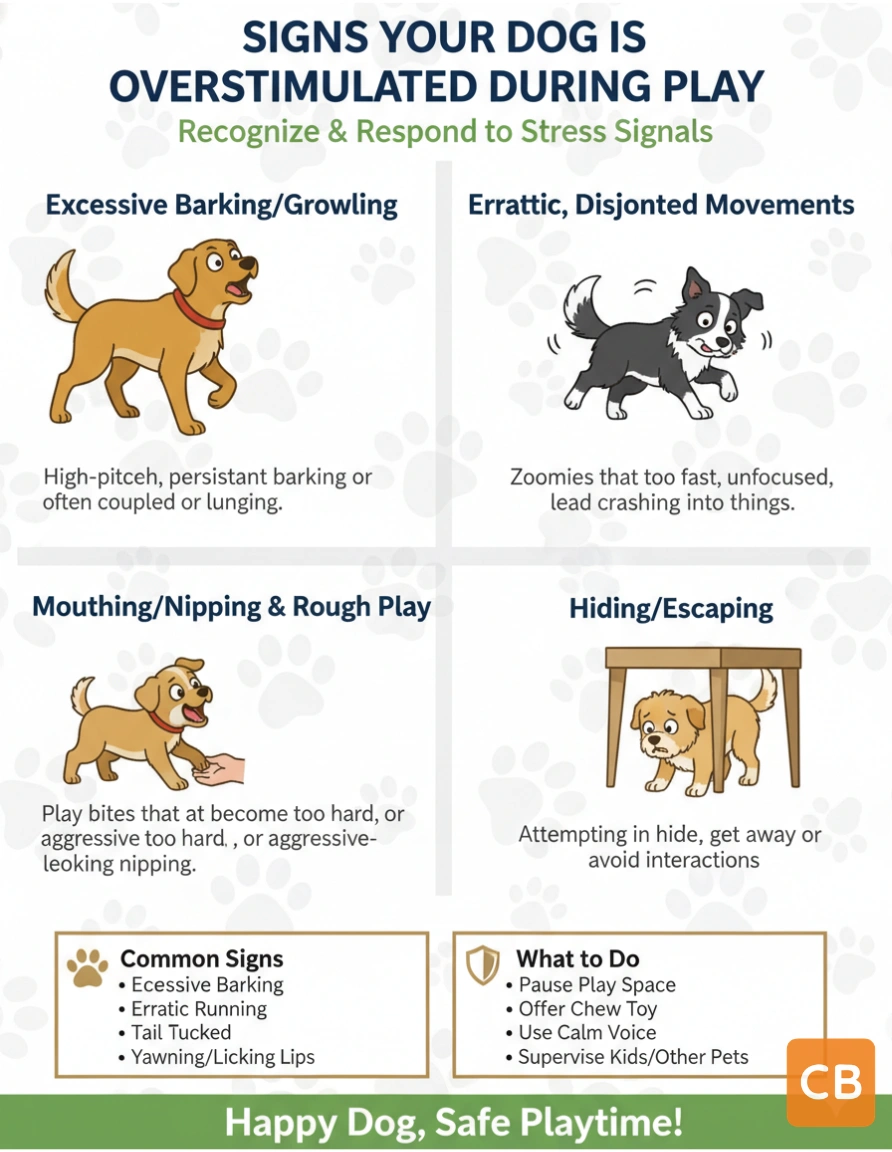
The first rule of this “Fight Club” is: Do not panic. The Second rule is: Do not shout.
If your dog is overstimulated during play, yelling, shouting or panicking only adds more intensity and only pours fuel on the fire rather than putting it out.
Instead:
1. Pause the Game Immediately
Stop the movement calmly and stand still. Remove all the toys and reduce stimulation.
2. Lower Your Energy
Dogs tend to mirror human emotions. Therefore, slow your breathing and use a soft voice. Gently make your dog know that the game is over. This is the simplest yet most effective thing you can do to calm an overstimulated dog.
3. Create Physical Space
If more than one dog is involved, separate them gently before tension escalates. Move them to a calm room or a space where they feel comfortable.
4. Ask for a Simple, Easy Cue
As soon as arousal drops, request something familiar to them, like “sit.” Reward calm compliance.
5. Initiate a Cooldown Routine
To calm an overstimulated dog, provide water and guide them to a mat. You may also use a short leash walk for decompression.
Play should help you build connection, not chaos. The goal of this routine is not to suppress excitement but to teach emotional regulation to your dog.
If you have recently experienced a massacre by your overstimulated dog, talk to a pet behaviorist through pet care online consultation on the Conbun app and learn how you can avoid such episodes in future.
Getting expert pet behavioural advice can help you learn easy techniques to calm your overstimulated dog and reinforce positive behaviors so that such episodes do not recur in future.
How To Prevent Overstimulation During Play
The secret? Don’t wait for the explosion.
Preventing overstimulation in dogs is about managing their arousal before it crosses the threshold.
Here’s what you can do:
1. Keep Play Sessions Short
5-10 minutes of structured play is better than 30 minutes of chaotic “royal rumble”. Especially for puppies who have developing brains.
2. Build in Micro Breaks
Incorporate micro-breaks between sessions. Pause every few minutes and ask for a “sit.” Let them reset and relax during the game. Resume only when calm. This helps them regulate their arousal levels.
3. Avoid High-Intensity Games Back-to-Back
Fetch, tug of war, and chase without rest can lead to adrenaline overload. Avoid these games back-to-back to keep their adrenaline in balance.
4. Reward Calm Behavior
When your dog voluntarily settles, mark and reward it. Calmness should pay. If your dog voluntarily settles, mark and reward such behaviour, so they can positively associate it.
Think of playtime like a gym workout. Warm up, train and cool down. No one always performs well in a non-stop sprint mode.
Related Readings: Top Rated Pet Care Consultation App: Features, Benefits, How It Works
Conclusion
If your dog is overstimulated during play, it is not bad behavior. It is their biology giving you signals that you need to reduce the excitement.
When excitement crosses the arousal threshold, impulse control can drop, and chaos begins. The good news is that you can prevent it. Short sessions. Built-in breaks. Calm endings. Structured play. Remember these key rules, and your dog will never be overstimulated.
Dogs don’t need endless intensity. They need regulated fun.
The most balanced dogs aren’t the ones who play the hardest; they’re the ones who know how to switch off.
Share this guide with a fellow pet parent you know who struggles with their dog turning into Godzilla. Also, download the Conbun android and iOS to instantly connect with a pet behaviourist via online pet care consultation and learn key hacks about your pet’s behavior.
FAQ (People Also Ask):
1. How to tell when a dog is overstimulated?
Answer. If the play suddenly becomes chaotic instead of rhythmic, it means your dog is overstimulated. Other signs of overstimulation in dogs include ignoring commands, hard nipping, excessive barking, alert stance and hyper-focussed staring
2. What is the 3-3-3 rule with dogs?
Answer. The 3-3-3 rule is the adjustment timeline for newly adopted dogs. The first 3 days to decompress (shy, nervous, anxious), 3 weeks to learn a routine and 3 months to settle down and trust the new owners.
During these adjustment phases, puppies are more sensitive to overstimulation. Structured, calm play can help them feel secure rather than overwhelmed.
3. How do you calm an overstimulated dog?
Answer. To calm an overstimulated dog, stop the play immediately, lower your voice and body movement, create physical space, offer water, guide them to a quiet area and ask for a simple cue like “sit” once calmer
Do not yell or grab, as it may increase arousal. Calm energy helps in reducing cortisol faster than correction.
4. Is overstimulation bad for dogs?
Answer. Occasionally, overstimulation can be normal, especially in puppies. However, if you see repeated episodes of overstimulation without recovery, it can reinforce poor impulse control and increase frustration-based behaviors.
5. How to calm a high anxiety dog?
Answer. To calm a high-anxiety dog, use structured routines, predictable play sessions, enrichment toys and expose them to environmental stimuli gradually. Other calming techniques include slow leash walks, scent games, relaxation training, and white noise.